William J. Burns has been the secret weapon of U.S. secretaries of state for more than two decades, serving consecutively under three Republicans and three Democrats. So it came as no surprise that John Kerry wanted to be the seventh chief diplomat to lean daily on Burns, currently the country’s highest-ranking career diplomat, by keeping him on as deputy secretary of state, a position to which Burns was appointed by Hillary Clinton.
“Bill is the gold standard for quiet, head-down, get-it-done diplomacy,” Kerry said of Burns. “He is smart and savvy, and he understands not just where policy should move, but how to navigate the distance between Washington and capitals around the world. I worked with Bill really closely from the Senate Foreign Relations Committee, and I’m even more privileged to work with him now every single day. He has an innate knack for issues and relationships that’s unsurpassed…”
Secretary of State Hillary Clinton says the United States has “to be in effect the chairman of the board of the world,” because true security and prosperity at home can only be achieved if the entire world is as stable and economically viable as possible.
In my new book “America’s Other Army: The U.S. Foreign Service and 21st Century Diplomacy,” Clinton says that “more peaceful, prosperous and democratic countries are not only good for the people living in them, but also good for the United States and our global goals.”
I began the week reminiscing about my travels with four secretaries of state, so I thought I’d end it by answering another question I’m frequently asked: What happened to the three secretaries I covered before Hillary Clinton? Starting with the most recent, they are Condoleezza Rice, Colin Powell and Madeleine Albright.
I’ve also been asked often about the differences between those former chief U.S. diplomats, especially during travel. I usually point out an obvious similarity among them first: None of them is a white male. In fact, the last secretary to fit that description was Warren Christopher, who left office in January 1997, when Albright ended the centuries-old tradition.
A dispute over the State Department budget has pitted the chairman of the Senate Budget Committee, Sen. Kent Conrad of North Dakota, against a fellow Democrat and head of the Foreign Relations Committee, Sen. John F. Kerry of Massachusetts, and the Obama administration.
Mr. Conrad led an effort to slash President Obama’s $58 billion international affairs request for 2011 by $4 billion, a cut his committee approved last week. Despite protests from Secretary of State Hillary Rodham Clinton and all her living predecessors, the senator stood his ground on Wednesday.
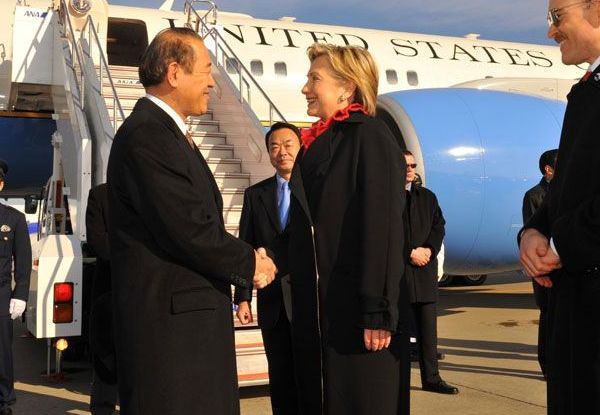
BEIJING — So much for the “diplo-speak” U.S. officials usually offer on trips abroad. Newly minted Secretary of State Hillary Rodham Clinton showed last week that she will not be constrained by diplomatic protocol or follow an official script and, so far, she seems to have the stature and celebrity to pull it off.
As she returns home Sunday from her first overseas trip since taking office, Mrs. Clinton leaves behind thousands of Asians thrilled to have met one of the world’s most famous and powerful women. At the same time, awaiting her in Washington are puzzled analysts, angry human rights activists and career diplomats not quite sure what to make of some of her comments.
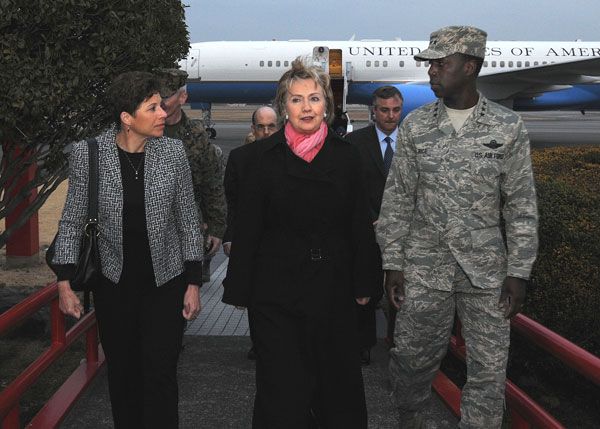
Flying more than 22,000 miles in a week filled with dozens of official meetings, public events and media interviews didn’t seem to have taken a toll on Secretary of State Hillary Rodham Clinton during her much-publicized trip to Asia. How does she do it?
I’ve been asked the same question about three of Mrs. Clinton’s predecessors I’ve traveled with — Condoleezza Rice, Colin L. Powell and Madeleine K. Albright. My answer is always the same, but it’s not the queen-size pullout sofa in their plane’s private cabin, though having a real bed in the air certainly helps.
Carol Hazzard was a 20-year-old secretary at the University of Buffalo in 1969, but the life she dreamed about was far removed from the monotony of upstate New York. “My only goal in life was to travel and see the world,” she recalled recently.
One night, her mother asked her to go to the corner grocery store for some milk, and on her way there, she ran into her old high-school basketball coach, who was working as a flight attendant for Eastern Airlines.
Ms. Hazzard thought such a job would help her realize her dream of traveling. But the former coach was not enthusiastic about recommending her new profession to others. Instead, she advised Ms. Hazzard that she could see the world while continuing to work as a secretary…
Thomas R. Pickering was a fresh college graduate in 1953 when he braved the notoriously lengthy entrance process at the State Department, prolonged even further by an ongoing investigation of suspected communists in the agency’s ranks.
Although he was offered a job earlier than he expected, Mr. Pickering by then had enrolled in the graduate program of Tufts University’s Fletcher School of Law and Diplomacy in Medford, Mass. He later left for Australia on a Fulbright scholarship to the University of Melbourne, which was followed by three years in the Navy.
So it was 1959 when the 28-year-old finally became a Foreign Service officer — or, to use the better-known term, a diplomat…
It was lunchtime on April 18, 1983, and the cafeteria of the American Embassy in Beirut was buzzing with customers. At about 1 p.m., a powerful blast tore apart the front of the seven-story building. The bomb, hidden in a van reportedly stolen from the embassy 10 months earlier, killed 63 employees, including 17 Americans.
It was the first time that a U.S. embassy had become a terrorist target, and it forever changed the way the Diplomatic Security Service (DSS), the State Department’s law-enforcement division, operates around the world.
“The bombings of the embassy in West Beirut in 1983 and of the embassy annex in East Beirut in 1984 were a major catalyst for creating the Bureau of Diplomatic Security,” which oversees the DSS, said John C. Murphy, special agent in charge of Secretary of State Colin L. Powell’s protective detail and a DSS agent for 29 years…
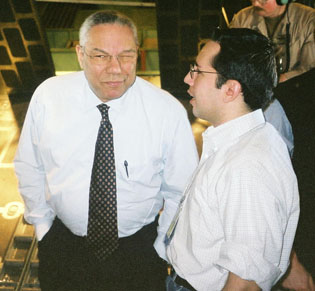
Colin Powell listened with growing but controlled anger. He saw the question coming. After all, there is no charge against a secretary of state more serious than the one leveled by some members of his own Republican Party — and even in the administration he serves.
They accuse him of leading a government agency that not only opposes President Bush’s foreign policy, but also tries to undermine it. His response came out in a single well-known barnyard expletive. Then, to emphasize the point, he added: “That’s quotable.”
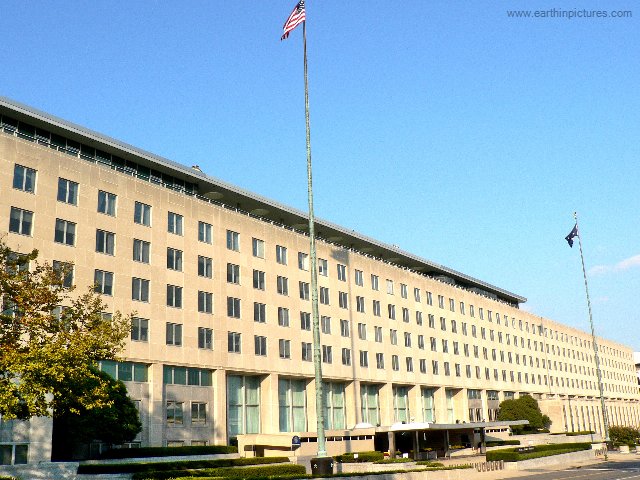
“I can show you people in Washington who claim to be pushing the president’s agenda, [but] who are not,” Mr. Powell continued, sitting in his small inner office on the seventh floor of the State Department…
Nicholas Kralev is an author and expert on diplomacy, global affairs and air travel. A former Financial Times and Washington Times correspondent, he has traveled around the world with four U.S. secretaries of state — Hillary Clinton, Condoleezza Rice, Colin Powell and Madeleine Albright. He has flown over 2 million miles and visited 83 countries.Subscribe to updates
Speaking engagements
MAY 14, 2013 — LOUISVILLE, KY
MAY 31, 2013 — BUENOS AIRES
OCT 03, 2013 — ATHENS, GREECE
OCT 07, 2013 — ANKARA, TURKEY
OCT 09, 2013 — ISTANBUL, TURKEY
OCT 15, 2013 — MADRID, SPAIN
OCT 17, 2013 — LISBON, PORTUGAL
OCT 21, 2013 — BERLIN, GERMANYClick here for details
Google Ads