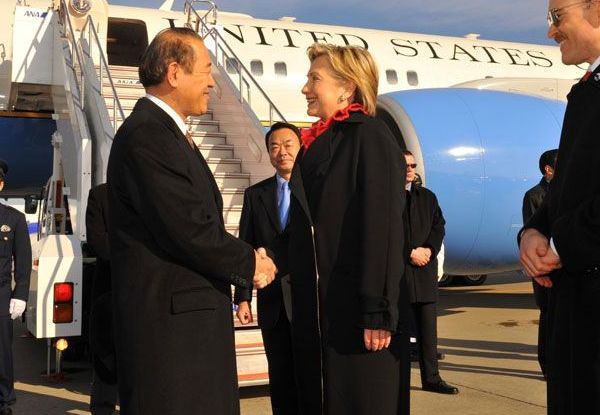
William J. Burns has been the secret weapon of U.S. secretaries of state for more than two decades, serving consecutively under three Republicans and three Democrats. So it came as no surprise that John Kerry wanted to be the seventh chief diplomat to lean daily on Burns, currently the country’s highest-ranking career diplomat, by keeping him on as deputy secretary of state, a position to which Burns was appointed by Hillary Clinton.
“Bill is the gold standard for quiet, head-down, get-it-done diplomacy,” Kerry said of Burns. “He is smart and savvy, and he understands not just where policy should move, but how to navigate the distance between Washington and capitals around the world. I worked with Bill really closely from the Senate Foreign Relations Committee, and I’m even more privileged to work with him now every single day. He has an innate knack for issues and relationships that’s unsurpassed…”
Every president has his own way of determining who would make his best secretary of state, but all commanders-in-chief tend to focus on how a candidate would carry out his or her boss’s foreign policy. In reality, the position of secretary of state is perhaps the most complex in the Cabinet, because it requires its occupant to wear three hats at the same time.
In most government departments, the secretary is mainly the CEO. At State, he or she is also the country’s chief diplomat — or the COO — as well as the president’s chief foreign policy adviser. To be truly successful, the secretary of state must give each of these roles the time and attention they deserve, which is even more challenging when one has various crises to resolve around the world and a 24-hour news cycle…
Charles Rivkin is an American ambassador of a peculiar kind. He is not a career diplomat but a political appointee, with no previous professional experience in international relations. However, unlike most of his current and former non-career colleagues, he speaks fluently the language of the county he is posted to — France — and is very well plugged-in when it comes to political and social developments there. He has received rave reviews for his performance in Paris both in official State Department audits and from his embassy’s employees.
But it wasn’t Rivkin’s diplomatic skills that landed him the coveted political ambassadorship. Rather, it was his skillful fundraising for President Obama during his 2008 election campaign…
Imagine the following scenario: A 29-year-old restaurant manager becomes a U.S. diplomat. Five years later, he is appointed the founding director of the Arabian Peninsula office of the Middle East Partnership Initiative (MEPI), a major State Department program aimed at creating and strengthening civil society in a region vital to global stability.
Even though he is considered a good officer in general, the young diplomat has little idea how to do his new job. He speaks no Arabic and has never managed people or a budget outside a restaurant — let alone $2 million of taxpayers’ money. He has minimal knowledge of democracy promotion, institution-building, or grant-making, but he is expected to identify suitable NGOs in eight countries and award them grants to build an alternative to the authoritarian regimes across the Middle East…
The mob that had gathered at a soccer stadium descended on the U.S. Embassy in Belgrade, determined to avenge Washington’s recognition of Kosovo — a Serbian province until five days earlier — as an independent state. On that day in February 2008, the Serbian riot police stationed in front of the embassy at the request of U.S. Ambassador Cameron Munter conveniently vanished just before the hundreds-strong horde arrived. “The police marched away, got on buses, and drove away, so when the hoodlums came there was no one there,” Munter recalled.
A part of the embassy was soon ablaze. “One of the protesters who was drunk managed to get in and burned himself to death,” Munter said. Several others climbed the fence. The U.S. Marines guarding the compound had every right to shoot, but they managed to drive the intruders away with warnings and instructions instead…
Secretary of State Hillary Clinton says the United States has “to be in effect the chairman of the board of the world,” because true security and prosperity at home can only be achieved if the entire world is as stable and economically viable as possible.
In my new book “America’s Other Army: The U.S. Foreign Service and 21st Century Diplomacy,” Clinton says that “more peaceful, prosperous and democratic countries are not only good for the people living in them, but also good for the United States and our global goals.”
Most of us don’t think we are cut out to be doctors or engineers. Then why do so many of us believe we can be diplomats? Does one need training or a particular background to become a U.S. ambassador? I find myself asking these questions every time I hear about a failed non-career ambassador.
President Obama promised change in Washington, but he continued the decades-long tradition of dishing out ambassadorial posts to people whose only “qualifications” were their big donations to his election campaign. As I’ve written before, the American Academy of Diplomacy and the American Foreign Service Association have called him out on this disgraceful practice.
The silver lining for U.S. diplomats of this week’s WikiLeaks release of secret State Department cables is that there is more buzz about their work than there has been in years. Even though it’s for the wrong reasons, it provides a chance to use the public attention for a serious debate on modern diplomacy.
The general public usually hears about diplomats when there is a spy scandal, or when a diplomat is arrested for selling U.S. entry visas to foreigners — for money or sex. Members of the U.S. Foreign Service often complain that it’s an unknown entity to the very people diplomats represent abroad. My extensive research in the last seven years confirms that concern. Most Americans have no idea what their representatives do every day — and many have no interest in learning about it, either.
Nicholas Kralev is an author and expert on diplomacy, global affairs and air travel. A former Financial Times and Washington Times correspondent, he has traveled around the world with four U.S. secretaries of state — Hillary Clinton, Condoleezza Rice, Colin Powell and Madeleine Albright. He has flown over 2 million miles and visited 83 countries.Subscribe to updates
Speaking engagements
MAY 14, 2013 — LOUISVILLE, KY
MAY 31, 2013 — BUENOS AIRES
OCT 03, 2013 — ATHENS, GREECE
OCT 07, 2013 — ANKARA, TURKEY
OCT 09, 2013 — ISTANBUL, TURKEY
OCT 15, 2013 — MADRID, SPAIN
OCT 17, 2013 — LISBON, PORTUGAL
OCT 21, 2013 — BERLIN, GERMANYClick here for details
Google Ads