
nkralev on August 24th, 2010

It has been more than seven months since the new U.S. Electronic System for Travel Authorization (ESTA) has been mandatory for airlines that fly citizens of visa-waiver countries to the United States. Yet some carriers’ computer systems are reportedly experiencing serious problems, resulting in denied boarding for travelers with valid ESTAs.

Last week, I received a disturbing e-mail message from an Austrian citizen who had read my previous coverage of ESTA issues. On July 5, she wasn’t allowed on a Scandinavian Airlines (SAS) flight from Stockholm to Chicago, for which the carrier blamed problems with the passenger’s ESTA.

In fact, the customer, who asked that her name not be used because she hasn’t yet resolved the matter with SAS, had a valid ESTA on which she had previously traveled to the United States. The validity was confirmed by my sources at the Department of Homeland Security (DHS), the federal agency in Washington that administers ESTA.

There were no signs of any problems when the passenger checked in at the SAS counter in Stockholm, according to her account. Her boarding pass, a copy of which she sent me, clearly shows “API OK,” which means that all necessary documentation was in order. However, when the boarding pass was scanned at the gate, it produced a sound indicating that not everything was actually in order.

She was then sent to a customer-service counter, where only one agent was equipped to handle ESTA issues, and she had to wait in line — with her flight already boarding. A German citizen in front of her in the queue had the same problem, but the agent was able to request a new ESTA for him that was instantly approved, and the SAS system was able to establish a link with the ESTA system and issue a boarding pass.

But the Austrian traveler had no such luck. No fewer than six new ESTA requests were approved as soon as the agent submitted them, but the SAS computer was never able to link them to the airline’s boarding system.

The passenger missed her flight and was told that no seats were available to the United States for the next two weeks. Her “dream vacation,” as she called it, which had taken weeks to plan, never happened. SAS refunded the miles she had used for the award ticket, as well as the money paid for taxes, but she claims she lost about $2,500 in non-refundable domestic U.S. airline tickets, and hotel, rental car and tour reservations.

SAS has yet to respond to her letters, but that’s not what she’s most worried about.

“What makes me angry is that they are obviously having problems with passengers traveling on [non-Scandinavian] passports and have not bothered to do anything about it — not even a simple measure, such as asking these people to show up at the boarding gate a little earlier to settle things,” the Austrian passenger said.

I e-mailed SAS spokeswoman Elisabeth Manzi in Stockholm asking whether the carrier was aware of the problem and if it’s doing anything to fix it. Instead of responding, Manzi forwarded my message to Martina Vercellini, a customer-relations representative in Frankfurt, who wrote me that she would contact the Austrian traveler directly. It’s not clear why SAS hasn’t done so seven weeks after the incident.

Still, as the passenger suggested, the problem is bigger than her. “Now I’m wondering how to avoid similar problems in the future,” she said. “For my next trip to the U.S., I’m very much leaning towards getting a visa beforehand, whether it is necessary or not” — and despite the $140 visa application fee.

On Sept. 8, DHS will start charging ESTA applicants $14 — $10 for the new Congress-mandated U.S. “travel promotion” initiative, and $4 to “recover the costs incurred [for] providing and administering the ESTA system.” Perhaps DHS could make sure that airlines are capable of verifying the validity and authenticity of an ESTA, so fee-paying travelers aren’t denied boarding for no good reason.

It’s important for passengers to know that each ESTA is linked to the passport for which the ESTA was originally requested, so if you get a new passport, you also need to apply for a new ESTA. That wasn’t the case with the Austrian citizen — she has had the same and only passport since 2002.

My DHS sources also told me that tens of thousands of people are applying for an ESTA every day. If you want to beat the $14 fee, make sure you apply before Sept. 8 — an ESTA is valid for two years, so it makes sense to do it if you plan at least one U.S. visit in that period.

Many travelers consider ESTA a de facto visa — except that it’s much cheaper and faster to get than a regular visa, for which you have to be interviewed by a U.S. consular officer, wait in long lines and sometimes travel long distances from your hometown.

Currently, 36 countries participate in the visa-waiver program, but that number can change at any time, as their qualification is reviewed periodically. To be eligible for an ESTA, you must stay in the U.S. no longer than 90 days and possess a machine-readable passport. Other passport security features also apply, depending on the issuing country.

Just like with a visa stamped in your passport, holding a valid ESTA doesn’t guarantee you admission to the United States, which is at the discretion of the immigration officers at the point of entry.

However, if you have a valid ESTA linked to the passport you are traveling on, and no warning has been issued by the U.S. authorities against you, airlines should be able to verify that and let you on the flight you’ve paid for.

RETURN TO MAIN COLUMN PAGE

Related stories:

Airline agents make up U.S. entry rules

U.S. visa-free travel comes with strings

Continue reading about U.S. ESTA trouble for SAS passengers

nkralev on July 13th, 2010

How do you decide which hotel to choose in the city you are visiting if you want to redeem your points for a free night? I had to make that decision this month, and unlike in many similar situations, it wasn’t even a close call.

I usually start with the chains where I have top elite status — Hilton HHonors and Starwood. Hilton’s Diamond benefits are inferior to Starwood’s Platinum perks — Hilton doesn’t give you suite upgrades and free Internet. The only advantage with Hilton is that award stays count toward elite status, which is rather significant in my book.

However, in January, Hilton devalued its points by raising both the categories of many hotels and the number of points needed for a free night in some categories. Even though the affected properties weren’t as many as the unaffected ones, the average traveler wouldn’t know that, because those that remained unchanged are in places few people visit. I have the full list, but have yet to come across a hotel that stayed the same while making reservations.

Even before the devaluation, I thought all Hilton properties in Anchorage, AK, were a bit overrated, but I had stayed at three of them on points nevertheless. When I looked at the new categories last month, I was horrified — not only was the Hilton now Category 6 (previously the highest until a seventh tier was created this year), but the Hampton Inn, the lowest-end brand in the chain, was Category 5, requiring 35,000 points for one night.

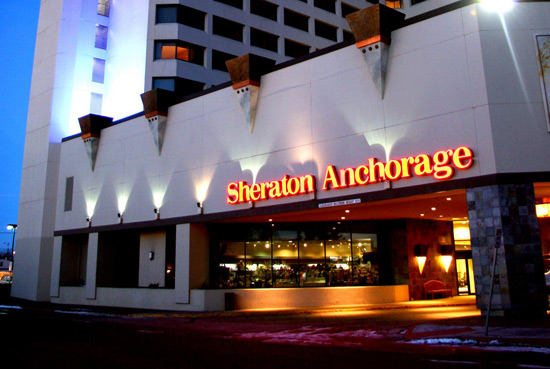
By contrast, the only Starwood property in Anchorage, the Sheraton, is Category 3, which means only 7,000 points per night. Unfortunately, it doesn’t offer the popular cash-and-points option.

So let’s compare the two full-service hotels — the Hilton and the Sheraton. At the first — Category 6 out of seven — I need 40,000 points out of a maximum of 50,000 for the highest category. At the second — Category 3 out of seven — I need 7,000 points out of maximum 35,000. Naturally, I chose the Sheraton.

There was another factor in my decision. I needed a conference room for my “On the Fly” Seminar, so I called and left messages for the sales managers at the Sheraton and four of the Hilton properties — the Embassy Suites, the Hilton Garden Inn, the Homewood Suites and the Hampton Inn. Of the last four, only the Embassy Suites — one of the newest and nicest hotels in town — bothered to call me back, but their price was too high. The Sheraton offered me a much better rate.

So I was happy with the Sheraton. Although it’s not a very attractive building from outside, it underwent a major renovation recently and is quite decent inside. I got a suite, lounge access, free Internet and free breakfast. My only cash expense was on the conference room.

What would you have done?

Continue reading about Hilton or Starwood? Not even a close call
nkralev on June 11th, 2010

I’m usually cautious about accepting invitations to visit Russia, because of the obscene amount of cigarette smoke I’m forced to put up with, but this time I was rather pleased, indeed.

I was invited by RIA Novosty, the news agency, to attend a conference on Afghan drug production, which was opened by President Dmitry Medvedev. I doubt he was the reason for the smoking ban anywhere in the conference center, but whoever decided to implement that policy deserves a big thank-you. Russian staff and participants actually stood outside the building to smoke and no one violated the ban. Very impressive.

If only the Egyptians could do the same…

The conference center belonged to the Swissôtel Krasnye Holmy in the Russian capital. Usually, if I make hotel decisions when I travel, I choose either a Hilton or Starwood property, because of my top elite status with those two chains. That way, not only do I get bonus points for my stays, but I also enjoy elite benefits, such as free room upgrades, free breakfast even if it’s not included in the room rate, executive lounge access and, with Starwood, free Internet.

This time, the choice wasn’t mine, and I was a bit concerned about how I’d be treated at the Swissôtel as a non-elite guest. But my concerns were unfounded. Although I couldn’t use the lounge, my room had everything an upgraded room would have at a Hilton or Starwood hotel, including a bathrobe and slippers, and breakfast was also provided.

I did have to pay for Internet access — about $25 a day — but I have to do that even as a Diamond Hilton member. As I wrote in March, Hilton is one of the major chains resisting the trend of offering top elites free Internet. In Moscow, free access was provided at the conference center, so I only had to pay for one day, before the forum began.

What most impressed me at the Swissôtel was the peace and quiet I enjoyed in my room. That hotel must have some of the least noisy elevators I’ve ever seen. You could barely hear them, even if you stood right in front of their doors.

In addition, the housekeeping staff was probably the quietest I’ve encountered. Typically, I’d be awaken early in the morning by door banging or maids talking loudly to each other as if they were in a park, and the thin walls of many U.S. hotels make it even worse. This time, had I not seen housekeeping staff in the corridor, I wouldn’t have known there were working.

Continue reading about Great hotel and non-smoking conference in Moscow

nkralev on March 9th, 2010

Is the room rate for your next hotel stay too high for your travel budget? No need to cancel that trip yet. There are creative ways to pay for your accommodation, and using your own money is just one of the options.

The creativity I have in mind involves more than just redeeming your hotel points with a loyalty program. In fact, let’s assume that you don’t have enough points for your intended stay.

Mike Schlappig was recently in that position. He was planning a trip to Egypt next month and wanted to spend the last two nights at Le Meridien Pyramids in Cairo. However, he was unpleasantly surprised by the rate of $220 per day, which is relatively high for that market…

Continue reading about Hotel rates too high? Get creative!