National Security Council

nkralev on May 31st, 2011

“Going political” is a phrase used in the U.S. Foreign Service to indicate career diplomats’ frustration that yet another ambassadorship has been taken from them and given to a political appointee. For 20 years, the post in Russia has been reserved for professionals because of its difficulty and sensitivity — but that’s about to change.

Although President Obama’s decision to nominate Michael McFaul as the next U.S. ambassador to Moscow, which the White House announced late last week, surprised many in the Foreign Service, it’s unlikely to be met with serious criticism. Despite my recent series of critical columns on political ambassadors, I have no reason to question Obama’s motives in this case, either.

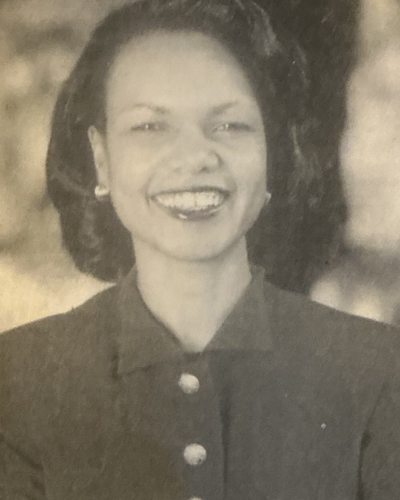
The first reason — I readily admit — is personal. I’ve known McFaul for 12 years, and I really like and respect him as a person and political scientist. We first met when he wrote an article for a journal I edited in 1999, for which he gave me the photo above.

I don’t know him well enough to call him a friend, but over the years he has been very helpful with many of my stories on Russia — as an academic, as Obama’s 2008 campaign adviser and, most recently, as senior director for Russian and Eurasian affairs at the National Security Council (NSC). We traveled to Moscow together on Secretary of State Hillary Clinton’s plane in 2009.

Interestingly, the first story for which I sought McFaul’s help in 2000 wasn’t about Russia, but about Condoleezza Rice. I had just done an interview with Rice, who was George W. Bush’s campaign adviser at the time, for the Financial Times and asked McFaul for his opinion of her. He had a unique perspective — both as a student and colleague of Rice’s at Stanford University.

Even though McFaul is only nine years younger than Rice, he was one of her first students as a young professor in the early 1980s. Unfortunately, his quote was edited out of my story for length, but everything he told me contributed to my understanding of the future secretary of state — after all, I was only 25 back then, and of course neither Rice nor I had any idea that we would be traveling together around the world five years later.

The differences between Rice’s and McFaul’s views on Russia are fascinating, but that’s a topic for another column.

The second reason not to question Obama’s decision is that, unlike most political ambassadors who are awarded an embassy because of their campaign contributions, McFaul knows his stuff. In fact, few other Americans know and understand Russia better than him. Most importantly, he is not just a scholar and distant observer — he speaks Russian quite well, has visited the country many times and maintained personal relationships with some of its leading minds.

While McFaul is an excellent choice for Moscow as an architect of Obama’s Russia policy, he has two potential shortcomings.

First, his diplomatic experience is limited to the last two years, and being at the NSC is somewhat different from doing day-to-day diplomacy. It’s no coincidence that, of eight ambassadors to Russia in the last 30 years, only one was a political appointee — ironically, Democrat Robert Strauss sent to Moscow by President George H.W. Bush in 1991.

Second, a modern ambassador should not be only about policy. Management is extremely important, especially at a large embassy like the one he is about to head. Unfortunately, McFaul hasn’t run anything before. There is a solution to that problem: Having a good, hands-on and experienced career diplomat as deputy chief of mission.

RETURN TO MAIN DIPLOMACY PAGE

Related stories:

Who qualifies to be a U.S. ambassador?

The greatest understated U.S. diplomat

Why are political ambassadors tolerated?

Career diplomats protest Obama appointments

Diplomats in the news for wrong reasons

Foreign Service: America’s other army

Continue reading about Ambassadorship to Russia goes political

nkralev on March 1st, 2010

Condoleezza Rice has rarely heard a question she doesn’t know how to answer, from queries about her tumultuous childhood in segregated Alabama to her success in the male world of superpower politics, nuclear weapons and arms control.

She meets me with the friendly smile and easy hospitality of a west-coaster, defying the image of someone anointed by Washington insiders to become the most powerful woman in the world in a year. The chief foreign policy adviser to Republican presidential candidate George W. Bush, Rice is being tipped as a likely secretary of state or national security adviser should Bush win the White House.

As huge a task as this sounds, Rice’s own life story has the word “amazing” written all over it. At 45, she has been the first black woman in just about any job she’s taken on: from special assistant for national security affairs to President George Bush when she was only 34, to provost of California’s prestigious Stanford University (the Harvard of the west coast) where she managed a budget of nearly $2bn…

Continue reading about Political punch in a package of charm

nkralev on February 19th, 2010

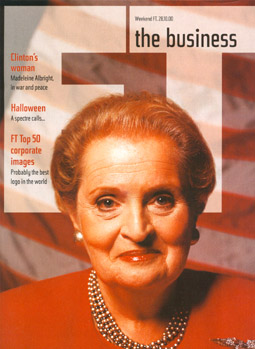
Madeleine Albright is almost shouting. She can’t hear me any more, she says. The noise on her aircraft has, indeed, become more deafening; but she also seems to be deliberately avoiding my question, and with good reason. This very moment is probably her happiest as secretary of state because of “the most important thing that has happened” during her nearly four-year tenure.

She has just received news about the Belgrade revolution and the ousting of Yugoslav president Slobodan Milosevic, and here I am, asking how she feels about having to leave office in three months. We’ve just spent a 30-hour day, having saved six hours by flying east-west from Egypt to Washington, and she says that’s exactly what she intends to continue doing for the rest of her term — “working every minute and extending the days”…

Continue reading about Albright’s final bow