nkralev on January 18th, 2011

If you are a frequent flier, you know there is a war raging between American Airlines and third-party travel providers, such as online agencies and Global Distribution Systems (GDS). It appears things might get worse before they get better, leaving millions utterly confused. So I’ve created a new addition to the “On the Fly” curriculum to help you through the hard times.

The two-hour live seminar, FLY 203: The travel-booking war and the future of airline data distribution, will be first offered in Miami and Honolulu next week, and in Washington, San Juan and San Francisco next month, followed by other cities around the country. If you are not in any of those cities, you can join in from anywhere for an hour-long webinar version, FLY 115: Weathering the travel-booking storm, on Feb. 10.

I’m not advocating any particular position in the current dispute, and my only goal is to give you all relevant information, so you can make the best decisions when it comes to booking your travel.

The new seminar offers a detailed description and explanation of the current airline data distribution model and the fundamentals of today’s booking system. It also looks at the events of the last several weeks and provides a factual rundown of the arguments and positions of all sides involved in the dispute.

Most importantly, the session examines how the current conflict affects travel agencies, companies and individual travelers. It offers specific advice on what they can do to avoid being caught in the crossfire, and to make sure they don’t increase costs and sacrifice convenience and comfort.

Late last year, American banned Orbitz from booking seats on its flights. Earlier this month, Expedia stopped selling American tickets. Meanwhile, Delta removed its data from eight less popular sites. Sabre, the GDS American created more than four decades ago and current owner of Travelocity, announced its intention to drop American data later in the year. In response, American sued, and last week it won a court order temporarily blocking Sabre’s move.

Thus began the very public war — and possibly the start of a new trend in the distribution and sales of air travel products. Airlines incur significant costs by having their flights booked on a GDS, which also prevents them from selling additional products, such as preferred seating, priority boarding and doubling or tripling your frequent-flier miles for a fee. American wants both online and traditional travel agencies to use its DirectConnect channel to lower costs and increase revenue.

The significance of American’s move is much bigger than a dispute with a couple of third-party sites. It seeks to shake up the longtime airline data distribution system, including the GDS model. Travel agents haven’t received airline commissions for years, except for the largest agencies, though a part of the GDS fees airlines pay goes back to agents. American wants to reduce or scrap those fees.

In an indication of where things are going, American CEO Gerard Arpey said in 2009 that third parties should be paying the airlines for access to their data, “rather than us paying them to distribute our product.”

American has imposed “booking source premium” fees on some GDS users. Those fees will have to be either absorbed by travel agencies or passed on to passengers. Critics accuse American of trying to suppress transparency and deny consumers the opportunity to compare various airlines’ fares on the same screen, potentially forcing them to pay higher prices. But American points out that a change in the GDS model — establishing direct channels with airlines — would secure customers’ continued comparison-shopping ability.

So it’s messy out there, and the new seminar will try to make it less so in your mind by giving you specific tools that will help you follow the best booking process for you.

RETURN TO MAIN COLUMN PAGE

Related stories:

Time for travel school — you are invited

Educating the flying public

Announcing ‘On the Fly’ Seminars

Announcing Kralev International travel advisory business

Continue reading about New seminar on travel-booking war

nkralev on October 18th, 2010

Why have corporate travel managers become so prone to inertia and averse to innovation in recent years? Why are numerous companies spending millions of dollars more on travel than necessary? Is it time for the travel manager’s job description to change?

I’ve been trying to find answers to these questions since I dedicated myself to travel education and training this summer, through my “On the Fly” Seminars and the Kralev International advisory services.

But it was a post by Scott Gillespie, who writes a blog on procurement and corporate travel management, that prompted me to air my thoughts in public. Although my arguments aren’t quite what he had in mind, I was happy to see that others share my concerns about corporate complacency.

Why do I feel qualified to pass judgment? Because I almost always pay the lowest coach fares, but I haven’t sat in coach since 2002 — and I’ve flown nearly 2 million miles and visited 38 states and 82 countries. And because this year, I’ve flown 100,000 revenue miles, for which I paid a grand total of $747. I’ve never admitted this publicly before, although friends have repeatedly urged me to use it as a selling point — I just didn’t think anyone would believe it. That’s why I’m writing a book, so I can explain it.

I’ve been shocked by how many companies still rely on large travel agencies without almost any meaningful supervision. I’m not suggesting that they stop using travel agents, because this may be the only way to handle high volume. The problem is that, in many cases, they are not getting the cheapest available tickets — but they don’t know it.

Why does that happen? One reason is that many travel agencies have lucrative contracts with certain airlines that encourage them to send more business their way. If your agency receives its biggest commission from American Airlines, it will likely book you on American even if United Airlines has a lower fare. Did the agency disclose any of this before you signed a contract?

The other reason is much less obvious, but hopefully this column will change that. While technology and automation are enormously useful and efficient, they discourage us from using our brains. Automation is no doubt vital for the travel-booking process, but the extent to which travel agents rely on computers to tell them what to do is stunning — and it costs your company a lot of money.

Let me give you an example. Last year, my former managing editor at the Washington Times had to go to Mongolia at a week’s notice and asked if I could find an affordable business-class fare. The cheapest ticket from Washington to Ulan Bator we could find — both from a travel agent and online booking engines — was about $8,700, which was out of the question.

So I started thinking outside the box and decided to try splitting the fare — if I could get a much lower business-class fare to a northeastern Asian city where one would connect on the way to Ulan Bator, I’d book the short haul in coach. Sure enough, I found a $3,250 business-class ticket to Beijing on Air Canada, and coach on to Ulan Bator on Air China for about $550. Both carriers are members of the global Star Alliance.

While any company most likely would have paid $8,700, I saved almost $5,000 — and it took me 15 minutes to do it. When was the last time your travel agent did that? I’m not suggesting that splitting the fare makes sense every time, but there are other creative — and legitimate — ways to save money that computers are not yet fully capable of mastering.

There are also things you can do to help your travel agency save you money. One of the services I offer is strategic travel planning. What does that mean? If you have more than one trip coming up, why not plan them at the same time? You don’t have to take them together — in fact, they can be months apart.

Several months ago, I had a client in Washington who wanted to go to Paris in the spring and to Buenos Aires in the fall. I knew that coach fares from Europe to South America are generally lower than fares from North America, so I suggested an unconventional way of booking two tickets simultaneously — one originating in Washington and the other one in Paris — and the savings exceeded $800. I won’t bore you with further details here, but send me a message if you’d like to know more.

How do you think most travel managers respond when I offer to train them and anyone in their company who might book travel directly? Some say their travel agency already takes care of all their needs and there is no reason to rock the boat. Others are unhappy with the travel agency, but they don’t have money to invest in learning how to save much more money. Yet others don’t seem to understand what exactly I can do for them.

Last week, a friend in Phoenix recommended my services to his company’s travel manager. The response was that, “due to budget cuts to travel budgets and their departmental budget, they felt that they could not justify the expenditure right now.” No comment.

In June, a business-development specialist from a Washington law firm took one of my seminars and saved $500 on her first ticket, so she recommended to the firm that I train their executive assistants who book travel for the attorneys. Management, however, saw things differently. “We have an agreement with American Express, so bringing you in would conflict,” they said.

I asked how exactly that would represent a conflict, since I wasn’t offering to book tickets for them, but I never received a response.

Nor did I hear back from the Association of Corporate Travel Executives, having contacted Megan Costello, then-acting executive director, Kate Farrell, senior director for global education, and Amber Kelleher, director for global education, three months ago. I suppose they have better things to do than listen to new ideas that can actually benefit their members.

RETURN TO MAIN COLUMN PAGE

Related stories:

Announcing Kralev International travel advisory business

Time for travel school — you are invited

Educating the flying public

Continue reading about Corporate travel’s lack of innovation

nkralev on July 13th, 2010

How do you decide which hotel to choose in the city you are visiting if you want to redeem your points for a free night? I had to make that decision this month, and unlike in many similar situations, it wasn’t even a close call.

I usually start with the chains where I have top elite status — Hilton HHonors and Starwood. Hilton’s Diamond benefits are inferior to Starwood’s Platinum perks — Hilton doesn’t give you suite upgrades and free Internet. The only advantage with Hilton is that award stays count toward elite status, which is rather significant in my book.

However, in January, Hilton devalued its points by raising both the categories of many hotels and the number of points needed for a free night in some categories. Even though the affected properties weren’t as many as the unaffected ones, the average traveler wouldn’t know that, because those that remained unchanged are in places few people visit. I have the full list, but have yet to come across a hotel that stayed the same while making reservations.

Even before the devaluation, I thought all Hilton properties in Anchorage, AK, were a bit overrated, but I had stayed at three of them on points nevertheless. When I looked at the new categories last month, I was horrified — not only was the Hilton now Category 6 (previously the highest until a seventh tier was created this year), but the Hampton Inn, the lowest-end brand in the chain, was Category 5, requiring 35,000 points for one night.

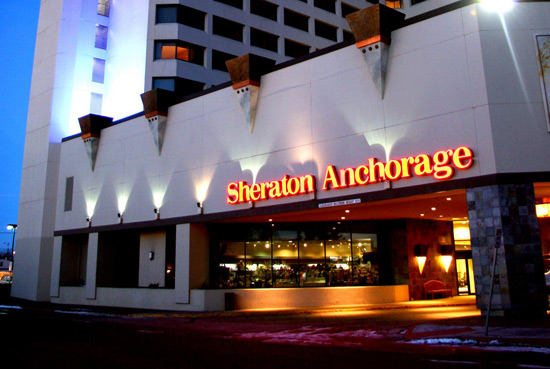
By contrast, the only Starwood property in Anchorage, the Sheraton, is Category 3, which means only 7,000 points per night. Unfortunately, it doesn’t offer the popular cash-and-points option.

So let’s compare the two full-service hotels — the Hilton and the Sheraton. At the first — Category 6 out of seven — I need 40,000 points out of a maximum of 50,000 for the highest category. At the second — Category 3 out of seven — I need 7,000 points out of maximum 35,000. Naturally, I chose the Sheraton.

There was another factor in my decision. I needed a conference room for my “On the Fly” Seminar, so I called and left messages for the sales managers at the Sheraton and four of the Hilton properties — the Embassy Suites, the Hilton Garden Inn, the Homewood Suites and the Hampton Inn. Of the last four, only the Embassy Suites — one of the newest and nicest hotels in town — bothered to call me back, but their price was too high. The Sheraton offered me a much better rate.

So I was happy with the Sheraton. Although it’s not a very attractive building from outside, it underwent a major renovation recently and is quite decent inside. I got a suite, lounge access, free Internet and free breakfast. My only cash expense was on the conference room.

What would you have done?

Continue reading about Hilton or Starwood? Not even a close call