nkralev on May 31st, 2011

“Going political” is a phrase used in the U.S. Foreign Service to indicate career diplomats’ frustration that yet another ambassadorship has been taken from them and given to a political appointee. For 20 years, the post in Russia has been reserved for professionals because of its difficulty and sensitivity — but that’s about to change.

Although President Obama’s decision to nominate Michael McFaul as the next U.S. ambassador to Moscow, which the White House announced late last week, surprised many in the Foreign Service, it’s unlikely to be met with serious criticism. Despite my recent series of critical columns on political ambassadors, I have no reason to question Obama’s motives in this case, either.

The first reason — I readily admit — is personal. I’ve known McFaul for 12 years, and I really like and respect him as a person and political scientist. We first met when he wrote an article for a journal I edited in 1999, for which he gave me the photo above.

I don’t know him well enough to call him a friend, but over the years he has been very helpful with many of my stories on Russia — as an academic, as Obama’s 2008 campaign adviser and, most recently, as senior director for Russian and Eurasian affairs at the National Security Council (NSC). We traveled to Moscow together on Secretary of State Hillary Clinton’s plane in 2009.

Interestingly, the first story for which I sought McFaul’s help in 2000 wasn’t about Russia, but about Condoleezza Rice. I had just done an interview with Rice, who was George W. Bush’s campaign adviser at the time, for the Financial Times and asked McFaul for his opinion of her. He had a unique perspective — both as a student and colleague of Rice’s at Stanford University.

Even though McFaul is only nine years younger than Rice, he was one of her first students as a young professor in the early 1980s. Unfortunately, his quote was edited out of my story for length, but everything he told me contributed to my understanding of the future secretary of state — after all, I was only 25 back then, and of course neither Rice nor I had any idea that we would be traveling together around the world five years later.

The differences between Rice’s and McFaul’s views on Russia are fascinating, but that’s a topic for another column.

The second reason not to question Obama’s decision is that, unlike most political ambassadors who are awarded an embassy because of their campaign contributions, McFaul knows his stuff. In fact, few other Americans know and understand Russia better than him. Most importantly, he is not just a scholar and distant observer — he speaks Russian quite well, has visited the country many times and maintained personal relationships with some of its leading minds.

While McFaul is an excellent choice for Moscow as an architect of Obama’s Russia policy, he has two potential shortcomings.

First, his diplomatic experience is limited to the last two years, and being at the NSC is somewhat different from doing day-to-day diplomacy. It’s no coincidence that, of eight ambassadors to Russia in the last 30 years, only one was a political appointee — ironically, Democrat Robert Strauss sent to Moscow by President George H.W. Bush in 1991.

Second, a modern ambassador should not be only about policy. Management is extremely important, especially at a large embassy like the one he is about to head. Unfortunately, McFaul hasn’t run anything before. There is a solution to that problem: Having a good, hands-on and experienced career diplomat as deputy chief of mission.

RETURN TO MAIN DIPLOMACY PAGE

Related stories:

Who qualifies to be a U.S. ambassador?

The greatest understated U.S. diplomat

Why are political ambassadors tolerated?

Career diplomats protest Obama appointments

Diplomats in the news for wrong reasons

Foreign Service: America’s other army

Continue reading about Ambassadorship to Russia goes political

nkralev on July 2nd, 2010

Many people, including famous ex-KGB spies, were shocked this week that Russia is still spying on the United States. Really? Did we forget that even Washington’s allies have been known to engage in such activities?

As I said in three radio and TV interviews, the real surprise in the latest case is that those people were willing to risk so much to gain so little. It appears that they sent no classified information or any other intelligence secrets to Moscow in the decade they operated.

In fact, most of the information they were tasked with collecting can be obtained in perfectly legal ways. What will President Obama’s agenda be during his trip to Russia? What will the U.S. negotiating position be on the new START treaty? Those were among the questions I was trying to answer at the time, along with my colleagues on the diplomatic beat and analysts at various think-tanks. Of course, we all wanted to know the answers before they were made public — no matter whether we intended to publish them or not.

I still don’t fully understand why the Russians had to resort to such complicated and sophisticated methods from the golden age of spying. The best explanation I could come up with is that they didn’t comprehend the rules of the U.S. policy community, or perhaps they were too paranoid to have diplomats at the embassy in Washington try to get the information they needed.

Why do you think foreign diplomats invite U.S. journalists to lunch? Sure, they have their own propaganda to spread, but they also try to learn things, since many Washington reporters are better plugged-in to U.S. policy-making and personalities than the average diplomat.

The main difference in the purpose of the Russians’ activities in this case compared to the Cold War is that, back then, they were trying to harm U.S. interests. Now their goal was to use the collected information to protect and advance Russian interests. A legitimate goal but certainly an illegitimate method to achieve it.

Continue reading about Who thought spying on U.S. was dead?
nkralev on June 11th, 2010

I’m usually cautious about accepting invitations to visit Russia, because of the obscene amount of cigarette smoke I’m forced to put up with, but this time I was rather pleased, indeed.

I was invited by RIA Novosty, the news agency, to attend a conference on Afghan drug production, which was opened by President Dmitry Medvedev. I doubt he was the reason for the smoking ban anywhere in the conference center, but whoever decided to implement that policy deserves a big thank-you. Russian staff and participants actually stood outside the building to smoke and no one violated the ban. Very impressive.

If only the Egyptians could do the same…

The conference center belonged to the Swissôtel Krasnye Holmy in the Russian capital. Usually, if I make hotel decisions when I travel, I choose either a Hilton or Starwood property, because of my top elite status with those two chains. That way, not only do I get bonus points for my stays, but I also enjoy elite benefits, such as free room upgrades, free breakfast even if it’s not included in the room rate, executive lounge access and, with Starwood, free Internet.

This time, the choice wasn’t mine, and I was a bit concerned about how I’d be treated at the Swissôtel as a non-elite guest. But my concerns were unfounded. Although I couldn’t use the lounge, my room had everything an upgraded room would have at a Hilton or Starwood hotel, including a bathrobe and slippers, and breakfast was also provided.

I did have to pay for Internet access — about $25 a day — but I have to do that even as a Diamond Hilton member. As I wrote in March, Hilton is one of the major chains resisting the trend of offering top elites free Internet. In Moscow, free access was provided at the conference center, so I only had to pay for one day, before the forum began.

What most impressed me at the Swissôtel was the peace and quiet I enjoyed in my room. That hotel must have some of the least noisy elevators I’ve ever seen. You could barely hear them, even if you stood right in front of their doors.

In addition, the housekeeping staff was probably the quietest I’ve encountered. Typically, I’d be awaken early in the morning by door banging or maids talking loudly to each other as if they were in a park, and the thin walls of many U.S. hotels make it even worse. This time, had I not seen housekeeping staff in the corridor, I wouldn’t have known there were working.

Continue reading about Great hotel and non-smoking conference in Moscow

nkralev on June 10th, 2010

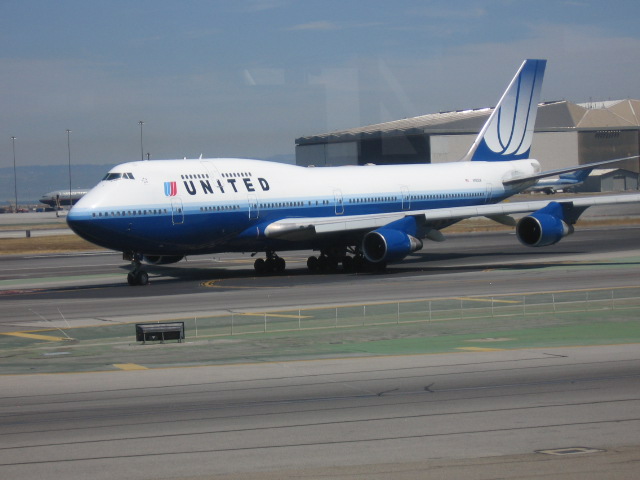
It doesn’t happen very often that I fly a new route on United Airlines, especially out of Washington — it seems I’ve flown a huge number of them. But my 467th United flight this week was on the relatively new nonstop service to Moscow.

That flight is flown on a Boeing 767, which means that it’s reconfigured with the new truly flat business-class seats. Even better, upgrading to business on that flight is usually fairly easy, and I was on a pretty high M fare, so I never had any doubt my upgrade would clear.

By the time that happened a week before the flight, I had two choices in terms of window seating: a forward-facing seat in the row before the last or a rear-facing seat in the first row of the business cabin. About six months ago, I would have chosen the first option, but after flying backward from San Francisco to Sydney in December, the direction doesn’t bother me anymore. Each couple of seats feels very much like a private compartment, and you don’t really see anything outside that compartment while seated, so you forget there are other passengers facing in a different direction. I chose the first row because it’s away from the galley and the coach cabin, which makes it quieter and less trafficked.

It was a standard United flight in terms of the service — pretty good, but nothing spectacular. My glass of water never remained empty for too long. A couple of flight attendants asked if I worked for United, because I looked familiar — that tells you how often I’m on those planes.

My routine on long-haul flights begins with changing into my plane pajamas, which are given to first-class passengers on some non-U.S. carriers — this time, I’d taken a set from Lufthansa, but I usually rotate them with sets from SWISS or Singapore Airlines. I used to change after takeoff, but by the time the seat-belt sign is off, the service has already begun, and I’d rather not be in the flight attendants’ way.

During takeoff, I read newspapers — usually the Financial Times, where I used to write, and the International Herald Tribune on flights originating outside the United States. Then I turned on my entertainment system and start a film — “Valentine’s Day” was the first one I watched. It didn’t do well at the box office when it was released in February, despite the all-star cast and the director Gary Marshall, who also did “Pretty Woman.” I thought it was good enough for a plane ride.

After dinner — not-so-tasty chicken breast and cheesecake — and Chardonnay, it was bedtime. The flight left as 5 p.m., so it was too early to sleep. I tried really hard but not very successfully. At least I had a long and nice rest in a flat bed. Later, I watched another film — the very good documentary, “Celine: Through the Eyes of the World.”

Breakfast was disappointing, as it usually is in United business — just a croissant and fruit — and way behind competition, but United has never excelled at its soft product. Only first class gets eggs for breakfast.

This was my seventh time in Moscow, but the first at Domodedovo Airport — I found it much nicer than Sheremetevo. It was my 202th airport overall, according to my profile on FlightMemory.

Continue reading about Flying new United route — rare occurrence

nkralev on March 18th, 2010

BERLIN — Most Berliners adore their city and are proud that this former symbol of East-West division has become a modern and united capital, as well as one of the world’s most visited places. But 20 years after the wall dividing Berlin fell, the country is still not nearly as unified as the capital, many Berliners and other Germans say.

“We all underestimated the challenges,” said Friedrich Merz, a former member of parliament from Chancellor Angela Merkel’s ruling Christian Democratic Union and now chairman of Atlantic Bridge, a nonprofit organization. “It takes much longer to unify a country.”

Political analysts, economists and ordinary Germans point to the rapidity of communism’s fall, the legacy of state ownership and mistakes made at different stages of the reunification process as reasons why parts of eastern Germany remain underdeveloped and are still losing people to the West…

Continue reading about True German unity proves elusive