Warren Christopher

nkralev on April 5th, 2011

During my decade as a State Department correspondent, I never expressed personal opinions about the diplomats I covered — as it should be. The closest I came to offering a glimpse of how I felt was a 2009 profile of William J. Burns, undersecretary of state for political affairs. Last week, President Obama nominated Burns to be Hillary Clinton’s deputy.

As I wrote in a private e-mail message to Burns, whom I consider one of my friends in the Foreign Service, there is no one more deserving. My sources tell me that Clinton has been enormously impressed with him in the two years they have been working together. I haven’t found a single person with a negative opinion of Burns.

Deputy secretary of state is a political post, and very few career diplomats have held it. It’s extremely telling that of all Democrats in the foreign-policy establishment, Clinton didn’t see one better suited for the job than Burns.

It’s also a great testament to Burns’ abilities and achievements that Obama went along with Clinton’s choice and didn’t nominate a person from his inner circle. Clinton’s current deputy, James Steinberg, is considered Obama’s man at the State Department. The deputy secretary during the eight years of the Clinton administration was Strobe Talbott, Bill Clinton’s onetime roommate at Oxford University.

Steinberg, who advised Obama during the 2008 presidential campaign, is stepping down to become dean of the Maxwell School of Public Affairs at Syracuse University.

Here is my profile of Burns, which ran in the Washington Times on April 12, 2009, with contribution from Barbara Slavin.

Diplomatic Dedication

By Nicholas Kralev

Call him the understated undersecretary.

The highest-ranking career diplomat in the U.S. government, William J. Burns, held onto his job as undersecretary for political affairs when the administrations changed in January — a testament to his abilities, experience and, unusual for Washington, apparent lack of desire to grab the limelight, his friends and colleagues say.

There are many subjects he can discuss with ease — from Russia to the Middle East — but one he always shies away from: himself. Predictably, he declined to be interviewed for this profile. Many others, however, were happy to share their views.

Secretary of State Hillary Rodham Clinton said that Mr. Burns was the first State Department official she met with after she was nominated by President-elect Barack Obama in November.

“He immediately lived up to his stellar reputation as a seasoned diplomat, and I have valued his insight and judgment every day,” she said. “He personifies the very best of our Foreign Service and is a model of dedication to our country.”

Mr. Burns was appointed a year ago by Mrs. Clinton’s predecessor, Condoleezza Rice. Although it is typical for every secretary to hire her own undersecretary, Mrs. Clinton made the almost unprecedented decision to retain Mr. Burns. “She knew from the start she wanted him to stay and wasn’t ever in doubt,” said one of Mrs. Clinton’s closest aides.

Just before Ms. Rice left the State Department in January, she said she was “really sad to leave people like” Mr. Burns, but “delighted” that he would continue to work with the new team, which “will never find a better repository of skill and dignity and integrity and honor.” Similar praise from departing political appointees to civil servants is not unusual, but Ms. Rice teared up when she uttered those words, and Mr. Burns was visibly touched.

During his nearly three decades of public service, Mr. Burns has received the nation’s highest honors, including two Presidential Distinguished Service Awards and several State Department awards. But perhaps most telling is the fact that both Democratic and Republican administrations have appointed him to senior positions.

“He is one of the two finest diplomats I’ve ever met. The other happens to be a Japanese diplomat,” said Richard L. Armitage, who was deputy secretary of state during President George W. Bush’s first term, when Mr. Burns was assistant secretary of state for Near East affairs. “What makes Bill so special is that he is calm, unflappable, informed, with an absolute steel core. He is a man of principle who will not bow to expediency.”

Former Secretary of State James A. Baker III called Mr. Burns a “top-notch public servant” who “speaks truth to power in an understated way.” He is “not ideological, calls it like he sees it, and everybody has confidence in him,” Mr. Baker said. “I don’t know anyone who thinks ill of him, and if you look at the results of his work, you’ll know why.”

Elliott Abrams, the top Middle East expert in the Bush White House who has often been described as a neoconservative, said he traveled with Mr. Burns “quite a bit and had a very pleasant experience.”

“He knows how to make the machinery work and to serve the secretary well,” Mr. Abrams said of Mr. Burns, who was the Bush administration’s point man on diplomatic efforts to prevent Iran from developing a nuclear weapon. “He worked within the policy guidelines, and he did everything he could within that framework. So critics of the policy should focus on people who made the policy.”

The Bush administration refused to join European Union-led negotiations with Iran unless Tehran suspended uranium enrichment. Ms. Rice sent Mr. Burns to a meeting with an Iranian official in Geneva last summer, but he was not authorized to engage directly with the Iranian. On Wednesday, the Obama administration decided that Mr. Burns will participate in such discussions with Iran from now on.

Mr. Burns is expected to have a major influence on U.S. policy toward Iran and the wider Middle East, a reflection of experience that goes back to the administration of George H.W. Bush. Then Mr. Burns was one of a handful of so-called food processors” who churned through ideas for Arab-Israeli peace following the 1990 Gulf War.

Toby Gati, who was assistant secretary of state for intelligence and research in the Clinton administration, said that, although Mr. Burns has been able to serve both Republican and Democratic administrations “without losing his core beliefs,” he appears “liberated” working for the Obama administration. “Whenever we have a problem, I would sleep a lot easier knowing that Bill Burns is in charge of it,” Mrs. Gati said.

Several State Department officials said Mr. Burns has been an inspiration for young Foreign Service officers, because his career is proof that a modest but capable civil servant can reach the highest levels of the U.S. government.

Unlike his predecessor, R. Nicholas Burns, who loved being in the spotlight and held regular on-camera press briefings, “Bill Burns is not a politician — he prefers to do things quietly,” said one official who has worked for both men but asked not to be named because he was not authorized to speak publicly.

Mr. Burns gave a rare speech at Princeton University last month, during which he talked about humility in foreign policy and seemed to be criticizing the Bush administration’s “lecturing” other countries on human rights and other issues, rather than leading by example.

“We do make mistakes,” he said, “and we gain in global status when we admit them, and then show how our own democratic system can reliably correct them.”

Mr. Burns returned to Washington last year after a stint as ambassador to Russia. His expertise is highly valued by the current administration, and he sat at Mr. Obama’s right during a meeting with Russian President Dmitry Medvedev in London earlier this month.

“I entered the Foreign Service in 1982, in a world defined largely by the Cold War and an international order organized largely around Russian-American rivalry,” Mr. Burns said at Princeton. “Twenty-seven years later, the world is, of course, a much different place, and a constant source of humility for those of us trying to navigate through it, in pursuit of our country’s interests and values.”

Earlier in his career, Mr. Burns was ambassador to Jordan and also held senior staff positions at the State Department, such as executive secretary and executive assistant to Secretaries of State Warren Christopher and Madeleine K. Albright.

Mrs. Gati, who has known Mr. Burns since he was on the Soviet desk in the 1980s, said that one of Mrs. Clinton’s most challenging tasks would be “to produce the next generation of Bill Burnses.” “These people don’t appear from nowhere,” she said. “It takes 20-30 years to nurture someone like that.”

RETURN TO MAIN DIPLOMACY PAGE

Related stories:

Why are political ambassadors tolerated?

Career diplomats protest Obama appointments

Diplomats in the news for wrong reasons

Foreign Service: America’s other army

Continue reading about The greatest understated U.S. diplomat

nkralev on November 19th, 2010

I began the week reminiscing about my travels with four secretaries of state, so I thought I’d end it by answering another question I’m frequently asked: What happened to the three secretaries I covered before Hillary Clinton? Starting with the most recent, they are Condoleezza Rice, Colin Powell and Madeleine Albright.

I’ve also been asked often about the differences between those former chief U.S. diplomats, especially during travel. I usually point out an obvious similarity among them first: None of them is a white male. In fact, the last secretary to fit that description was Warren Christopher, who left office in January 1997, when Albright ended the centuries-old tradition.

So here is a brief summary of my impressions and experiences with three people who had very different backgrounds but rose to the highest levels of the U.S. government and became household names around the world.

Condoleezza Rice

After handing the job over to Clinton in January 2009, Rice returned to Stanford University in Palo Alto, Calif., where she has spent most of her career, and where I first met her in January 2000. We did an interview for the Financial Times over a long breakfast at the famed Ricky’s Hyatt hotel, after which we drove — in our separate cars — to her office at the Hoover Institution.

I was a student at Harvard at the time and was first introduced to Rice indirectly through a book she co-authored with Philip Zelikow, “Germany Unified and Europe Transformed.” I thought she had a great story, and my editor in London agreed, so I sent Rice an e-mail message requesting an interview and she agreed to do it. I flew to San Francisco a day after my last final exam for the semester.

Condi, as she introduced herself, was utterly charming and exhibited great confidence while responding to my questions about various foreign-policy issues.

The next day, I was in New York to interview Barbara Walters, and I told her about the fascinating woman I’d just met, who might be national security adviser or secretary of state some day. Barbara’s reaction was, “She is not big enough for me yet.” In 2005, Barbara included Rice in her “10 Most Fascinating People” ABC special, but Rice declined to be interviewed. I take absolutely no credit for that decision.

In her first year as secretary, Rice was far from the confident woman I’d met five years earlier. On the plane, she appeared closed off and a bit insecure, which had a lot to do with getting used to the sudden and overwhelming public attention focused on a very private person.

That, of course, changed, and eventually she became one of the most influential secretaries of state in history, mainly because of her closeness to President George W. Bush. She recently published a book about her parents, which she has been promoting in the media, including on the “Daily Show” with Jon Stewart. A book about her experience in the Bush administration is planned to next year.

Colin Powell

I didn’t meet Powell until he was already secretary of state. I always had deep respect for him, but what impressed me on trips with him more than anything was his rare ability to hold meaningful conversations with various kinds of people — from a handyman or a cleaner to presidents and kings.

While Rice couldn’t wait to get back to her private cabin after a briefing on the plane, Powell spent a lot of time with us, often joking — and teasing me for being the youngest in the press corps. Looking back, perhaps that was an escape from the fierce battles he was fighting with Vice President Dick Cheney and Defense Secretary Donald Rumsfeld, who would often use his absence from Washington to outmaneuver him.

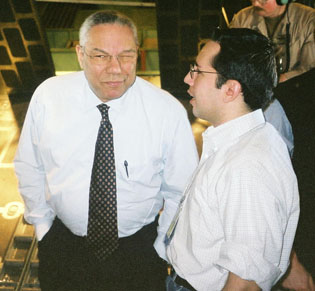
In 2004, I did an interview with Powell for an eight-part series on the Foreign Service, and he expressed anger with detractors who accused him of undermining Bush’s agenda — in fact, he called those accusations “bullshit,” but we couldn’t print that, even though he’d said it was “quotable.”

Still, I built the whole story around that theme, and he wasn’t happy about it. He told me so himself on a flight from Islamabad to Kabul, and that moment was captured on the above photo.

I’ve seen Powell several times since he left office, though not since last year’s White House Correspondents Dinner at the Washington Hilton. I’ve also been to his office in Alexandria, Va., from where his trusted assistant Peggy Cifrino runs most of his post-government life. He is on several boards and often gives speeches around the country and abroad.

From time to time, he resurfaces in the media — usually, on Sunday morning TV shows, as he did to endorse Barack Obama for president in 2008, or on CNN’s “Larry King Live,” where he appeared this week.

He stays very informed about current events and reads most foreign-policy stories in the press. Sometimes, he sends the reporters he knows comments about their articles, mostly to correct what he perceives as inaccuracies.

In 2008, I was surprised to receive an e-mail message while I was in Singapore with Rice, covering the annual meeting of foreign ministers from the Association of Southeast Asian Nations (ASEAN). In one of my stories, I’d mentioned in a brief sentence at the end of a paragraph that Powell met with the North Korean foreign minister in Jakarta in 2004. My editor had changed “met” to “had coffee,” and Powell thought that inaccurately diminished the meeting’s importance.

Madeleine Albright

I have a soft spot for Albright, not only because she was the first secretary of state I knew personally, but also because she has been very helpful to me — and she is a lot of fun.

I first met her in an ornate suite at New York’s Waldorf-Astoria hotel in 2000, while working on a profile of her for the Financial Times. Then I went on a trip with her to Europe and the Middle East — the first time I traveled on the secretary’s plane. We were flying when word came that Slobodan Milosevic had been driven out of power in Belgrade. I was surprised when she winked at me during a press conference in Egypt, but later I learned that she had winked at other reporters before.

When I got a job offer from the Washington Times in 2001, I was concerned about the newspaper’s affiliation with the Unification Church, so I asked Albright for advice. She pointed out that the Times had a stellar foreign coverage, and she didn’t see anything wrong in working there.

Over the years, she’d send me her newly published books with lovely inscriptions, writing “You are a star” in one and calling me “one of the outstanding journalists of our time” in another. In 2002, we had breakfast in her native Prague during a NATO summit.

At 73 — the same age as Powell — Albright is astonishingly active and extremely busy. She owns and runs two companies, travels around the world all the time and is involved in many projects. She recently chaired an expert group tasked with drafting a new NATO strategic concept. She is also chairman of the National Democratic Institute.

In October 2008, a couple of weeks before the last presidential election, I invited Albright to meet with the Washington Times editorial board. We left together from her office and she drove to the Times’ building in Northeast D.C.

During the ride, she said she was tired of people asking her who would be Obama’s secretary of state, because she wasn’t close to him and had no inside information. I suggested it would be fun for the press corps if Hillary Clinton got the job. Albright, who has been a good friend of Clinton’s since the mid-1990s, said: “It’s not gonna happen.” Of course, Clinton herself was shocked when Obama offered her the position weeks later.

We had a wide-ranging discussion about various foreign-policy issues during the meeting, and one of the things Albright said was that she opposed a deadline for withdrawing U.S. troops from Iraq. The Clinton administration’s experience in the Balkans had taught her that the president shouldn’t commit to a specific date not to tie his hands.

The Times’ executive editor at the time, John Solomon, thought our headline should be that Albright disagreed with Obama, who had proposed a deadline. I tried to write a story based on the facts without a “gotcha” element, but Solomon thought my lede wasn’t strong enough and wrote it himself.

Albright, who flew to Nevada to campaign for Obama the next day, was furious. Even though she and her aides have assured me it’s all in the past, things between us haven’t been the same since then. As thick of a skin she claims to have, she clearly still holds a big grudge against me, which she seems to have shared with other people.

RETURN TO MAIN COLUMN PAGE

Related stories:

My trips with Clinton back in the news

Albright’s final bow

Powell: “I am on the president’s agenda’

Political punch in a package of charm

Continue reading about Where are my ex-secretaries of state?
nkralev on April 29th, 2010

A dispute over the State Department budget has pitted the chairman of the Senate Budget Committee, Sen. Kent Conrad of North Dakota, against a fellow Democrat and head of the Foreign Relations Committee, Sen. John F. Kerry of Massachusetts, and the Obama administration.

Mr. Conrad led an effort to slash President Obama’s $58 billion international affairs request for 2011 by $4 billion, a cut his committee approved last week. Despite protests from Secretary of State Hillary Rodham Clinton and all her living predecessors, the senator stood his ground on Wednesday.

“The fact is that international funding has grown significantly in recent years,” he said. “Budgets are about setting priorities. Our budget provides a responsible and balanced approach”…

Continue reading about Cuts to State Dept. budget ignite interparty row

nkralev on March 3rd, 2010

Part 1: Powell: ‘I am on the president’s agenda’

Part 2: Diplomats fight stuffed-white-shirt image

Part 3: Diplomacy adapts to new threats

Part 4: Cultural diplomacy pays off, envoys say

Part 5: Consular services changed after 9/11

Part 6: Embassy bombings spur security boost

Part 7: Diplomatic reorientation

Part 8: Ups and downs of diplomatic life

Continue reading about Foreign Service: America’s other army

nkralev on March 3rd, 2010

At first glance, David T. Donahue’s experience on September 11, 2001, was not much different from that of most other Americans. “I heard the first plane had already hit the World Trade Center, and then watched the second live on television, like everybody else,” he recalled recently.

But while most Americans were at home or at work when the terrorists struck the World Trade Center and the Pentagon, Mr. Donahue was in Kabul, the capital of Afghanistan, where the plot that killed about 3,000 Americans most likely was hatched.

He had been dealing for days with the country’s Taliban regime, which had provided safe haven to Osama bin Laden and his al Qaeda network since 1996…

Continue reading about Consular services changed after 9/11