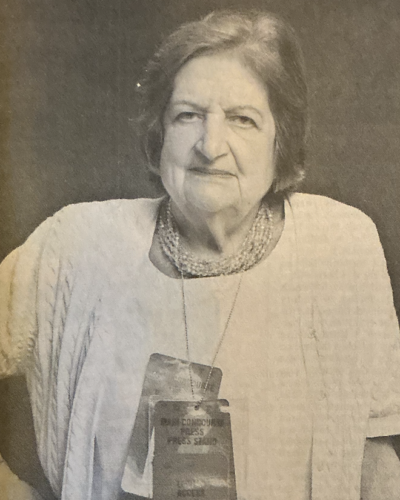
Helen Thomas hoped in vain that her 80th birthday on August 4 — a date she shares with the British Queen Mother and Yasser Arafat, the Palestinian leader — would pass unnoticed. “I don’t want anyone to know,” she said. “I don’t see why people have to be stamped by their age — that’s prejudice.”
But nothing made her angrier than the “congratulations” she received on her “retirement”, when she announced in May that she was leaving her front-row seat in the White House press room, where she had reported on eight presidents for United Press International (UPI) over four decades. She was simply changing jobs, and is now a columnist for Hearst Newspapers, the US chain that owns dozens of publications, including the Houston Chronicle and the San Francisco Examiner…
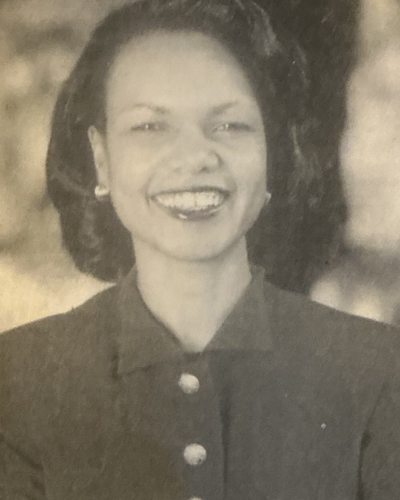
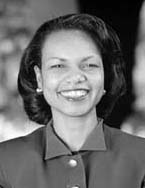
Condoleezza Rice has rarely heard a question she doesn’t know how to answer, from queries about her tumultuous childhood in segregated Alabama to her success in the male world of superpower politics, nuclear weapons and arms control.
She meets me with the friendly smile and easy hospitality of a west-coaster, defying the image of someone anointed by Washington insiders to become the most powerful woman in the world in a year. The chief foreign policy adviser to Republican presidential candidate George W. Bush, Rice is being tipped as a likely secretary of state or national security adviser should Bush win the White House.
As huge a task as this sounds, Rice’s own life story has the word “amazing” written all over it. At 45, she has been the first black woman in just about any job she’s taken on: from special assistant for national security affairs to President George Bush when she was only 34, to provost of California’s prestigious Stanford University (the Harvard of the west coast) where she managed a budget of nearly $2bn…
Continue reading about Political punch in a package of charm
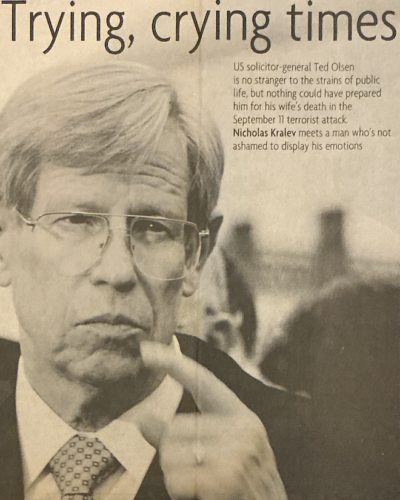
Ted Olson’s eyes fill with tears when he talks about his late wife, Barbara, but he doesn’t mind the emotion, even in public. More than eight months after she died in the September 11 terrorist attack on the Pentagon, he still can’t get used to waking up alone in bed and not speaking with her on the telephone several times a day.
“This was a love affair that lasted as long as we knew each other,” he says, staring into the distance. “That relationship was the most wonderful thing that ever happened to me, and when I think about her, I can hardly think about anything else.”
Olson has had a lot to think about — he is the US solicitor-general, or the government’s top courtroom lawyer — but trying times such as these are certainly no novelty for him. During the disputed 2000 presidential election, he argued George W. Bush’s case before the Supreme Court. In the early 1980s, he defended President Ronald Reagan in the infamous Iran-Contra scandal…
Vojislav Kostunica is still trying to recover from the “shock” he felt nearly four months ago when he finally realised that he was indeed the president of Yugoslavia. He was “thrilled and humbled”, he says, and had thought much about how he would “behave as president-elect” after his September 24 victory over Slobodan Milosevic, who disputed the results of the vote until he was forced out of power on October 6.
But since then, “things have been changing very quickly” for the soft-spoken and studious 56-year-old lawyer, who readily acknowledges his “lack of experience” in governing, and finds his new duties and unlikely celebrity rather overwhelming.
“This job is very difficult, but also very creative,” he says, “and I wouldn’t be in politics if the creativity were missing”. Although he remains entirely serious, it seems that he is wittily hinting at the total mess which he inherited in his country’s affairs — both domestic and foreign — from his predecessor and which necessarily will require quite a bit of “creativity” to overcome…