nkralev on March 9th, 2011

As United and Continental prepare to become one airline, they are making changes that, though necessary, are affecting negatively their customers. One consequence is that upgrades on international flights will be harder to get in the short run, and more expensive in the long run.

The carriers announced last month that they would begin “cross-fleeting” — swapping routes in each other’s network — and some of those changes have already been loaded in their schedules. Both United and Continental will be serving certain routes in the next several months, but each of them is taking over other routes entirely.

For example, all Anchorage flying goes to Continental, as do the Washington-Paris and Washington-Amsterdam routes, now operated by United. The current Continental flights from Newark to Zurich and Brussels, as well as its Houston-Lima flights, will be flown by United.

That practice is not unusual in airline pre-merger situations. While the United-Continental merger was legally completed late last year, they will be operating as separate airlines until they secure a single certificate from the Federal Aviation Administration, which is expected to happen by early next year.

However, United and Continental are implementing the route changes before resolving some technical issues that will harm their customers.

If you are a United 1K flier and have system-wide upgrade certificates, you can’t use them on the previously United flights now operated by Continental — and the other way around. The same applies to your confirmed regional upgrade certificates on domestic flights. As of now, it’s technically impossible for the carriers’ reservations systems to accept upgrade certificates from the other airline’s frequent-flier program.

Mary Clark, a Continental spokeswoman in Houston, confirmed that certificates will be “carrier-specific” for the time being. “We are in the process of aligning the programs, and changes to the current policies will be announced as they are rolled out throughout the year. We aim to fully combine the programs by 2012.”

United is expected to adopt Continental’s reservations system eventually, but until then, there may be another way to resolve the issue. The carriers announced this week that miles can now be transferred between United and Continental accounts. I wonder if they can make it possible for upgrades to be transferred as well. It’s unclear if they looking into such an option yet.

There is another issue with the United system-wide upgrades whose impact is just now becoming apparent. For years, they have been allowed only on tickets booked in W class or higher, which makes S, T, L and K classes ineligible. Continental recently adopted the same rules.

This means that customers often have to spend hundreds of dollars more than the lowest available fare, just to qualify for an upgrade request — and if the upgrade doesn’t clear, they are left with a lot less money and the same coach seat they would have had if they had paid much less for it.

Things are getting even worse. In January, because of the merger, United added a 14th coach booking class, G, which was a regular published booking class on Continental, but on United it was previously an unpublished travel-industry discount class — it didn’t earn miles and was ineligible for upgrades.

Now, instead of four, there are five booking classes ineligible for system-wide upgrades. So what? you might ask — just a small technicality. Not quite. As a result of this change, W fares are getting more expensive. For example, a base fare of $800 that might have booked in W class before, now books in S or T. A few days ago, I helped a friend with a ticket from Washington to Bangkok, and the W base fare was more than $1,400 round trip — including taxes and surcharged, it came up to $1,900.

There is no question that fares have been going up for some time. A few years ago, a W fare to Bangkok was about $900, including taxes. In 2002, an H fare was $900. So the trend is clear and it didn’t start yesterday. But adding one more booking class makes things even worse.

It’s worth pointing out that American Airlines system-wide upgrades are allowed on all published booking classes.

Another negative change as a result of the United-Continental merger is that, similarly to the upgrades, discount vouchers from one airline cannot be used on the other. So if you want to use a United voucher for a ticket to Anchorage, you can’t, because United has given its seasonal service to Continental.

This week, the United website seems to be including Continental flights in electronic certificate-discounted itineraries, but the official policy hasn’t changed. It may be a website glitch, given that it also allows Lufthansa flights, and the vouchers’ terms and conditions specifically say that they are not valid on code-share flights.

One positive merger-related change is that United customers can now avoid StarNet blocking — it has diminished but still exists — by transferring their miles to Continental, which doesn’t block Star Alliance partner award seats.

NOTE: Several months after this column was published, United and Continental made it possible to use upgrades on flights operated by the other airline, including on mixed itineraries.

RETURN TO MAIN COLUMN PAGE

Related stories:

United, Continental execs at odds over loyalty program

United executive breaks old barriers

Keeping United international first class

United StarNet blocking

Continue reading about United fliers hit by pre-merger changes

nkralev on July 13th, 2010

How do you decide which hotel to choose in the city you are visiting if you want to redeem your points for a free night? I had to make that decision this month, and unlike in many similar situations, it wasn’t even a close call.

I usually start with the chains where I have top elite status — Hilton HHonors and Starwood. Hilton’s Diamond benefits are inferior to Starwood’s Platinum perks — Hilton doesn’t give you suite upgrades and free Internet. The only advantage with Hilton is that award stays count toward elite status, which is rather significant in my book.

However, in January, Hilton devalued its points by raising both the categories of many hotels and the number of points needed for a free night in some categories. Even though the affected properties weren’t as many as the unaffected ones, the average traveler wouldn’t know that, because those that remained unchanged are in places few people visit. I have the full list, but have yet to come across a hotel that stayed the same while making reservations.

Even before the devaluation, I thought all Hilton properties in Anchorage, AK, were a bit overrated, but I had stayed at three of them on points nevertheless. When I looked at the new categories last month, I was horrified — not only was the Hilton now Category 6 (previously the highest until a seventh tier was created this year), but the Hampton Inn, the lowest-end brand in the chain, was Category 5, requiring 35,000 points for one night.

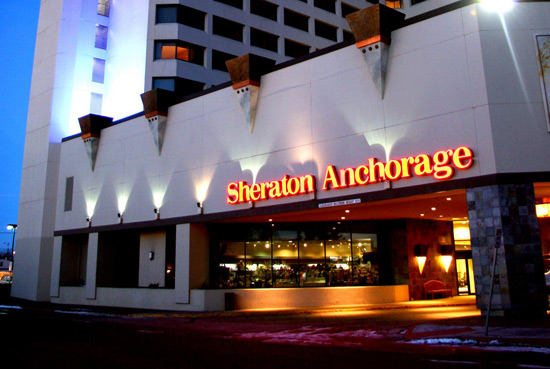
By contrast, the only Starwood property in Anchorage, the Sheraton, is Category 3, which means only 7,000 points per night. Unfortunately, it doesn’t offer the popular cash-and-points option.

So let’s compare the two full-service hotels — the Hilton and the Sheraton. At the first — Category 6 out of seven — I need 40,000 points out of a maximum of 50,000 for the highest category. At the second — Category 3 out of seven — I need 7,000 points out of maximum 35,000. Naturally, I chose the Sheraton.

There was another factor in my decision. I needed a conference room for my “On the Fly” Seminar, so I called and left messages for the sales managers at the Sheraton and four of the Hilton properties — the Embassy Suites, the Hilton Garden Inn, the Homewood Suites and the Hampton Inn. Of the last four, only the Embassy Suites — one of the newest and nicest hotels in town — bothered to call me back, but their price was too high. The Sheraton offered me a much better rate.

So I was happy with the Sheraton. Although it’s not a very attractive building from outside, it underwent a major renovation recently and is quite decent inside. I got a suite, lounge access, free Internet and free breakfast. My only cash expense was on the conference room.

What would you have done?

Continue reading about Hilton or Starwood? Not even a close call
nkralev on July 9th, 2010

Dealing with flight delays and cancellations is challenging enough for travelers, but for some of us it has an additional complication: How to preserve our upgrades in case of rebooking. My trip to Alaska this week provided a textbook example.

As experienced and creative as I might be in handling flight disruptions, the weather is always my worst enemy. I’ve rarely felt more helpless than I did in Denver on my way to Anchorage. My plane had diverted to Colorado Springs because of a thunderstorm, and my departure time kept being pushed back more times than I cared to count.

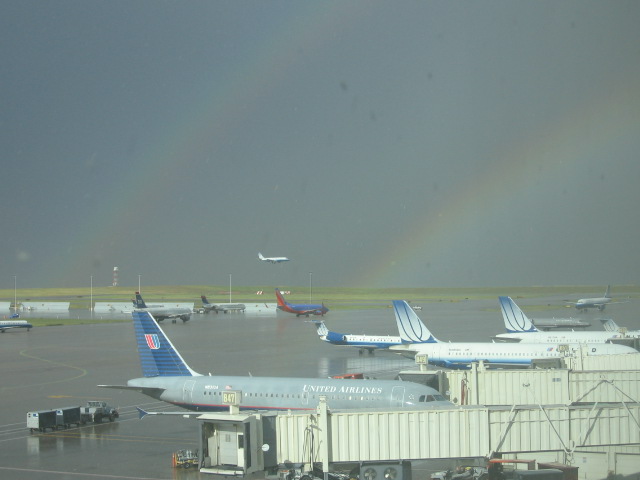
I was sitting in United’s Red Carpet Club watching other planes take off and land, but the one I needed was still at another airport. The only reason to smile was the double rainbow that appeared at one point — you can see it in the photo above.

I had no other options. United has only one flight to Anchorage a day from Denver, though it also flies up there from San Francisco and Chicago. Those flights, however, had already left, so connecting was impossible, even if I could make it to those two cities.

At least I didn’t have to worry about missing another flight, rebooking and potentially losing a previously confirmed upgrade, as this was my last segment for the day.

Things were very different, though, on my way back home. The plane coming to Anchorage from Denver was late — another patch of bad weather had diverted in to Wyoming. It was clear I’d miss my connecting flight, so I called United to get rebooked. The flight I wanted was to Washington National (DCA) — there was no upgrade space available, but they were still selling two revenue seats in first class. An alternative was a flight to Dulles Airport (IAD), which had four revenue seats in first class but nothing to upgrade, either.

A supervisor refused to open upgrade space for me despite the second long delay I was experiencing in three days and was only willing to waitlist me for first class on either flight — there were 22 people waitlisted for an upgrade to DCA, and she didn’t think it was fair to jump me over them.

I got really angry — but not because of her refusal. The plane to DCA was a Boeing 757 and had 24 seats in first class, and the one to IAD was a Boeing 767 with 34 seats in first. Until recently, it was very likely that those flights would have had at least a couple of upgrade seats the night before departure.

But in March, United implemented free domestic upgrades for all elites, which they don’t even need to request. So by the time a top elite member needs a seat because of involuntary rebooking, those seats have been given away to customers with much lower status.

When I got to the Anchorage airport, I saw that I was first on the waitlist, and with two seats still open at 4 a.m. Denver time for an 11 a.m. departure, I thought I was pretty safe. But when I landed in Denver, those two seats were gone. I was still at the top of the waitlist, and three people with reservations on the flight hadn’t checked in.

I did get the upgrade at the gate in the end, but this was the closest I’d come to flying in coach in years.

Continue reading about Preserving upgrades in case of rebooking

nkralev on July 1st, 2010

Have you tried to watch fireworks in the bright late-night Alaska sky on July 4th? I had the sun in my eyes a couple of years ago, but if the weather forecast is correct, this coming Sunday will be gloomy and rainy. Too bad for me.

I decided to make my third visit to Anchorage a couple of months ago, and since I was going anyway, I thought I’d teach an “On the Fly” Seminar there on July 6. It will take place at 6:30 p.m. in the second-floor boardroom of the Sheraton hotel. Only ladies have signed up so far. Where are all the male travel enthusiasts? Here is an easy link to the registration page.

One of our students in DC just told me she has already saved $500 on her very first domestic plane ticket since she attended a seminar last week. I’ll do a separate post about that, but the point is, the proud Alaska travelers should act quickly, before the limited seats vanish.

About four years ago, I decided that I’d try to get to Alaska every summer, and to Hawaii every winter — but only if airfares drop to about $400. Not only is it appropriate to go to Alaska during the very hot and humid DC summer, and to Hawaii during the cold winter, but both those places are the furthest one can get to on a domestic plane ticket — and get tons of frequent-flier miles. I did miss Alaska last summer, and Hawaii this past winter.

I try to be creative with my routing when I can, so this time I’m flying from DC to San Francisco, then to Denver and on to Anchorage. I was surprised to find such an option in the legal-routing section of the fare, but I took advantage of it. The trip will yield about 23,000 miles, including my double bonus as a top elite, which of course is only 2,000 miles short of a free domestic round-trip ticket.

So Alaskans, look forward to seeing you in a few days.

Continue reading about White-night July 4th in Alaska

These are some of the participants in the first official “On the Fly” Seminars in Washington last week. Everyone who came was extremely satisfied — in fact, none of my students had expected to learn nearly as much as they did.

As you can see from the comments on the seminars’ website, they were called “a traveler’s dream,” “incredibly revealing and extraordinarily valuable,” and “a mandatory tool to save money for frequent fliers and corporations.”

“These are perfectly practical methods to make the system work to your advantage — just a few steps to get inexpensive flights, ideal itineraries, upgrades, no fees, and free flights,” said David Aidekman, founder of Adventurati, a group travel company.

Charles Zhang, who came all the way from Princeton, N.J., to attend one of the DC seminars, said he has had top elite status with a couple of airlines for a while, and flies more than 150,000 miles a year. “But I still learned lots of new things from your seminar, which I had never heard before,” he said. “I will use my skills from you seminar toward my future flights, and enjoy my travel more.”

Of course, I couldn’t be happier with the feedback, but it seems I have a serious challenge to overcome: It’s clear the seminars are extremely valuable for those who attend, but the problem is that they don’t know that until they come. Despite the detailed curriculum and syllabuses I’ve posted, last week’s participants said they had no idea that much of what I taught was possible and available to all travelers.

So it seems I need to come up with a catchier way to compress material that takes hours to teach into a few soundbites and paragraphs. Wish me luck!

In the meantime, I’m pleased to announce that the next seminars in Washington will take place on July 23 and 24. Before that, I’ll be offering a seminar in Anchorage, Alaska, on July 6. I’m also looking into doing the same in New York, either in July or August.

Continue reading about Lessons from ‘On the Fly’ Seminars, and July dates announced