Democratic
In September, five Americans took up assignments as English teachers thousands of miles from home, determined that, by the end of the school year, their students would not only speak some English, but know much more about the United States.
“They welcomed us with open arms,” Craig Dicker, a Foreign Service officer who helped to place the newcomers, said of the schools that hired the teachers. “They were thrilled to have Americans teach there.”
There would have been nothing exceptional about the teaching assignments had it not been for the particular schools: Islamic institutes in Indonesia that prepare teachers for the country’s large network of religious high schools, known as madrassas…
Continue reading about Cultural diplomacy pays off, envoys say
It was well past the official close of business at NATO headquarters in Brussels on September 11, 2001, but the chamber of the North Atlantic Council, the alliance’s political decision-making body, was anything but dark and quiet.
Hours after the terrorist attacks in New York and suburban Washington, Secretary-General George Robertson had gathered the ambassadors from all 19 member states to discuss how the events that were still unfolding live on television affected the organization and what NATO might do in the immediate aftermath.
“After the meeting, the Canadian ambassador, David Wright, took me aside to ask if Article 5 should be considered,” Nicholas Burns, the U.S. ambassador, recalled last week, referring to a clause in the 1949 Washington Treaty that created the alliance that says an attack on one member is an attack on all…
George Herbert Walker III, a Missouri businessman who headed a financial-services company for 14 years, wanted to serve his country overseas. So in early 2002, he turned for advice to his first cousin, George H.W. Bush, the current president’s father.
“He thought it would be a good idea,” Mr. Walker recalled recently. “He didn’t want to tell his son what to do, but told me to write the president a letter. I didn’t name a country, but there are many countries we have a fragile relationship with.”
Today, Mr. Walker, who is in his early 70s, is the ambassador to Hungary — a NATO ally and supporter of Bush administration policies with several hundred troops in Iraq. Like many political appointees, he was immediately struck upon taking up his posting in October with the stark contrast between modern diplomacy and the lingering image of the Foreign Service as a collection of stuffy white males in striped pants…
Continue reading about Diplomats fight stuffed-white-shirt image
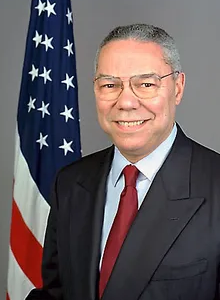
Colin Powell listened with growing but controlled anger. He saw the question coming. After all, there is no charge against a secretary of state more serious than the one leveled by some members of his own Republican Party — and even in the administration he serves.
They accuse him of leading a government agency that not only opposes President Bush’s foreign policy, but also tries to undermine it. His response came out in a single well-known barnyard expletive. Then, to emphasize the point, he added: “That’s quotable.”
“I can show you people in Washington who claim to be pushing the president’s agenda, [but] who are not,” Mr. Powell continued, sitting in his small inner office on the seventh floor of the State Department…
Continue reading about Powell: ‘I am on the president’s agenda’