Elite Status

nkralev on November 16th, 2010

One of the questions I’ve been asked most frequently in the last decade is whether I’ve earned any frequent-flier miles from my nearly 200 flights with four U.S. secretaries of state. Sadly, the answer is no — and what makes it even sadder is that my press colleagues accompanying the president do get miles and even elite status.

I’ve known many journalists over the years who were top elites purely as a result of White House travel. Some of them didn’t really use their elite benefits because of their very limited commercial flying. There were also a few who didn’t even know they had the coveted status.

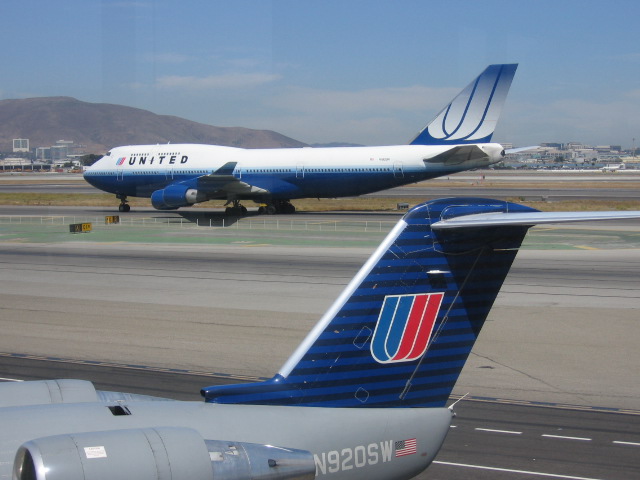
So why the differentiation? The above photo will help explain things. I snapped it while waiting for Secretary of State Hillary Clinton in Beijing a year ago — we flew to Afghanistan that day.

Clinton’s plane is the one of the right — as I wrote last year, it’s the Air Force version of the Boeing 757, also known as C-32. Air Force One — the Boeing 747 on the left — was waiting for President Obama and later took him to Seoul.

The State Department traveling press corps — about a dozen on average — flies on the secretary’s aircraft. Air Force One, however, has enough seats only for a pool of 12, and usually more than 100 reporters go on a foreign presidential trip. There is a rotation for the pool seats on every flight, but most of the time reporters fly on a so-called press plane chartered by the White House, usually from United Airlines.

What you don’t see on the above photo is that, across from the two Air Force planes, to the left of the traffic lane, there was a parked United aircraft, which was of course the press charter.

Everyone on that plane earned United miles, and many of those traveling with the president regularly have 1K status — United’s highest published elite level, requiring 100,000 flown miles per calendar year. Moreover, fliers get first-class mileage credit, which means 150 percent elite-qualifying miles.

Before every trip, different airlines bid for the charter contract, and the White House travel office and the White House Correspondents Association choose the offer they deem best. Although most of the time they select United, for Obama’s trip to Asia last week the winner was Delta Airlines.

The trip took travelers around the world — they flew over the Atlantic en route to India, then went to Indonesia, South Korea and Japan, before returning to Washington via the Pacific. According to the Great Circle Mapper, that’s about 22,000 miles. Delta spokesman Anthony Black declined to say whether the fliers will earn mileage, citing “customer privacy.”

I admit I’ve been a little jealous about all the “missed” miles over the years — almost half a million — but I never wanted to cover the White House because of the domestic politics involved in that beat.

I found another way to earn miles from official trips. After flying almost 100,000 miles with Colin Powell in 2003, I’d had it with non-mileage-earning flights. I still needed to re-qualify for 1K. The following year, I decided that I’d go on the secretary’s plane but would drop off at the last stop and come home commercially. Now I’ve been 1K for a decade.

Some of you might think I was crazy to give up a seat on the secretary’s plane and a hassle-free journey, not having to worry about passport control, customs and sometimes even security screening.

But I thought about it in a different way. I was paying half the price the State Department would charge me — yet, I was getting much better seats as a result of business-class upgrades, mileage credit and better food — yes, even on United.

RETURN TO MAIN COLUMN PAGE

Related stories:

My trips with Clinton back in the news

In air with Clinton on first trip abroad

Clinton weathers job’s long flights

Press ready for Obama, Clinton travel

Continue reading about Flying with Obama and earning miles

nkralev on November 11th, 2010

There are many things about today’s air travel system that annoy the most patient people — passengers and airline employees alike. It’s easy to encounter rudeness on both sides. I’ve learned to block out most of the noise and avoid hassle or stress, but I realized during a trip this week that I have my own pet peeves list.

1. Passengers demanding upgrades from gate agents, because they are on a “full fare” or have elite status — except that their ticket’s booking class is nowhere near Y or B, and they have the lowest status level.

2. Airport lounge gatekeepers wrongly denying you access and insisting they are correct when you confront them with the actual rules. Worse yet, they find a supervisor who agrees with them — as if repeating a mistake twice makes it right.

3. Passengers trying to hide a bag they put on the floor of an exit row, not to be seen by the flight attendant who warned them that luggage is not allowed there.

4. Flight attendants holding your glass with their fingers on the rim — I don’t fancy putting my lips there, especially after I’ve seen the attendant running those fingers through her hair.

5. Passengers trying to talk to you when you are making it clear you’d rather be left alone.

6. Airline agents making up rules.

7. Passengers blaming the airline for ruining their trip, when whatever happened to them could have been avoided only if they had been better educated about the basic rules of airfares and tickets.

8. Flight attendants showing how much they dislike their job.

9. Passengers treating flight attendants like servants.

10. Passengers going to the lavatory without their shoes on — or without in-flight footwear provided by the airline in first and business class.

RETURN TO MAIN COLUMN PAGE

Related stories:

Educating the flying public
Time for travel school — you are invited

Continue reading about What are your air travel pet peeves?

nkralev on September 6th, 2010

Three major travel-industry organizations begin a campaign on Tuesday to compel the airlines to disclose all fees not included in the ticket price at the same time as the actual fare — and before the ticket is issued. But will such a campaign succeed?

The groups — the Business Travel Coalition (BTC), the American Society of Travel Agents and the Consumer Travel Alliance — want consumers to sign a petition to Transportation Secretary Ray LaHood. The text urges him “to require airlines to fully disclose their fees, whether airfares are purchased on an airline’s website or through an online or brick-and-mortar travel agency.”

The organizations plan to deliver the petition to LaHood on Sept. 23, which they have designated as “Mad As Hell Day.” They have created a special website and a YouTube channel.

“It is imperative that we, as consumers, have the ability to comparison-shop and know the full cost of a trip before committing to a purchase,” BTC Chairman Kevin Mitchell said in an e-mail message on Monday. The “airline hidden fees can surprise us at the airport, ruining our holidays, or vanquishing our business travel budgets. For example, check baggage fees can add 30%, 40% or more to the price of a ticket.”

The campaign is in support of the Department of Transportation’s Notice of Proposed Rule Making, regarding airline-passenger protections, Mitchell said.

What’s the likelihood that this initiative will be more successful than previous attempts to extract similar disclosures from the airlines? How long has the battle over false airfare advertising been going on? To this day, you see examples like this one on most U.S. airline websites: $199 each way, based on a required round-trip purchase, plus taxes and surcharges.

If a round trip is mandatory, why on earth are they quoting half of the price? It’s actually less than half, given the extra taxes. As I’ve written before, such deception is not tolerated in Europe and most other parts of the world.

If you can’t get the airlines to be open and honest about their fares, how are you supposed to force them to disclose additional fees? While everyone has to pay for the fare, many passengers are exempt from luggage, standby and other fees — an argument the airlines will no doubt use against the new campaign.

Getting those fees waived is easier than most travelers think. As I wrote in July, all you need is the lowest level of elite status on any member of one of the three global airline alliances — Oneworld, SkyTeam or the Star Alliance — to have your bags fly for free alliance-wide. And sometimes, it takes as little as 3,000 miles to achieve that.

As often happens, my advice has to do with travel education. Air travel has become a maze of rules, fees and restrictions that’s hard to keep up with. So travelers need to invest time to learn the system and find ways to work around it. My experience so far with “On the Fly” Seminars shows that most people don’t think they need to get educated. How many more fees and other frustrations will it take to change their mind?

RETURN TO MAIN COLUMN PAGE

Related stories:

Avoiding luggage and other airline fees

When an airfare sale is not quite a sale

Fare sales often lost in translation

Continue reading about 9/23 is ‘mad as hell day’ over airline fees

nkralev on August 10th, 2010

Air travel is one of those topics that no radio or TV show can go wrong with — it’s certain to touch a nerve with many people and provoke numerous comments and questions. That’s what happened yesterday on NPR’s Diane Rehm Show, which I was on for the first time.

I always thought the reason to be invited would be to talk about foreign policy on the Friday news roundup, where Diane has three Washington journalists discussing issues from the passing week. That never happened, but a couple of weeks ago I suggested to one of the show’s producers that the summer is a good time for a program on travel.

The Diane Rehm Show is widely considered the best talk show on NPR, with more than 2 million listeners a week. It’s produced by WAMU, the NPR station in DC, and airs in dozens of markets across the U.S. Diane is on vacation this week, so the guest-host was Frank Sesno, a former CNN bureau chief in DC who now heads the George Washington University’s School of Media and Public Affairs.

There were two other guests except me: from Dallas, Scott McCartney, who writes “The Middle Seat” column for The Wall Street Journal, and from New York, Susan Stellin, a New York Times contributor.

You can listen to the show and read some of the comments left by listeners on its website. We actually got hundreds of comments and questions by phone, e-mail and on Facebook and Twitter.

We talked about various familiar topics, such as airline fees, seats, delays, the proposed Passengers’ Bill of Rights, re-regulation prospects and others.

Since the show’s topic was “Navigating the not-so-friendly skies,” I wanted to offer some advice on how to do that. The main point I tried to make was about the need for travel education, realizing that most people don’t see such a need because they think they know how to travel. But if that were true, we’d be hearing many fewer complaints and horror stories about air travel.

It’s convenient and popular to blame the airlines all the time — and they often deserve much of that blame — but there is a lot travelers can do to make their own experience less stressful and more seamless.

The airlines have made the system very complex, confusing and frustrating. It is what it is, and we can’t changed it that much. However, we can find ways to make the system work for us — and to do that, we need to know it really well. That’s why I believe every traveler can use a bit of education.

My other main point was about the importance of elite airline status, which is the only decent way to travel today. The reality is that airlines don’t even pretend to try taking care of you if something goes wrong unless you are a loyal customer. More practically, elite passengers are exempt from luggage and other fees.

Unfortunately, most people don’t even try to achieve elite status, because they only travel a couple of times a year. As I wrote last month, you only need 4,000 miles on Greece’s Aegean Airlines to get silver status on the Star Alliance, and Aegean gives you 1,000 miles just for signing up. You don’t have to fly on Aegean — just to credit your miles from flights on any of the 28 Star carriers to that program. Silver status waives baggage fees on United Airlines, US Airways and Continental Airlines.

I was amused to read in the comments on the Diane Rehm Show’s website that a listener accused me of being unpatriotic for recommending membership in a foreign airline’s frequent-flier program.

RETURN TO MAIN COLUMN PAGE

Related stories:

Media coverage of travel seminars

Educating the flying public

Back to basics of air travel

Continue reading about Talking air travel for an hour on NPR

nkralev on July 22nd, 2010

Nicholas Kralev talks about saving on airfare, achieving elite airline status and his upcoming “On the Fly” Seminars on FOX 5 in Washington, DC, on July 22, 2010.

Continue reading about FOX 5 DC: Summer travel tips