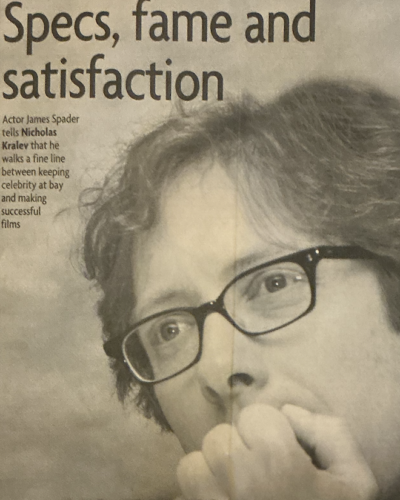
James Spader calmly challenges the “mystery man” image he’s had among film audiences since playing a sexually troubled youth in “Sex, Lies and Videotape” more than 13 years ago, and he does it with the simplest, facts-of-life arguments.
His choice of roles, he explains, has never been determined by a need to “manage” his career or build himself up as a particular “type”, but rather by how a certain project fits into the rest of his life — sometimes it’s “my being out of money”, sometimes it’s “my children being out of school”. So he would “take whatever I can find at that time” and “try to make the best of it”.
“Every few years I do a film I’m really excited about, and the rest of the time I’m finding a way to make a living, still doing something that interests me,” he says in a characteristically soft manner. “I’m able to do that, and it works out great for me. I like making films, but I’m not going to connect my entire life to it”…
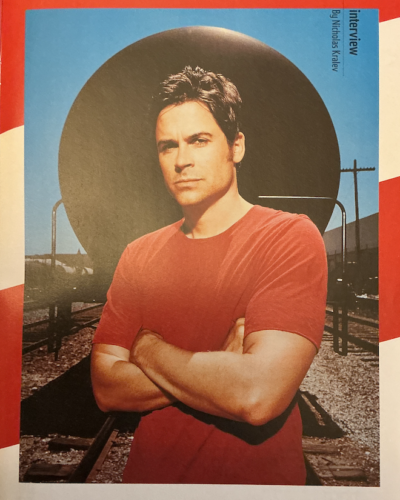
Anjelica Huston has already come to terms with the fact that her first half-century will soon be behind her, but the prospect of joining the ranks of Hollywood’s much-pitied unemployed middle-aged actresses has yet to make her list of immediate concerns. With three films scheduled for release this year, another one having just started production and a script she’s writing to direct, Huston is now busier than she was in her early thirties.
She claims that one can “always find jobs” in show business, or “create jobs if one can’t find them”, although she says that her turning to writing and directing “certainly wasn’t as a result of not getting any work”.
“Most young actors aren’t being offered parts, either, so what’s the point of harping on a negative when you can create something?” she demands. “Go to a class, learn to dance, do something with your life but don’t sit complaining about what you haven’t got. I don’t have $100m — it’s too bad. But I can go and figure something that will get me my next $10m”…
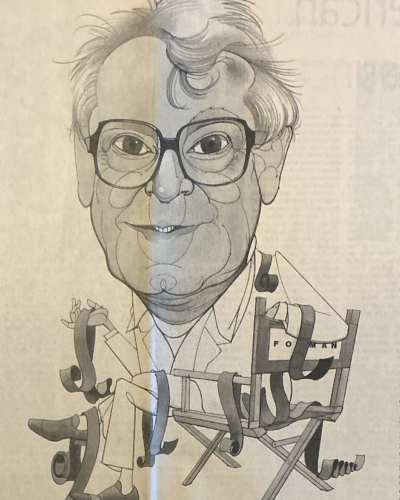
Milos Forman has never rebelled against his films being labelled “quintessentially American” — he is just not a revolutionary type, he says — but the Czech-born director passionately dismisses such categorisation every time he is asked about it.
“For me, ‘One Flew Over the Cuckoo’s Nest’ is a Czech film, because when you are young in a communist country, all you dream about is breaking free,” he says of his 1975 film set in a psychiatric hospital, which earned him his first Oscar and established him as one of the world’s most prominent film-makers.
“Hair” (1979), another Forman movie now considered a classic, “was about young people rising up against the status quo — something we all dreamt about under communism but didn’t dare to do,” says the 70-year-old director…