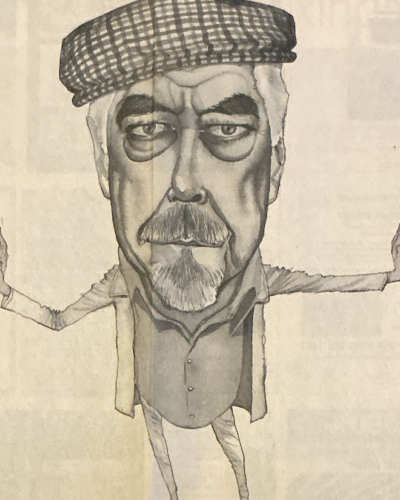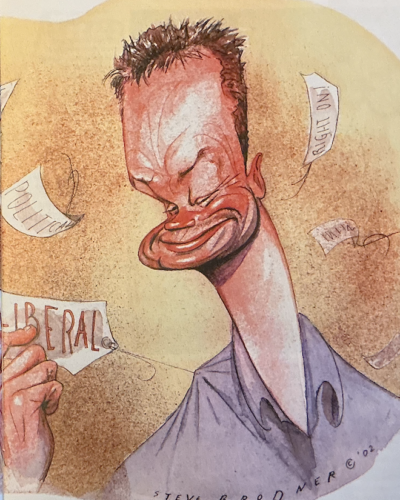
Tim Robbins seems a man of contrasts at first, but what appear to be conflicting sides of his personality actually complement each other in a character of the rarest type. He has the ability to engage in the most profound conversation while provoking a genuine and contaminating laughter. On screen, he has been naively stupid (in “Bull Durham” and “The Hudsucker Proxy”) as well as shrewdly slick (in “The Player” and “The Shawshank Redemption”). And, of course, his dimpled babyish face tops a nearly 6’5” body.
So no wonder the actor-writer-director-producer Robbins is crusading against labels and stereotypes, the most common of which in his case have been “political” and “liberal”. He says he doesn’t “buy the liberal thing”, but appreciates progressivism and libertarianism. He also notes that he has a hard time distinguishing between Democrats and Republicans.
“The great illusion in America is that we have a choice, because if we don’t have that illusion, we don’t have a democracy,” he says…
Joshua Bell never meant to help redefine the image of the classical musician, but he might have done just that. For this acclaimed young violinist, who has performed with the world’s leading orchestras, is also renowned for his film-star looks, addiction to online stock trading and his passion for computer games.
“I like to have something happening every minute,” he says. “I don’t allow for much downtime, doing nothing. But if you like stress, you can fit in a lot of things. I’m even thinking of taking up yoga.”
He doesn’t trade nearly as much as when the stock market was going up, having lost money like everybody else. “I got addicted to seeing stocks move, rather than trying to invest for 40 years from now.” His love of computer games has resulted in two desktops and two laptops in his lower Manhattan apartment, where he gathers friends for gaming sessions.
Robert Altman spent three decades after his first hit film, the 1970 war satire “M*A*S*H”, telling the US what was wrong with it. Whether it was the unlikely mixture of country music and politics in “Nashville”, the scathing view of Hollywood in “The Player” or the suburban epic “Short Cuts”, American audiences reluctantly recognised the merits of Altman’s films but rarely gave him wholehearted approval at the box office.
Europeans loved the maverick director’s take on just about all things American, partly because his shrewd observations reflected their own perceptions of the superpower’s arrogance and greed. In fact, Altman’s name today stands next to Bergman’s, Fellini’s and Truffaut’s much more naturally than beside Coppola’s, Scorsese’s or Spielberg’s…