One by one, airlines are waking up to the sobering reality of the modern Global Distribution System (GDS) model, which they created decades ago. Two carriers have now taken legal action, and this is only the beginning. If more airlines want to see changes and lower costs, they should join forces instead of watching from the sidelines.
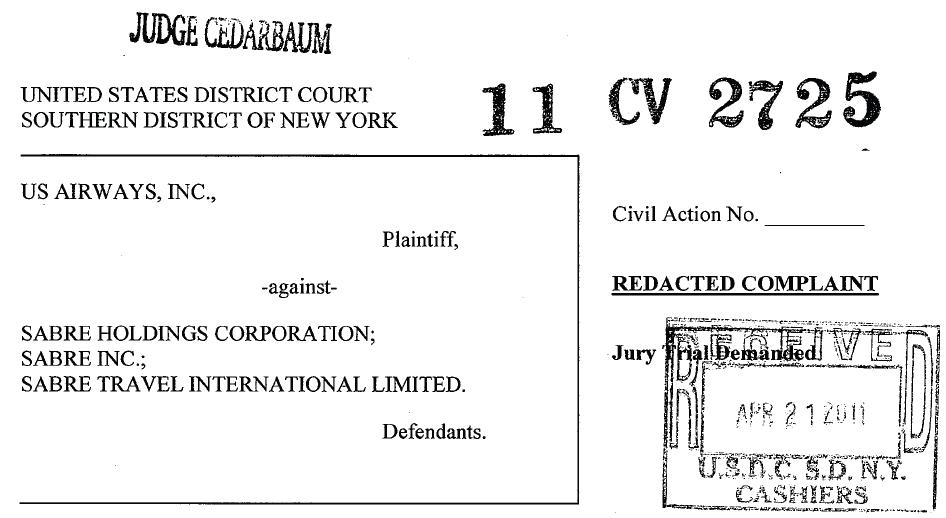
Judge Miriam Goldman Cedarbaum of the United States District Court for the Southern District of New York is about to become an expert on airline data distribution — in the 82nd year of her life. You can see her name stamped on a complaint (pictured above) filed last week by US Airways against Sabre, the largest GDS in the United States.
Sabre should take this lawsuit very seriously. Cedarbaum is not just any judge, and she is certainly not to be trifled with. One of the many high-profile cases she has overseen was against would-be Times Square bomber Faisal Shahzad, who was sentenced to life in prison without parole in October.
The most important reason for Sabre to prepare for a serious fight is the actual merit of the US Airways complaint, which the GDS predictably dismissed in a press release after the court filing. The airline accuses Sabre of monopoly, unfair practices and stifling competition by “locking travel agents” into using the GDS, so they “effectively become unable and unwilling to provide their customers with alternative, more efficient” booking channels.
“Rather than compete on the merits, Sabre has used its massive power over airlines such as US Airways to entrench its antiquated and inefficient technological systems, to preserve its supra-competitive booking fees, and to harm competition,” the carrier wrote in its complaint.
“Sabre’s technology has hardly changed from your grandfather’s distribution system, and was long ago left in the dust by new, innovative solutions that are web-based and take advantage of the networked economy,” it added. “These new offerings, however, have been stifled by the GDSs’ grasp over travel agencies and the exercise of their market power over airlines.”
The airline is referring to the technology I’ve written about before, known as a “Direct Connect” model, which allows carriers to host their data and make bookings independently of a GDS. Airlines prefer that model because it lets them control their data and offer non-airfare products, and it also saves them lots of money.
As I explained in February, about 60 percent of the roughly 1 billion tickets issued worldwide each year are sold through a GDS, according to Farelogix, a technology company mentioned in the US Airways filing. The average GDS fee paid by the airlines is about $12 per ticket, or more than $7 billion a year in distribution costs, Farelogix CEO Jim Davidson told me. In contrast, Farelogix’s “Direct Connect” allows carriers to spend only between $2 and $3 per ticket, saving about 80 percent of the current costs.
In its court filing, US Airways said that 35 percent of its revenue, “amounting to
over $3.5 billion annually, is booked through Sabre.” That’s exactly why no airline wants to be taken off a GDS — whether Sabre, Travelport or Amadeus. That’s also the reason why US Airways is only the second carrier — after American Airlines — to stand up to a GDS.
Having just written about a hybrid model that would make it possible for GDS portals to provide access to a carrier’s “Direct Connect” channel, I was surprised when US Airways signed a new agreement with Sabre several weeks ago. Instead of joining in America’s efforts to change the GDS model, US Airways is simply caving in, I thought.
Earlier this month, American reached an agreement with Expedia to implement a hybrid model, and then sued Travelport and Orbitz, claiming violation of antitrust laws. Online travel agencies like Expedia and Orbitz rely almost exclusively on GDS use, and some of them are owned by GDS companies.
Now US Airways has reconsidered and decided in favor of a fight. In its complaint, it says that Sabre forced it into their latest contract with “numerous oppressive and
anti-competitive terms.” The carrier “had no choice but to sign the agreement, which it did under protest, or face a complete shut off from Sabre’s network,” it said.
One of the most draconian clauses is that US Airways is banned from offering fares on its website unless it also makes them available to Sabre. In addition, Sabre penalizes travel agents who book tickets through any other channel.
As my record in this column shows, I’m a frequent critic of the airlines. But their complaints against the GDS companies are legitimate and need to be addressed. What the GDS management teams are doing is nothing short of business bullying. Worse yet, they pretend to be victims, trying to trick consumers into supporting them by falsely claiming that their model is the only way to ensure comparison-shopping.
Instead, they should be less greedy and let go of their unrealistic dreams of enormous and easy profits. Resisting inevitable change as a result of advanced technology is a recipe for extinction, not prosperity and longevity. The sooner the GDS companies realize that, the better for all parties in the air travel system, including consumers.
For their part, airlines should unite in their opposition to the current GDS model if they want to see results they like. They shouldn’t leave it to American and US Airways to fight their battle alone and then benefit from the outcome — and I’m sure the outcome will ultimately be more favorable for the airlines than the present state of data distribution.
Related stories:
American wins first battle in data war
GDS travel-booking model faces change
New seminar on travel-booking war
Airlines find new way to overcharge fliers
The risks of third-party airline bookings
Continue reading about Airlines, want better GDS model? Unite!
If you are a frequent flier, you know there is a war raging between American Airlines and third-party travel providers, such as online agencies and Global Distribution Systems (GDS). It appears things might get worse before they get better, leaving millions utterly confused. So I’ve created a new addition to the “On the Fly” curriculum to help you through the hard times.
The two-hour live seminar, FLY 203: The travel-booking war and the future of airline data distribution, will be first offered in Miami and Honolulu next week, and in Washington, San Juan and San Francisco next month, followed by other cities around the country. If you are not in any of those cities, you can join in from anywhere for an hour-long webinar version, FLY 115: Weathering the travel-booking storm, on Feb. 10.
I’m not advocating any particular position in the current dispute, and my only goal is to give you all relevant information, so you can make the best decisions when it comes to booking your travel.
The new seminar offers a detailed description and explanation of the current airline data distribution model and the fundamentals of today’s booking system. It also looks at the events of the last several weeks and provides a factual rundown of the arguments and positions of all sides involved in the dispute.
Most importantly, the session examines how the current conflict affects travel agencies, companies and individual travelers. It offers specific advice on what they can do to avoid being caught in the crossfire, and to make sure they don’t increase costs and sacrifice convenience and comfort.
Late last year, American banned Orbitz from booking seats on its flights. Earlier this month, Expedia stopped selling American tickets. Meanwhile, Delta removed its data from eight less popular sites. Sabre, the GDS American created more than four decades ago and current owner of Travelocity, announced its intention to drop American data later in the year. In response, American sued, and last week it won a court order temporarily blocking Sabre’s move.
Thus began the very public war — and possibly the start of a new trend in the distribution and sales of air travel products. Airlines incur significant costs by having their flights booked on a GDS, which also prevents them from selling additional products, such as preferred seating, priority boarding and doubling or tripling your frequent-flier miles for a fee. American wants both online and traditional travel agencies to use its DirectConnect channel to lower costs and increase revenue.
The significance of American’s move is much bigger than a dispute with a couple of third-party sites. It seeks to shake up the longtime airline data distribution system, including the GDS model. Travel agents haven’t received airline commissions for years, except for the largest agencies, though a part of the GDS fees airlines pay goes back to agents. American wants to reduce or scrap those fees.
In an indication of where things are going, American CEO Gerard Arpey said in 2009 that third parties should be paying the airlines for access to their data, “rather than us paying them to distribute our product.”
American has imposed “booking source premium” fees on some GDS users. Those fees will have to be either absorbed by travel agencies or passed on to passengers. Critics accuse American of trying to suppress transparency and deny consumers the opportunity to compare various airlines’ fares on the same screen, potentially forcing them to pay higher prices. But American points out that a change in the GDS model — establishing direct channels with airlines — would secure customers’ continued comparison-shopping ability.
So it’s messy out there, and the new seminar will try to make it less so in your mind by giving you specific tools that will help you follow the best booking process for you.
Related stories:
Time for travel school — you are invited
Announcing ‘On the Fly’ Seminars
Announcing Kralev International travel advisory business
Long before the current American Airlines campaign to shake up the data distribution system, airline agents often refused to change tickets issued by travel agencies and third-party websites, such as Expedia and Orbitz. Dealing with those companies’ agents can be frustrating, and many fliers call the airlines for help directly, only to be sent back to the “original booking source.” Why?
Because once the airline takes control of the ticket, it effectively releases the original booking source from its responsibilities as the issuing agent — and when the booking source loses control of the ticket, it will no longer keep track of your reservation.
So if there is a schedule change, that source won’t alert you, because it won’t know itself that a change has affected you. In other words, the link between the booking source and the airline will be broken, and the source won’t act as your agent. Instead, the airline will have to assume responsibility not only for notifying you of any changes, but also for rebooking you and reissuing your ticket.
Airlines don’t want that responsibility. The reasoning they offer customers usually is that the issuing agency may not have transmitted the passenger’s correct and full contact information, and they don’t want to be blamed in case you weren’t informed of any changes. That can be easily taken care of when the customer calls to voluntarily change a ticket, but there is a more serious reason, which airline agents almost never mention.
It comes down to money. Here is the airlines’ argument: They will be happy to keep track of your reservation, notify you of schedule changes (whether they actually do is another issue), rebook you and make any other changes, if the particular fare allows them. But if this is what you want, you should book your ticket directly with them. They pay web travel agencies to display their flights. If you booked your Delta ticket on Orbitz, why should Delta, which is paying Orbitz, have to bear the labor and other costs of changing your ticket?
Now, Delta will charge you the $150 or $250 change fee either way, depending on your fare rules, but that’s a different issue. This is about spending the time of a reservations agent — and possibly other airline employees. Delta prefers to use those employees’ time and effort to help direct Delta customers, not those booking through a middleman.
So don’t be surprised if an airline agent declines to deal with your reservation and sends you back to Travelocity or Priceline — or wherever you booked your ticket. That other agent may not be as well-trained as an airline employee and may have a limited capacity to help you, but you should think about that before you buy a ticket.
When might an airline agent agree to help you? Most likely, after travel has begun or if you are affected by severe weather and the airline has issued a change-fee waiver. Some agents may take mercy on you if you’ve been battling in vain with an online agency’s outsourced customer-service representatives in India or other overseas locations. It’s fashionable to pick on India, but did you know that Expedia has an English-speaking call center in Egypt?
As with any exceptions you want made for you, your chances of succeeding are much higher if you are an elite member of the airline’s loyalty program. Just ask politely — not as if you are entitled — and ensure the agent that you understand it’s your responsibility to check your reservation’s status from time for time and stay informed about any schedule or other changes.
Related stories:
The peculiarities of airline agent training
Flight schedule changes overwhelm agents, travelers
Travel companies teach customer-service lessons
U.S. airlines handle disruptions best
Continue reading about The risks of third-party airline bookings
I’ve always brushed off suggestions that airline websites are deliberately programmed to increase the fare if you don’t take their initial offer immediately. But I’ve become suspicious since Air Canada’s site recently jacked up a ticket price on me by hundreds of dollars in seconds, even as its lowest published fare and the flight inventory remained unchanged.
Airlines have gone to great lengths in recent years to encourage customers to book tickets on their websites, and that can certainly save travelers time and hassle in the event of any changes to a ticketed reservation. However, to their utter shame, many carriers haven’t built reliable and user-friendly sites.
In fact, some airlines, such as South Korea’s Asiana, have outsourced their entire online booking process — at least in the U.S. market — to a third-party travel agency, which charges its own booking fees. And some of us thought a carrier’s own website was the one place we could go to avoid fees.
Other airlines have made their sites so difficult to navigate that one needs a day off to figure out basic booking features and frequent-flier program rules. Not to mention that many, such as Qatar Airways, never display the most important element of a reservation: ticket numbers.
And then there are those carriers whose sites look all modern and dandy, only to go nuts on you once you begin using them. A case in point is Air Canada’s site, which went out of control last month when I tried to price out a trip from Washington to Tokyo via Toronto, as part of the research for my forthcoming book.
At first, I got a total of $1,014.82, booked in L class on all four segments. The site cancels the pricing page automatically after 10 minutes if you don’t make a purchase — I didn’t — and sends you back to the home page. I thought I’d simply rebuild the same itinerary.
To my astonishment, this time the site broke the fare into W and S classes, producing a total of $1,611.82. I checked the tariff and the inventory on ExpertFlyer.com, which I use to access raw real-time airline data, to make sure nothing had changed in the past 15 minutes, and it hadn’t. I also called Air Canada to verify that. There was no reason for the site’s odd behavior.
I started a new search with the same elements, and a new surprise followed just seconds later. Now the booking classes were M on the outbound and L on the return, for a total of $3,794.82. I tried again, and this time I got a through M fare on the outbound and broken S/W on the way back, for a total of $4,088.82.
I’ve been skeptical about suggestions that airline deliberately increase prices on unsuspecting customers because I know how airfares work. For a particular fare to change, one of two things has to happen: a change in the tariff or the inventory. If they both stay the same, there is no reason for the price to jump by hundreds or thousands of dollars within seconds. That was the case here.
So what was the Air Canada website doing? Did it remember my data and play tricks on me? I tried closing my browser and reopening it, but that didn’t help. I checked back a couple of days later, and the same shenanigans repeated. In another couple of days, I rebooted my computer, and I finally got the initial and proper fare — at $1,015.29, it was 47 cents higher because of currency fluctuations.
I decided to do the same experiment again and performed three additional searches, just a couple of minutes apart. Sure enough, the fare came back higher every time: $1,612.29, $3,795.29 and $4,089.29.
I called Air Canada and spoke with a very polite reservations supervisor named Monalisa. At first, she thought I was doing something wrong and confirmed the $1,015.29 fare on her system, and also verified the tariff and the inventory, which still showed nine seats in L class. Then she went to the website and did exactly what I’d done — she was as surprised as I was to see those outlandish prices. She promised to report the problem to the appropriate department.
It could be just a software glitch — after all, the fare difference should be more subtle than $600 if deliberate — but it certainly looks suspicious. If Air Canada doesn’t want to drive customers away and into the arms of third-party sites, such as Expedia and Travelocity — or worse, other airlines — it should offer a much stellar booking experience on its own site.
But that wasn’t Air Canada’s only problem. I noticed that the penalties for changes and cancellations displayed under the priced itineraries were unusual for heavily discounted international tickets. Moreover, they never changed even as the fare kept going up.
They said the tickets were refundable for C$200 — there is currently near-parity between the U.S. and Canadian dollars — and “cancellations can be made up to 45 minutes prior to departure.” Changes could be made “prior to day of departure” for $100 each way, “plus applicable taxes and any additional fare difference.” On the departure day, changes were permitted at the airport for C$100 “plus applicable taxes (no charge for fare difference) for same-day flights only.”
I didn’t trust what I saw, so I checked the actual fare rules on ExpertFlyer, which are published by none other than Air Canda. As I suspected, the L fare was nonrefundable, and the change fee was $250. I went back to the carrier’s website and discovered a hardly noticeable link at the bottom of the page to the proper fare rules, which matched the information on ExpertFlyer.
These were big discrepancies, and I suspected they were causing serious problems, so I mentioned them to Monalisa. Unlike the fare-rising problem, she was aware of this one. “I’ve made several complaints in the last several months [to the website people], but they apparently this isn’t a priority for them,” she told me.
She also explained that the rules shown on the Air Canada site are typical for domestic Canadian tickets, and they use the same template for the much more diverse international rules, instead of creating new content. If a customer who has booked a nonrefundable ticket on the website wants to cancel it, Monalisa said they will honor the incorrect rules displayed on the site.
So until they bother to fix the problem — perhaps that would be more expensive than refunding tickets — travelers will keep taking advantage of the mistake. If you are one of them, make sure to print out those made-up rules.
Similar examples can be found on many other websites. Delta Airlines, for instance, has put the following text on a page titled “Ticket Changes”: “For travel outside the United States, the change fee is typically $250, but can vary based on location and type of fare. Changes are usually permitted only to the return portion of an international itinerary.”
No issue with the first sentence, assuming travel originates in the United States. As for the second, I can’t even imagine who and why came up with such a misguided blanket statement. All you need to do is read the actual rules of any international Delta fare to realize that, if any changes can be made, they are in fact allowed on both the outbound and return portions.
Related stories:
Airlines find new way to overcharge fliers
US Airways hears feedback, fixes website
Openness rattles airline industry
Is India going too far in curbing airfares?
Continue reading about When airfares jump on you for no reason
Have you ever taken advantage of a suspiciously low airfare — say $300 to Europe in business class — that turned out to be a mistake? Did the airline cancel your ticket or did you fight to keep it? If you gave in, it might have been premature.
Like any human activity, filing fares is prone to errors once in a while — a few times a year at most, which is too much for the airlines, but not enough if you ask bargain-hunting travelers.
In the most recent reported example, on Dec. 27, a traveler looking for a ticket stumbled upon a Swiss International Airlines business class fare of $0 plus tax from Toronto to several European cities. It was available on various booking engines, including Swiss’ Web site and Travelocity. The lowest such fare is usually about $3,000 plus tax…