Democracy
BURGAS, Bulgaria — The evening news bulletin on Bulgarian National Radio began with a familiar item: Another meeting of the Politburo of the Communist Party’s Central Committee. Then the announcer uttered a sentence that left Bulgarians stunned: The country’s dictator of more than 35 years, Todor Zhivkov, had just been “relieved of his duties.”
It was Nov. 10, 1989. I was only 15, but understood that what had happened was not just a simple personnel change in the Soviet Union’s most trusted satellite. Within minutes — though a day late — I learned of the fall of the Berlin Wall.
Last month, as I sat in the same room in my parents’ apartment where I heard the news, I realized that those events had changed my life more fundamentally than anything else I have experienced before or since. Had communism not collapsed, I would never have been allowed to go to the United States…
Continue reading about Momentous change brings new challenges to Bulgaria
George Herbert Walker III, a Missouri businessman who headed a financial-services company for 14 years, wanted to serve his country overseas. So in early 2002, he turned for advice to his first cousin, George H.W. Bush, the current president’s father.
“He thought it would be a good idea,” Mr. Walker recalled recently. “He didn’t want to tell his son what to do, but told me to write the president a letter. I didn’t name a country, but there are many countries we have a fragile relationship with.”
Today, Mr. Walker, who is in his early 70s, is the ambassador to Hungary — a NATO ally and supporter of Bush administration policies with several hundred troops in Iraq. Like many political appointees, he was immediately struck upon taking up his posting in October with the stark contrast between modern diplomacy and the lingering image of the Foreign Service as a collection of stuffy white males in striped pants…
Continue reading about Diplomats fight stuffed-white-shirt image
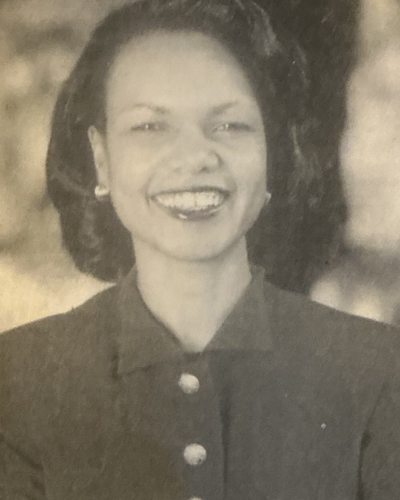
Condoleezza Rice has rarely heard a question she doesn’t know how to answer, from queries about her tumultuous childhood in segregated Alabama to her success in the male world of superpower politics, nuclear weapons and arms control.
She meets me with the friendly smile and easy hospitality of a west-coaster, defying the image of someone anointed by Washington insiders to become the most powerful woman in the world in a year. The chief foreign policy adviser to Republican presidential candidate George W. Bush, Rice is being tipped as a likely secretary of state or national security adviser should Bush win the White House.
As huge a task as this sounds, Rice’s own life story has the word “amazing” written all over it. At 45, she has been the first black woman in just about any job she’s taken on: from special assistant for national security affairs to President George Bush when she was only 34, to provost of California’s prestigious Stanford University (the Harvard of the west coast) where she managed a budget of nearly $2bn…
Continue reading about Political punch in a package of charm
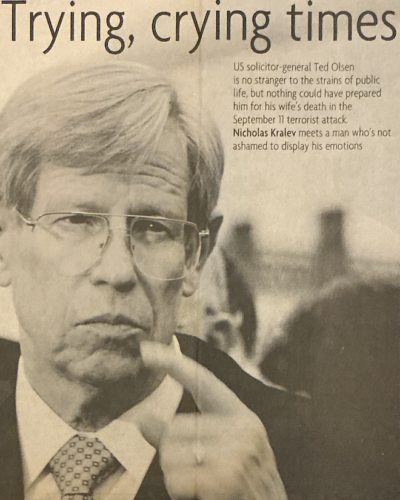
Ted Olson’s eyes fill with tears when he talks about his late wife, Barbara, but he doesn’t mind the emotion, even in public. More than eight months after she died in the September 11 terrorist attack on the Pentagon, he still can’t get used to waking up alone in bed and not speaking with her on the telephone several times a day.
“This was a love affair that lasted as long as we knew each other,” he says, staring into the distance. “That relationship was the most wonderful thing that ever happened to me, and when I think about her, I can hardly think about anything else.”
Olson has had a lot to think about — he is the US solicitor-general, or the government’s top courtroom lawyer — but trying times such as these are certainly no novelty for him. During the disputed 2000 presidential election, he argued George W. Bush’s case before the Supreme Court. In the early 1980s, he defended President Ronald Reagan in the infamous Iran-Contra scandal…