London

nkralev on December 7th, 2011

While most U.S. airlines have learned to be relatively honest with their best customers, many of their foreign peers have not yet realized that travelers are not as stupid as to fall for their PR spin and questionable practices.

It’s time for those carriers to wake up to the fact that it’s the end of 2011, and much in the airline industry is rather transparent to those of us who pay attention. Trying to persuade customers that bad news is actually good may be an essential PR trick, but in today’s hyper-connected world, it’s not hard to figure out someone’s true intentions.

Among the airlines still using the old playbook is British Airways, which is surprising for such a major and quite good global carrier. Last month, it drastically devalued its award redemption chart, but it tried to present that negative change as a positive one.

The clue came with the usage of the world “revitalizing” to describe the changes to the carrier’s frequent-flier program, Executive Club. At least they steered clear of “enhancement,” which is what many U.S. carriers used in the past, inviting much derision from frequent fliers.

British Airways announced a few weeks before the changes took effect that they were coming, but what those changes actually were going to be remained a secret until the very day they were implemented. That move showed gross disrespect for the company’s best customers who deserved much better for their loyalty.

In contrast, many U.S. airlines and hotel companies publish their new charts, as well as other program changes, months in advance. One recent exception was Delta Airlines, which didn’t really have an official global chart for more than a year, until it finally published one in February, effective immediately — actually, much of it was already in use unofficially.

Apparently, British Airways was afraid that many Executive Club members would rush to burn their miles before the last change — after all, there were plenty of miles on its books, partly thanks to its giving away 100,000 miles as a credit-card sign-up bonus. So it said that the number of award miles required for “97 percent of our routes” will stay the same or even go down.

In fact, that turned out to be false. In an attempt to save face when the new chart came out, the airline said it had meant 97 percent of the nonstop routes out of London.

While some of those nonstop routes have indeed become cheaper, there are many Executive Club members outside London who earned their miles hoping to use them for trips to cities other than London. Unfortunately, they are the big losers — the increases in those cases can be over 80 percent. Substantial premiums have been added to connecting and partner flights across the board.

Those changes, along with the huge amounts British Airways charges in taxes and fees on award tickets, have drastically devalued its miles. Just this week, I booked award tickets to Asia for two clients, and I really wanted to help them burn their British Airways miles. However, that particular award had almost doubled in price, and the taxes were over $1,200 per person. So I booked with another airline for nearly half the miles and $85 in taxes.

British Airways in certainly not alone in thinking that customers are stupid. Air Canada quietly started charging fuel surcharges on some partner award tickets earlier this fall. Did it hope no one would notice that they were asked to pay hundreds of dollars more than before? Finally, after Air Canada was exposed on various blogs, it admitted what it was doing and said that even more partner flights would be included in the new program.

And then there is the scandalous behavior of the United Arab Emirates’ Etihad Airways last month.

For two days in October, it advertised a First Class fare from Spain to Australia on its website for less than 400 euro. According to Spanish media reports, about 300 people bought tickets. The first of them traveled 10 days later, when an agent in Brussels noticed the fare and alerted the appropriate department. It was then determined that the fare was a mistake, and the passenger was downgraded to coach without any compensation. The rest of the tickets were canceled.

I’ve written about mistake fares before, but the issue here is not whether Etihad was wrong not to honor the tickets. I said scandalous because of a letter the airline sent to the passengers who decided to put up a fight and wanted to defend their rights through the media.

Etihad hired a law firm in Spain that in no uncertain terms threatened those customers in writing with litigation, if they dared to go to the media. The last time I checked, Spain was a democracy with freedom of speech, and the United Arab Emirates was something quite different. I don’t believe anything has changed since.

RETURN TO MAIN COLUMN PAGE

Related stories:

Airlines neglect non-flying experience

How much slack do the airlines deserve?

U.S. warns airlines on fare mistakes

Singapore Air’s inept agents, dark side

Continue reading about Airlines still think customers are stupid

nkralev on May 18th, 2011

There must be very few things more embarrassing to an airline than losing the luggage of a passenger who paid more than $12,000 for a First Class ticket. Even more shockingly, British Airways, which did just that last week, didn’t try to right the screamingly obvious wrong and offer some sort of a good-will gesture.

Many of us often wonder who would pay $10,000 or $15,000 for a plane ticket, but let me assure you, there are such people. Premium travel has staged a remarkable recovery in recent months. As I look at flight inventory, I’m amazed every day by how full Business and First Class cabins are on various carriers.

The case in point was actually very close to home, as the passenger was a colleague whom I’d helped book his ticket. Another curious detail was that, after the ticket was issued, he needed to move his return flight a day earlier, and British Airways imposed a $750 penalty for the change — yes, on a $12,000 ticket.

He had one connection — in London, of course — on his way to another European city. Not too complicated, one might think. However, when he arrived at his final destination, his luggage was missing. It was eventually discovered in London, but although British Airways had several more flights to the city where he was that day, the luggage wasn’t delivered at his hotel until 1 a.m. the following day — 12 hours after his arrival.

Not too bad, you might say. Many passengers wait days for their bags, and some never see them again.

I may have agreed with such an attitude had the airline not collected $12,000 from the passenger for this trip. How could any self-respecting carrier not take all necessary measures to ensure that such customers’ luggage arrives on time at the right place? In the grand scheme of things, this wasn’t a huge problem, but it speaks ill of the airline — and it certainly ruins the First Class experience.

What makes things much worse is that, a week after the incident, British Airways, which is a member of the Oneworld alliance, has offered no compensation, good-will gesture or whatever one might call it. Moreover, when the customer asked for a token of appreciation in the Concorde Room, the carrier’s First Class lounge at Heathrow Airport, on his return journey, his request was rejected.

Instead, he was advised to contact Customer Relations. While that may be considered a standard procedure in the airline industry, the airport agent could have been much more helpful and not passed the responsibility to someone else.

After all, the people who pay $12,000 for a plane ticket are not that many. Any airline should try really hard to keep them as customers.

RETURN TO MAIN COLUMN PAGE

Related stories:

New Lufthansa business class in a year

British leader flies to DC commercially

Avoiding luggage and other airline fees

Airlines cut back on first-class service


Continue reading about British Air loses bags on $12,000 ticket

I’ve always been puzzled by the grand “international” designation of numerous small airports throughout the United States, just because they boast the odd flight to and from Canada.

While Canada is, indeed, a foreign country, this week’s incident with a Virgin Atlantic plane at Bradley Airport in Hartford, Conn., provides sufficient justification for my bewilderment.

The image on the left is the official logo of the airport at issue, with the word “international” displayed very prominently. Yet, when the Virgin flight from London to Newark, N.J., was diverted to Hartford because of bad weather further south, about 300 passengers were forcibly confined to the aircraft for four hours without water or food. Some of them got sick and fainted, and chaos reined on board, according to press accounts.

Why? Because there was no one from the Department of Homeland Security’s Customs and Border Protection (CBP) division — immigration and customs officers, in plainer English — to process the travelers.

It’s unclear why it was decided that the plane should land at Bradley, instead of Boston, for example, which has a fully operational CBP facility. I wouldn’t be surprised if whoever made the decision didn’t even think about the lack of immigration and customs in Hartford.

Or perhaps they assumed that having “international” in the airport’s official name actually meant that it could handle international arrivals. Alas, flights from Canada don’t require such processing, because all CBP procedures are done at the respective Canadian airport, and those flights are treated as domestic arrivals once they land in the United States.

So it’s time the U.S. government rethought its “international airport” designation policies and made sure those designations match an airport’s true capabilities.

Continue reading about U.S. should change ‘international airport’ designation policy

nkralev on June 17th, 2010

How many busloads of passengers does it take to fill a Boeing 747? Ask the Frankfurt Airport.

With all the innovations and conveniences brought to modern airports, it’s inexplicable to me why airports in some of the most developed countries on the planet remind one of the Third World. Many travelers often complain about London’s Heathrow, but I find Frankfurt no less frustrating.

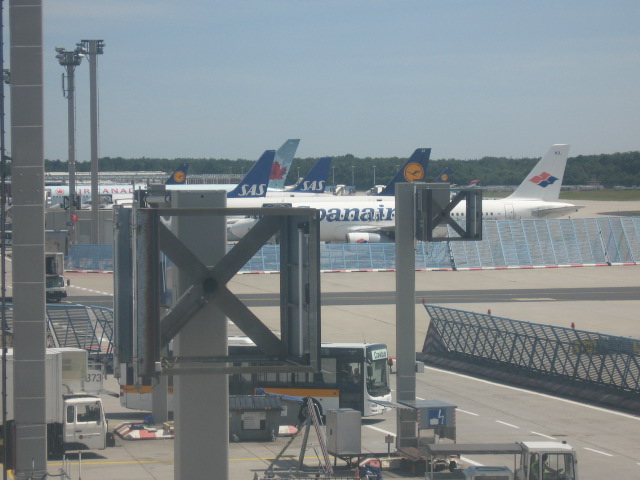
I realize there are not enough gates with jet bridges, and some airlines prefer “remote” gates because their use is cheaper, but I can’t remember flying through Frankfurt and not being taken to or from a plane by bus at least once. As of this week, I’ve had 111 takeoffs and landings at that airport.

As much as I hate the buses, by now I’m used to the prospect of having to put up with them, especially for flights to certain destinations. Most of the time, such flights are flown on narrow-body aircraft, such as Boeing 737 and Airbus 320, which can be filled with just two busloads.

This week, however, I experienced boarding a United Airlines Boeing 747 by bus. I was sure the flight wouldn’t leave on time, and I was right. I can hardly wait for the expansion of Terminal 1 to be completed.

What’s even harder for me to understand is why there aren’t enough gates with jetways at the much newer Munich Airport. I was also disappointed by the transfer experience there this week. With 52 takeoffs and landings, this was the first time I had to change terminals. I arrived at Terminal 1 — courtesy of another bus — and it took me about 45 minutes to reach Terminal 2. The signage was very poor, and the shuttle bus between the terminals runs only once every 20 minutes.

U.S. airports may have their problems, but when was the last time you were taken to the plane by bus?

Continue reading about Tired of ‘remote’ gates in Frankfurt

nkralev on March 18th, 2010

Having covered American diplomacy for a decade now, I’ve received many “diplomatic” answers to my questions — but none more so than “Yes, but not really.” I was reminded of it by the recently negotiated Open Skies aviation agreement between the United States and Japan.

The idea of the Open Skies accords, which Washington has with more than 90 countries, was to liberalize air travel between the signatories, allowing flights from any city in the first country to any city in the second without the previously imposed government restrictions.

However, the deal reached with Japan in December has one glaring exception — U.S. carriers can have only four pairs of takeoff and landing slots at Tokyo’s Haneda Airport, and only between 10 p.m. and 7 a.m. Even though the document hasn’t been signed yet, there are no plans to change the Haneda limits…

Continue reading about When ‘open skies’ aren’t really open