Airlines are consistently among the most criticized companies by both the public and the media. While much of the criticism is deserved, does some of it amount to nothing more than badmouthing that helps no one? Isn’t it time for fliers to learn the air travel system’s ins and outs, and not blame the airlines for all their ills on the road?
In this column, I’ve denounced certain airline practices, such as the fictitious “direct” flights that are simply two flights with the same number but nothing else in common. There is no question the industry has made the system very complex, mostly for financial reasons, and it’s profiting from customers’ lack of knowledge.
However, the system is what it is, and there isn’t much we can do to change it to our liking. What we can do is invest some time and effort in learning its intricacies, rules and restrictions, so we don’t feel like we got screwed next time we fly and make sure we don’t miss a wedding or a funeral, or let an airline ruin our vacation.
I talked about this on Peter Greenberg’s syndicated radio show last weekend, though I probably did too much complaining before I got to the point. Greenberg used to be the travel editor for NBC’s “Today” show but moved to CBS last year.
There are certainly times when criticism — or constructive customer feedback — does make a difference. Take just one issue with United Airlines. Last year, it announced it would do away with advance domestic upgrade certificates for top elites, but after an outcry it reversed its decision. Earlier this month, the carrier said it would reduce the number of certificates elite fliers get annually — another outcry followed, and the implementation of the new policy was delayed by a year.
Contrast that to the experience of Michelle Renee, about which I wrote last year. She decided to skip a flight on her ticketed itinerary from Los Angeles to Australia on United, but she didn’t tell the airline and was shocked to find out at the Sydney airport that the change would incur a fee. She wrote a blistering blog post against United on the Huffington Post. Had she known that if you miss a ticketed flight voluntarily, the rest of your itinerary is automatically voided, she would have thanked the agent who salvaged her ticket.
Is it the airlines’ job to educate passengers about the rules they impose or are travelers responsible for learning those rules on their own? Do most of us buy plane tickets blindly, without reading and understanding the conditions and restrictions that come with them?
In a more recent Huffington Post blog, another United critic, Tamar Abrams, wrote about being mistreated by an employee after her flight from Singapore to Tokyo was canceled. The agent’s behavior aside, I suggested to Abrams that she didn’t have to put herself in that agent’s hands. In fact, she could have known about the cancellation about 12 hours earlier, before she had gone to bed, because her plane didn’t make it to Singapore from Tokyo the previous night. She could have called United then and got rebooked, even before getting to the airport.
Was it Abrams’ responsibility to track her plane and predict the cancellation? No, but it would have helped her a lot and saved her hassle and an unpleasant experience. United usually contacts passengers regarding flight disruptions, though Abrams said she didn’t get notified in advance.
The ease with which anyone can book a plane ticket online gives the wrong impression that modern air travel is a piece of cake. Yet, most fliers don’t know the meaning of a code-share flight or the difference between a nonstop and a direct flight.
Next time, before you spend $1,000 on a ticket, it might be a good idea to learn exactly what you are buying and what it entitles you to. After all, travel should be an exciting experience, not a nuisance we dread.
Related stories:
Time for travel school — you are invited
Predicting flight delays and cancellations
Travel companies teach customer-service lessons
Continue reading about Does badmouthing airlines help anyone?
Singapore Airlines topped yet another industry ranking this week, and while it usually deserves the awards it wins, there are a few aspects of the way it does business that drive some customers and partner-carriers crazy. Still, don’t expect those practices to change anytime soon.
The latest awards were bestowed by Britain’s Business Traveller Magazine. Singapore was named best airline overall and also won best economy and business class. Best first class went to Emirates, probably because of the shower on its Airbus 380 aircraft.
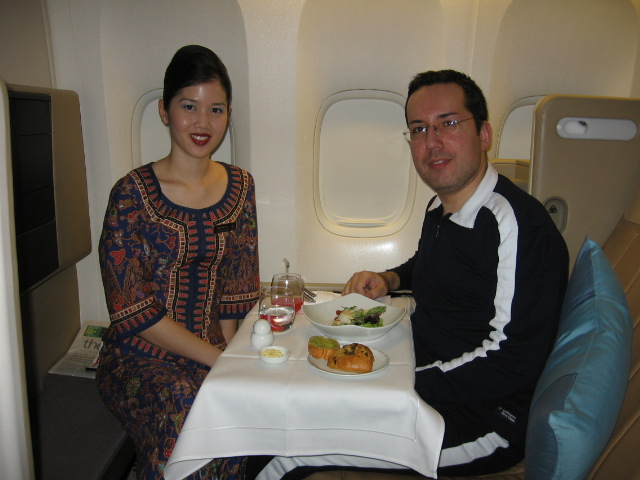
I have yet to meet anyone who has flown Singapore and didn’t like it, regardless of which cabin they were in. It has long been the world’s leading carrier in hard-product innovation and luxury, often years ahead of its competitors. One of my favorite features is the “Book the Cook” service, which allows passengers to order meals from a long and diverse menu as soon as they buy a ticket.
Many travelers point out the incredible attention to detail that Singapore flight attendants pay, but that is not uncommon among top Asian airlines, such as Asiana and All Nippon Airways. What has impressed me the most is that, in first class, the flight attendants anticipate your next need or wish and are ready to satisfy it before you even ask.
Once during a flight, I stood up from my seat to go to the lavatory, which was behind me, and when I turned around, I saw a flight attendant dashing toward the lavatory to open the door for me. I had just enjoyed black caviar as part of a five-course dinner I probably couldn’t afford on the ground, and I loved the bedding of the fully flat seat, but for some reason that gesture meant more than the luxuries.
The trouble with perfection is that it’s impossible 100 percent of the time, and most of Singapore’s policies are written for a perfect world, which is also impossible in the airline industry. Employees of every airline must follow certain rules, but Singapore’s staff has almost no flexibility in making exceptions or bending the rules to respond to a specific case or situation.
A couple of years ago, I flew from New to Singapore, with an hour-long layover in Frankfurt. Even though there was no plane change, all passengers had to get off and re-board. As soon as I reached the gate area, I realized I’d forgotten my cell phone in my seat pocket. I wasn’t allowed back because the cleaning crew had begun working, but a gate agent went to look for the phone. She came back and said it wasn’t there.
I was the last first-class passenger to deplane, and coach and business class passengers weren’t allowed in the first-class cabin, so most likely the phone was stolen by a cleaning crew members. But after a lengthy process that involved more paperwork than I’d expected, the airline refused to offer any good-will gesture or compensation.
There is no question that Singapore has some of the best premium products in the sky, but it may be overvaluing them a bit too much.
Let’s say you’ve paid more than $10,000 for a Star Alliance round-the-world ticket in business class. If you want to fly between Singapore and Los Angeles nonstop, you have to pay an additional $900 surcharge just for that one flight for the privilege of enjoying the “new” business class seats, which are now almost four years old. Charges of $500 and $600 apply to most flight between Singapore and both Europe and North America.
In addition, Singapore often blocks access to those flights by zeroing out the inventory in D booking class, which is the one required for round-the-world tickets.
It’s no secret that Singapore thinks the current round-the-world fares are too low. There are suspicions that it’s one of the driving forces behind the drastic increases in those prices in recent years, although there is no way to know this for a fact, because the Star Alliance uses a blind process based on input from its members to determine the fares.
Even more maddeningly for customers, Singapore bans members of the frequent-flier programs of its partners in the Star Alliance, such as Lufthansa, Air Canada or United Airlines, from using miles on flights with the “new” business-class seats. While the seats are the most spacious in the industry, the ban makes redeeming miles to Europe and North America virtually impossible — there are only two flights with the old seats.
Relations between Singapore and some of its Star partners — especially United — have long been sour, mainly because Singapore thinks it’s superior and doesn’t hide it. I’ve always been amazed that Singapore doesn’t code-share any of United’s flights, but it does code-sharing with US Airways.
There have been rumors that Singapore wants to leave the alliance, but so far they are just rumors.
Related stories:
Round-the-world fare mysteries revealed
What to do with empty premium seats?
Airlines require credit cards at check-in
Airlines want budget, premium fliers
Continue reading about Singapore Airlines’ maddening perfection
If anyone had any doubts that putting together the European Union’s new diplomatic service would be an utterly messy task, that is now an undisputed fact. A high-profile ambassadorial list released this week provoked publicly aired quarrels rather uncharacteristic of diplomats, and it raised questions about the future effectiveness of the EU corps.
The long-anticipated list, unveiled by EU foreign policy chief Catherine Ashton in Brussels, was apparently based not on merit, but on what Polish Foreign Minister Radoslaw Sikorski called “esoteric considerations.”
What are those? A quick look at the list shows that the most important ambassadorships are going to diplomats from the oldest EU members in the West — China was given to the Germans, Japan to the Austrians and South Africa to the Dutch. What about less important but plush posts? Of those, the Spanish got Argentina and Singapore went to Luxembourg.
So the considerations Sikorski referred to had more to do with where the diplomats come from, rather than what they can accomplish in their respective positions. “Appointments should be made on merit,” he said. “We in the new member-countries have people who speak the languages of the former Soviet Union, we have expertise there.”
Four posts out of 29 went to diplomats from Central and Eastern Europe. Despite Sikorski’s protest, Poland did better than any other former communist country, winning South Korea and Jordan. The Bulgarians got Georgia, and Afghanistan had gone to the Lithuanians earlier.
“I have appointed the best people for the right jobs,” said Ashton, whose official title is EU high representative for foreign affairs and security policy, as well as vice president of the European Commission, the EU’s executive body. She was also criticized for choosing only eight women.
“We have made a start to address the important issues of geographical and gender balance,” Ashton said in an apparent admission that those problems are not yet resolved.
The nominees, who have to be approved by the European Parliament, may be the “best people” for the jobs from their country, but it’s questionable whether they are the best from any EU state. It’s not clear, either, that the top criteria during the selection process were actually skills, qualifications and experience.
“We are deeply disappointed,” said Slovenian Foreign Minister Samuel Zbogar. “We expected more transparent decisions and that geographic balance would be taken into account, in particular for those states, like Slovenia, which have no presence at all in the EU’s foreign institutions.”
Creating the European External Action Service — the diplomatic corps’ official name — is a daunting task, and Ashton has an impossible job. She won’t be able to please everyone even if she really wants to. But more consultation with Eastern European members would go a long way.
If there is hostility among diplomats from different countries even before the foreign service’s launch, which is expected in December, it will likely affect trust and their ability to work together at the dozens of missions they are setting up around the world.
Here is the full list released by Ashton’s office on Wednesday:
China — Markus Ederer (Germany)
Japan — Hans Dietmar Schweisgut (Austria)
South Africa — Roeland van de Geer (Netherlands)
Afghanistan — Vygaudas Usackas (Lithuania)
Albania — Ettore Sequi (Italy)
Argentina — Alfonso Diez Torres (Spain)
Macedonia — Peter Sorensen (Denmark)
Bangladesh — William Hanna (Ireland)
Jordan — Joanna Wronecka (Poland)
Uganda — Roberto Ridolfi (Italy)
Senegal — Dominique Dellicour (Belgium)
Angola — Javier Puyol Pinuela (Spain)
Botswana — Gerard McGovern (Ireland)
Burundi — Stephane de Loecker (Belgium)
South Korea — Tomasz Kozlowski (Poland)
Gabon — Cristina Martins Barreira (Portugal)
Georgia — Philip Dimitrov (Bulgaria)
Guinea-Bissau — Joaquin Gonzalez-Ducay (Spain)
Haiti — Lut Fabert-Goossens (Luxembourg)
Lebanon — Angelina Eichhorst (Netherlands)
Mozambique — Paul Malin (Ireland)
Namibia — Raúl Fuentes Milani (Spain)
Pakistan — Lars-Gunnar Wigemark (Sweden)
Philippines — Guy Ledoux (France)
Singapore — Marc Ungeheuer (Luxembourg)
Chad — Helene Cave (France)
Zambia — Gilles Hervio (France)
China (Deputy) — Carmen Cano de Lasala (Spain)
Papua New Guinea — Martin Dihm (Germany)
Related stories:
Political ambassadorships hold at 30%
U.S., EU face off over travel, again
Career diplomats protest Obama appointments
Continue reading about EU diplo corps gets messy before launch
It’s puzzling why in the United States, one of the most lucrative travel markets in the world, the concept of airport transit hotels is so foreign. There are signs that may be changing, but current plans seem more like baby steps than bold decision-making.
A recent trip to Asia reminded me of the lack of entrepreneurial thinking exhibited by many U.S. airport operators. Readers of this column may remember my praise for terminals in Hong Kong and Singapore earlier this year.
Beyond design, comfort and cleanliness, having such a time- and hassle-saving convenience as a hotel under the same roof as your departure gate makes a lot of sense at a large international airport. It’s not hard to imagine that it could be a moneymaking venture…