Barack Obama
I began the week reminiscing about my travels with four secretaries of state, so I thought I’d end it by answering another question I’m frequently asked: What happened to the three secretaries I covered before Hillary Clinton? Starting with the most recent, they are Condoleezza Rice, Colin Powell and Madeleine Albright.
I’ve also been asked often about the differences between those former chief U.S. diplomats, especially during travel. I usually point out an obvious similarity among them first: None of them is a white male. In fact, the last secretary to fit that description was Warren Christopher, who left office in January 1997, when Albright ended the centuries-old tradition.
So here is a brief summary of my impressions and experiences with three people who had very different backgrounds but rose to the highest levels of the U.S. government and became household names around the world.
Condoleezza Rice
After handing the job over to Clinton in January 2009, Rice returned to Stanford University in Palo Alto, Calif., where she has spent most of her career, and where I first met her in January 2000. We did an interview for the Financial Times over a long breakfast at the famed Ricky’s Hyatt hotel, after which we drove — in our separate cars — to her office at the Hoover Institution.
I was a student at Harvard at the time and was first introduced to Rice indirectly through a book she co-authored with Philip Zelikow, “Germany Unified and Europe Transformed.” I thought she had a great story, and my editor in London agreed, so I sent Rice an e-mail message requesting an interview and she agreed to do it. I flew to San Francisco a day after my last final exam for the semester.
Condi, as she introduced herself, was utterly charming and exhibited great confidence while responding to my questions about various foreign-policy issues.
The next day, I was in New York to interview Barbara Walters, and I told her about the fascinating woman I’d just met, who might be national security adviser or secretary of state some day. Barbara’s reaction was, “She is not big enough for me yet.” In 2005, Barbara included Rice in her “10 Most Fascinating People” ABC special, but Rice declined to be interviewed. I take absolutely no credit for that decision.
In her first year as secretary, Rice was far from the confident woman I’d met five years earlier. On the plane, she appeared closed off and a bit insecure, which had a lot to do with getting used to the sudden and overwhelming public attention focused on a very private person.
That, of course, changed, and eventually she became one of the most influential secretaries of state in history, mainly because of her closeness to President George W. Bush. She recently published a book about her parents, which she has been promoting in the media, including on the “Daily Show” with Jon Stewart. A book about her experience in the Bush administration is planned to next year.
Colin Powell
I didn’t meet Powell until he was already secretary of state. I always had deep respect for him, but what impressed me on trips with him more than anything was his rare ability to hold meaningful conversations with various kinds of people — from a handyman or a cleaner to presidents and kings.
While Rice couldn’t wait to get back to her private cabin after a briefing on the plane, Powell spent a lot of time with us, often joking — and teasing me for being the youngest in the press corps. Looking back, perhaps that was an escape from the fierce battles he was fighting with Vice President Dick Cheney and Defense Secretary Donald Rumsfeld, who would often use his absence from Washington to outmaneuver him.
In 2004, I did an interview with Powell for an eight-part series on the Foreign Service, and he expressed anger with detractors who accused him of undermining Bush’s agenda — in fact, he called those accusations “bullshit,” but we couldn’t print that, even though he’d said it was “quotable.”
Still, I built the whole story around that theme, and he wasn’t happy about it. He told me so himself on a flight from Islamabad to Kabul, and that moment was captured on the above photo.
I’ve seen Powell several times since he left office, though not since last year’s White House Correspondents Dinner at the Washington Hilton. I’ve also been to his office in Alexandria, Va., from where his trusted assistant Peggy Cifrino runs most of his post-government life. He is on several boards and often gives speeches around the country and abroad.
From time to time, he resurfaces in the media — usually, on Sunday morning TV shows, as he did to endorse Barack Obama for president in 2008, or on CNN’s “Larry King Live,” where he appeared this week.
He stays very informed about current events and reads most foreign-policy stories in the press. Sometimes, he sends the reporters he knows comments about their articles, mostly to correct what he perceives as inaccuracies.
In 2008, I was surprised to receive an e-mail message while I was in Singapore with Rice, covering the annual meeting of foreign ministers from the Association of Southeast Asian Nations (ASEAN). In one of my stories, I’d mentioned in a brief sentence at the end of a paragraph that Powell met with the North Korean foreign minister in Jakarta in 2004. My editor had changed “met” to “had coffee,” and Powell thought that inaccurately diminished the meeting’s importance.
Madeleine Albright
I have a soft spot for Albright, not only because she was the first secretary of state I knew personally, but also because she has been very helpful to me — and she is a lot of fun.
I first met her in an ornate suite at New York’s Waldorf-Astoria hotel in 2000, while working on a profile of her for the Financial Times. Then I went on a trip with her to Europe and the Middle East — the first time I traveled on the secretary’s plane. We were flying when word came that Slobodan Milosevic had been driven out of power in Belgrade. I was surprised when she winked at me during a press conference in Egypt, but later I learned that she had winked at other reporters before.
When I got a job offer from the Washington Times in 2001, I was concerned about the newspaper’s affiliation with the Unification Church, so I asked Albright for advice. She pointed out that the Times had a stellar foreign coverage, and she didn’t see anything wrong in working there.
Over the years, she’d send me her newly published books with lovely inscriptions, writing “You are a star” in one and calling me “one of the outstanding journalists of our time” in another. In 2002, we had breakfast in her native Prague during a NATO summit.
At 73 — the same age as Powell — Albright is astonishingly active and extremely busy. She owns and runs two companies, travels around the world all the time and is involved in many projects. She recently chaired an expert group tasked with drafting a new NATO strategic concept. She is also chairman of the National Democratic Institute.
In October 2008, a couple of weeks before the last presidential election, I invited Albright to meet with the Washington Times editorial board. We left together from her office and she drove to the Times’ building in Northeast D.C.
During the ride, she said she was tired of people asking her who would be Obama’s secretary of state, because she wasn’t close to him and had no inside information. I suggested it would be fun for the press corps if Hillary Clinton got the job. Albright, who has been a good friend of Clinton’s since the mid-1990s, said: “It’s not gonna happen.” Of course, Clinton herself was shocked when Obama offered her the position weeks later.
We had a wide-ranging discussion about various foreign-policy issues during the meeting, and one of the things Albright said was that she opposed a deadline for withdrawing U.S. troops from Iraq. The Clinton administration’s experience in the Balkans had taught her that the president shouldn’t commit to a specific date not to tie his hands.
The Times’ executive editor at the time, John Solomon, thought our headline should be that Albright disagreed with Obama, who had proposed a deadline. I tried to write a story based on the facts without a “gotcha” element, but Solomon thought my lede wasn’t strong enough and wrote it himself.
Albright, who flew to Nevada to campaign for Obama the next day, was furious. Even though she and her aides have assured me it’s all in the past, things between us haven’t been the same since then. As thick of a skin she claims to have, she clearly still holds a big grudge against me, which she seems to have shared with other people.
Related stories:
My trips with Clinton back in the news
Powell: “I am on the president’s agenda’
Political punch in a package of charm
Continue reading about Where are my ex-secretaries of state?
One of the questions I’ve been asked most frequently in the last decade is whether I’ve earned any frequent-flier miles from my nearly 200 flights with four U.S. secretaries of state. Sadly, the answer is no — and what makes it even sadder is that my press colleagues accompanying the president do get miles and even elite status.
I’ve known many journalists over the years who were top elites purely as a result of White House travel. Some of them didn’t really use their elite benefits because of their very limited commercial flying. There were also a few who didn’t even know they had the coveted status.
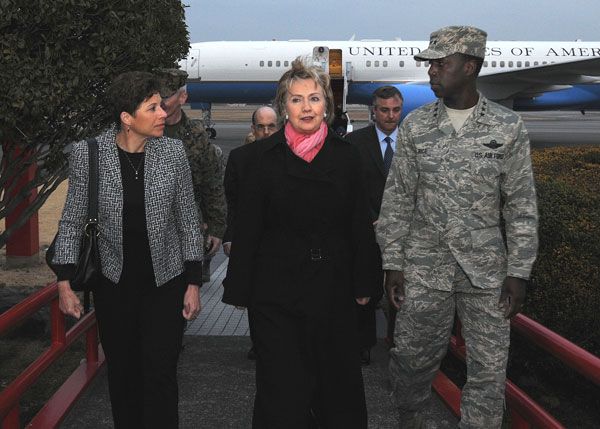
So why the differentiation? The above photo will help explain things. I snapped it while waiting for Secretary of State Hillary Clinton in Beijing a year ago — we flew to Afghanistan that day.
Clinton’s plane is the one of the right — as I wrote last year, it’s the Air Force version of the Boeing 757, also known as C-32. Air Force One — the Boeing 747 on the left — was waiting for President Obama and later took him to Seoul.
The State Department traveling press corps — about a dozen on average — flies on the secretary’s aircraft. Air Force One, however, has enough seats only for a pool of 12, and usually more than 100 reporters go on a foreign presidential trip. There is a rotation for the pool seats on every flight, but most of the time reporters fly on a so-called press plane chartered by the White House, usually from United Airlines.
What you don’t see on the above photo is that, across from the two Air Force planes, to the left of the traffic lane, there was a parked United aircraft, which was of course the press charter.
Everyone on that plane earned United miles, and many of those traveling with the president regularly have 1K status — United’s highest published elite level, requiring 100,000 flown miles per calendar year. Moreover, fliers get first-class mileage credit, which means 150 percent elite-qualifying miles.
Before every trip, different airlines bid for the charter contract, and the White House travel office and the White House Correspondents Association choose the offer they deem best. Although most of the time they select United, for Obama’s trip to Asia last week the winner was Delta Airlines.
The trip took travelers around the world — they flew over the Atlantic en route to India, then went to Indonesia, South Korea and Japan, before returning to Washington via the Pacific. According to the Great Circle Mapper, that’s about 22,000 miles. Delta spokesman Anthony Black declined to say whether the fliers will earn mileage, citing “customer privacy.”
I admit I’ve been a little jealous about all the “missed” miles over the years — almost half a million — but I never wanted to cover the White House because of the domestic politics involved in that beat.
I found another way to earn miles from official trips. After flying almost 100,000 miles with Colin Powell in 2003, I’d had it with non-mileage-earning flights. I still needed to re-qualify for 1K. The following year, I decided that I’d go on the secretary’s plane but would drop off at the last stop and come home commercially. Now I’ve been 1K for a decade.
Some of you might think I was crazy to give up a seat on the secretary’s plane and a hassle-free journey, not having to worry about passport control, customs and sometimes even security screening.
But I thought about it in a different way. I was paying half the price the State Department would charge me — yet, I was getting much better seats as a result of business-class upgrades, mileage credit and better food — yes, even on United.
Related stories:
My trips with Clinton back in the news
In air with Clinton on first trip abroad
Clinton weathers job’s long flights
Press ready for Obama, Clinton travel
My name was involved in a curious intrigue this week. One of Secretary of State Hillary Clinton’s aides, in an attempt to get back at the Washington Times for a recent series of critical stories about Clinton’s deputy Jacob Lew, leaked to a reporter unpaid bills for trips I took with the secretary last year.
I understand the bills are now being settled, following yesterday’s story on the Foreign Policy magazine’s website. I was the Times’ diplomatic correspondent for nine years, until June.
When reporters travel with the secretary, the State Department charges their respective media for the plane ride and any costs incurred on the ground, such as motorcade vehicles and filing centers. Sometimes, those bills are sent out months after a trip, but every time I received one, I gave it to the appropriate person at the Times, along with the original trip authorization from senior management.
I’m told that four unpaid bills have been sitting in a folder in the accounting office for months. Shortly before I left the paper, I was asked how important it is to pay them quickly, given the Times’ tight finances. I pointed out that the bills are overdue, but that was the last time the subject came up.
The Times has had a new editor since January, and it’s possible the issue was never raised with him. It appears he has now made sure the matter is resolved.
This was certainly a very creative way for the State Department to get its money back. Isn’t the Washington game just precious? The stories the Times has been running about Lew have to do with his financial disclosures from his time at Citigroup, before joining the Obama administration. Since I haven’t worked at the paper for two months, I obviously had nothing to do with those stories — nor did I have a hand in any articles about Lew that may have been written before my departure.
Lew has been deputy secretary of state for management since January 2009, and earlier this summer, President Obama chose him as the next director of the White House Office of Management and Budget — a post he held at the end of the Clinton administration.
Continue reading about My trips with Clinton back in the news
The middle of the summer is a good time to review the balance of political appointees vs. career diplomats in ambassadorial posts around the world. Not surprisingly, the familiar 30-percent quota for political appointments of the last several decades remains largely intact.
Actually, for some people, continuing the tradition of awarding presidential campaign contributors with embassies may be surprising, given President Obama’s promise to change the way Washington works during the 2008 election.
However, as I wrote a year ago, reality set in soon after Obama took office. According to a list maintained by the American Foreign Service Association (AFSA), the diplomats’ union, of all ambassadors Obama has nominated so far, about 40 percent are political appointees.
That number, though, is a bit misleading, because almost all political appointees change when a new president moves into the White House — unlike career diplomats, who typically remain in their posts for another year or two. It’s more appropriate to look at all embassies around the world — not just Obama’s nominees — and the AFSA list shows 29.7 percent political appointees out of 185 positions globally. That number is slightly lower than it was during the last years of George W. Bush’s presidency.
Another interesting number is that of the nominated but not-yet-confirmed career diplomats under Obama — there are 40 in each category. In contrast, of 55 political appointees, 52 have been confirmed by the Senate.
This issue is understandably controversial for Foreign Service members, and there was a time last year when the White House was on its way to nominating more than 30 percent political appointees. As I reported then, Secretary of State Hillary Clinton had to interfere.
“Why is ours the only profession where it’s considered acceptable to appoint someone without any experience?” Steven B. Kashkett, AFSA’s acting president, said at the time. “Would you appoint someone to head a hospital without medical experience?”
Continue reading about Political ambassadorships hold at 30%
British Prime Minister David Cameron surprised many this week by traveling to Washington for his first official White House visit since taking office on a commercial British Airways flight, instead of taking a dedicated plane, to save money. Now some Americans are wondering if U.S. officials could follow suit.
Having traveled around the world with four U.S. secretaries of state — Hillary Clinton, Condoleezza Rice, Colin Powell and Madeleine Albright — over the last decade, I can see how commercial flying would save the State Department millions of dollars a year. However, it would also guarantee a logistical nightmare.
Most people don’t know that Clinton has been taking commercial flights since she became secretary of state, but that happens only when she goes home to New York from DC. Work-related flights to New York are flown on small Air Force planes.
On foreign trips, the security detail and the staff accompanying the secretary make for a large entourage that would be hard to accommodate on one commercial aircraft in business or first class. Knowing the security requirements, I’m guessing regular passengers would be required to board two hours before takeoff.
More importantly, the secretary often visits more than one country in one day, so trying to accomplish that commercially is practically impossible. Not to mention that nonstop flights don’t exist to many destinations most of the time.
Last year, I wrote two columns detailing Clinton’s first trip as America’s chief diplomat.
Rice used to take a smaller plane than the C-32 — the Air Force version of the Boeing 757 — on quite a few trips. That required most of the staff and press corps to fly commercially, which was fine with me, since I flew much more comfortably and got tons of frequent-flier miles.
Apparently, Cameron didn’t have the limitations mentioned above, and there are plenty of nonstop stop between London and DC. It’s impressive, though, that he flew in business class — not first — and his meetings in DC were arranged around the British Airways schedule, according to the British press. His two immediate predecessors, Gordon Brown and Tony Blair, also flew on a BA plane, but it was chartered and dedicated to them.
Speaking of the State Department and saving money on travel, I’ve witnessed excessive spending of taxpayers dollars for years, but that’s a topic for another column.
Continue reading about British leader flies to DC commercially