Beijing

nkralev on November 16th, 2010

One of the questions I’ve been asked most frequently in the last decade is whether I’ve earned any frequent-flier miles from my nearly 200 flights with four U.S. secretaries of state. Sadly, the answer is no — and what makes it even sadder is that my press colleagues accompanying the president do get miles and even elite status.

I’ve known many journalists over the years who were top elites purely as a result of White House travel. Some of them didn’t really use their elite benefits because of their very limited commercial flying. There were also a few who didn’t even know they had the coveted status.

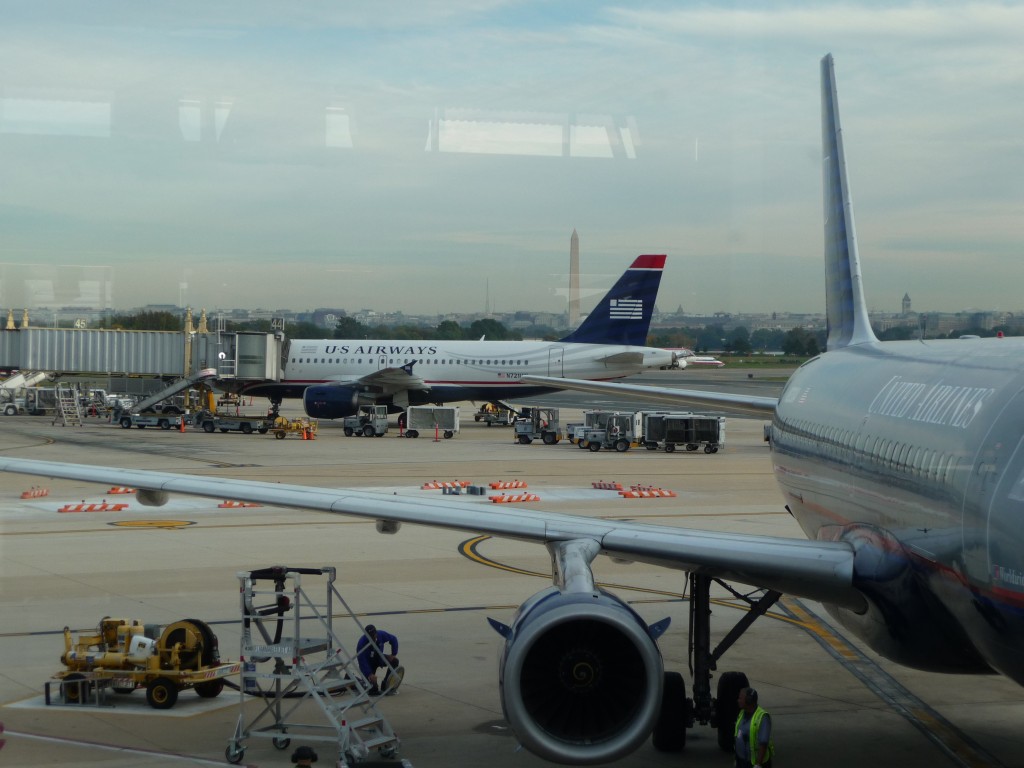
So why the differentiation? The above photo will help explain things. I snapped it while waiting for Secretary of State Hillary Clinton in Beijing a year ago — we flew to Afghanistan that day.

Clinton’s plane is the one of the right — as I wrote last year, it’s the Air Force version of the Boeing 757, also known as C-32. Air Force One — the Boeing 747 on the left — was waiting for President Obama and later took him to Seoul.

The State Department traveling press corps — about a dozen on average — flies on the secretary’s aircraft. Air Force One, however, has enough seats only for a pool of 12, and usually more than 100 reporters go on a foreign presidential trip. There is a rotation for the pool seats on every flight, but most of the time reporters fly on a so-called press plane chartered by the White House, usually from United Airlines.

What you don’t see on the above photo is that, across from the two Air Force planes, to the left of the traffic lane, there was a parked United aircraft, which was of course the press charter.

Everyone on that plane earned United miles, and many of those traveling with the president regularly have 1K status — United’s highest published elite level, requiring 100,000 flown miles per calendar year. Moreover, fliers get first-class mileage credit, which means 150 percent elite-qualifying miles.

Before every trip, different airlines bid for the charter contract, and the White House travel office and the White House Correspondents Association choose the offer they deem best. Although most of the time they select United, for Obama’s trip to Asia last week the winner was Delta Airlines.

The trip took travelers around the world — they flew over the Atlantic en route to India, then went to Indonesia, South Korea and Japan, before returning to Washington via the Pacific. According to the Great Circle Mapper, that’s about 22,000 miles. Delta spokesman Anthony Black declined to say whether the fliers will earn mileage, citing “customer privacy.”

I admit I’ve been a little jealous about all the “missed” miles over the years — almost half a million — but I never wanted to cover the White House because of the domestic politics involved in that beat.

I found another way to earn miles from official trips. After flying almost 100,000 miles with Colin Powell in 2003, I’d had it with non-mileage-earning flights. I still needed to re-qualify for 1K. The following year, I decided that I’d go on the secretary’s plane but would drop off at the last stop and come home commercially. Now I’ve been 1K for a decade.

Some of you might think I was crazy to give up a seat on the secretary’s plane and a hassle-free journey, not having to worry about passport control, customs and sometimes even security screening.

But I thought about it in a different way. I was paying half the price the State Department would charge me — yet, I was getting much better seats as a result of business-class upgrades, mileage credit and better food — yes, even on United.

RETURN TO MAIN COLUMN PAGE

Related stories:

My trips with Clinton back in the news

In air with Clinton on first trip abroad

Clinton weathers job’s long flights

Press ready for Obama, Clinton travel

Continue reading about Flying with Obama and earning miles

nkralev on October 18th, 2010

Why have corporate travel managers become so prone to inertia and averse to innovation in recent years? Why are numerous companies spending millions of dollars more on travel than necessary? Is it time for the travel manager’s job description to change?

I’ve been trying to find answers to these questions since I dedicated myself to travel education and training this summer, through my “On the Fly” Seminars and the Kralev International advisory services.

But it was a post by Scott Gillespie, who writes a blog on procurement and corporate travel management, that prompted me to air my thoughts in public. Although my arguments aren’t quite what he had in mind, I was happy to see that others share my concerns about corporate complacency.

Why do I feel qualified to pass judgment? Because I almost always pay the lowest coach fares, but I haven’t sat in coach since 2002 — and I’ve flown nearly 2 million miles and visited 38 states and 82 countries. And because this year, I’ve flown 100,000 revenue miles, for which I paid a grand total of $747. I’ve never admitted this publicly before, although friends have repeatedly urged me to use it as a selling point — I just didn’t think anyone would believe it. That’s why I’m writing a book, so I can explain it.

I’ve been shocked by how many companies still rely on large travel agencies without almost any meaningful supervision. I’m not suggesting that they stop using travel agents, because this may be the only way to handle high volume. The problem is that, in many cases, they are not getting the cheapest available tickets — but they don’t know it.

Why does that happen? One reason is that many travel agencies have lucrative contracts with certain airlines that encourage them to send more business their way. If your agency receives its biggest commission from American Airlines, it will likely book you on American even if United Airlines has a lower fare. Did the agency disclose any of this before you signed a contract?

The other reason is much less obvious, but hopefully this column will change that. While technology and automation are enormously useful and efficient, they discourage us from using our brains. Automation is no doubt vital for the travel-booking process, but the extent to which travel agents rely on computers to tell them what to do is stunning — and it costs your company a lot of money.

Let me give you an example. Last year, my former managing editor at the Washington Times had to go to Mongolia at a week’s notice and asked if I could find an affordable business-class fare. The cheapest ticket from Washington to Ulan Bator we could find — both from a travel agent and online booking engines — was about $8,700, which was out of the question.

So I started thinking outside the box and decided to try splitting the fare — if I could get a much lower business-class fare to a northeastern Asian city where one would connect on the way to Ulan Bator, I’d book the short haul in coach. Sure enough, I found a $3,250 business-class ticket to Beijing on Air Canada, and coach on to Ulan Bator on Air China for about $550. Both carriers are members of the global Star Alliance.

While any company most likely would have paid $8,700, I saved almost $5,000 — and it took me 15 minutes to do it. When was the last time your travel agent did that? I’m not suggesting that splitting the fare makes sense every time, but there are other creative — and legitimate — ways to save money that computers are not yet fully capable of mastering.

There are also things you can do to help your travel agency save you money. One of the services I offer is strategic travel planning. What does that mean? If you have more than one trip coming up, why not plan them at the same time? You don’t have to take them together — in fact, they can be months apart.

Several months ago, I had a client in Washington who wanted to go to Paris in the spring and to Buenos Aires in the fall. I knew that coach fares from Europe to South America are generally lower than fares from North America, so I suggested an unconventional way of booking two tickets simultaneously — one originating in Washington and the other one in Paris — and the savings exceeded $800. I won’t bore you with further details here, but send me a message if you’d like to know more.

How do you think most travel managers respond when I offer to train them and anyone in their company who might book travel directly? Some say their travel agency already takes care of all their needs and there is no reason to rock the boat. Others are unhappy with the travel agency, but they don’t have money to invest in learning how to save much more money. Yet others don’t seem to understand what exactly I can do for them.

Last week, a friend in Phoenix recommended my services to his company’s travel manager. The response was that, “due to budget cuts to travel budgets and their departmental budget, they felt that they could not justify the expenditure right now.” No comment.

In June, a business-development specialist from a Washington law firm took one of my seminars and saved $500 on her first ticket, so she recommended to the firm that I train their executive assistants who book travel for the attorneys. Management, however, saw things differently. “We have an agreement with American Express, so bringing you in would conflict,” they said.

I asked how exactly that would represent a conflict, since I wasn’t offering to book tickets for them, but I never received a response.

Nor did I hear back from the Association of Corporate Travel Executives, having contacted Megan Costello, then-acting executive director, Kate Farrell, senior director for global education, and Amber Kelleher, director for global education, three months ago. I suppose they have better things to do than listen to new ideas that can actually benefit their members.

RETURN TO MAIN COLUMN PAGE

Related stories:

Announcing Kralev International travel advisory business

Time for travel school — you are invited

Educating the flying public

Continue reading about Corporate travel’s lack of innovation

nkralev on September 28th, 2010

Did you know that hundreds of fictitious flights inhabit airline schedules every day? They don’t exist in real life — just on paper. They are meant to make more money for the airlines by tricking customers and perverting a practice that was actually started to help travelers. In fact, they spell nothing but trouble for passengers.

Those fictitious flights are labeled “direct” by the airlines, which years ago decided to rewrite the dictionary and use that term for flights that weren’t nonstop but made at least one stop on the way to their destination. First, those flights were operated by the same aircraft, but later a “plane change” was introduced. The Department of Transportation has allowed the airlines to abuse the practice any way they like.

On my way back home from Boston last weekend, I was on United Airlines Flight 897, which the purser announced repeatedly was “a nonstop service to Washington Dulles, with continuing service to Beijing.”

I immediately cringed, because there is nothing “continuing” about the two flights, except for their number. The plane I was on was a two-cabin Boeing 757 and arrived at gate C19 at Dulles. The plane destined for Beijing was a three-cabin Boeing 777 and departed from gate C3. So the passengers connecting to Beijing did exactly what others did connecting to Flight 803 to Tokyo at gate C1 — or any other flight for that matter. They left the first plane and walked to their new gate.

Did the Beijing-bound travelers benefit in any way from the fact that their tickets had one flight from Boston to Beijing? Absolutely not. In fact, many of them were probably surprised to discover they were on two separate flights.

Then why does United even have that fictitious “direct” flight? Because it wants customers to think that they can fly from Boston to Beijing without the hassle of a connection — a competitive advantage no other carrier offers.

Have you tried to upgrade a “direct” flight? That can be a nightmare — not just for passengers but also for those who work in inventory management. They have to create inventory for a flight that doesn’t exist and to balance the load of two separate flights on different aircraft types with a different number of cabins and hugely different number of seats. As a result, the lowest booking classes and upgrades are often unavailable on “direct” flights. Some travelers are willing to pay more to avoid the hassle of transfers, not realizing there is a hidden connection.

Almost every international United flight has a domestic tag attached to it, but United is by no means the only U.S. airline abusing the system. All major carriers do it. Delta pretends to fly “directly” from Minneapolis to Moscow, Continental from Amsterdam to Denver, US Airways from Los Angeles to Zurich and American from Tokyo to Boston.

As I wrote two years ago, United and Delta are the biggest abusers, while American seems to be the most prudent in that most of its “direct” flights are operated by the same aircraft. American is also the only one whose website displays a “direct” flight as two separate segments at the very beginning of the booking process.

In the rare cases when foreign carriers, such as Lufthansa and Singapore Airlines, operate “direct” flights, they are flown on the same plane, so there is no danger you will miss your “continuation,” which happens regularly on U.S. airlines. If my flight from Boston to Washington had been late, United wouldn’t have held the plane for Beijing just because the two flights share the same number.

RETURN TO MAIN COLUMN PAGE

Related stories:

Airlines abuse ‘direct’ flights

Target: Fake ‘direct’ flights

Continue reading about DOT should ban fictitious flights

nkralev on July 23rd, 2010

Secretary of State Hillary Clinton this week accomplished a diplomatic feat that her immediate predecessors tried but failed repeatedly to pull off: visiting South Korea, but skipping Japan and China on the same trip. It may sound immaterial, but defying protocol is a tricky thing in diplomacy, especially in Asia.

For years, I’ve been very amused when the State Department would send us in the traveling press corps a note about the secretary plans to visit just South Korea or just China or just Japan. Every time, I’d smirk and bet that he or she would end up going to all three countries — and I was right. That had become a tradition — the Japanese in particular considered it an affront to be ignored by their staunchest ally in favor of Seoul or Beijing.

In early 2008, Condoleezza Rice had to go to South Korean President Lee Myung-bak’s inauguration, and initially had no intention of stopping in Tokyo or Beijing. But after diplomatic pressure from both capitals, she caved in. I skipped Tokyo on that trip.

Clinton herself fell victim to protocol in May. She had to co-chair the so-called U.S.-China Strategic and Economic Dialogue with Treasury Secretary Timothy Geithner in Beijing, and to drop by the 2010 Shanghai Expo in Shanghai. For months, her aides said that no other stops were planned, but in the end, she went to Japan and South Korea, too.

It seems that this time Clinton successfully defied protocol. It helped that she met with her Japanese and Chinese counterparts at the annual meeting of foreign ministers from the Association of Southeast Asian Nations (ASEAN) in Vietnam. But I have little doubt that, in spite of those meetings, the Japanese and Chinese still lobbied for her to drop by their capitals.

By the way, this ASEAN meeting was the first I’ve missed in years. I always thought attending a high-level summit in Southeast Asia in late July was a misery because of the very hot and humid weather, but DC is much worse these days.

Continue reading about Clinton pulls off diplomatic rarity in Asia

Secretary of State Hillary Rodham Clinton has delighted reporters repeatedly during her travels by speaking off the cuff, but is she also speaking off the mark?

Compared with Vice President Joseph R. Biden Jr., the former first lady and senator from New York has committed only minor diplomatic gaffes. Still, twice during her trip to Asia last month, Mrs. Clinton made comments in which the accuracy was questioned by specialists and later had to be “clarified” by the State Department.

At a press conference in New Delhi on July 20, she was asked by an Indian reporter whether the United States opposed the transfer of sensitive reprocessing and enrichment nuclear technology from India to other countries…

Continue reading about Clinton goes off script abroad, ‘clarifications’ follow