nkralev on July 27th, 2010

How do airlines decide what fares qualify as “sales,” and why do they advertise certain fares, but not other, much lower ones? Why is United Airlines promoting a “sale” between Washington and Boston for $109 each way, when there are currently six published lower fares in that market, beginning with $49 each way?

For the most part, I don’t bother to figure out why airlines do certain things anymore. I just gather all the information I need about what they do and try to work with it — or around it. Years of watching fares have taught me not to fall for those “sales,” because in many cases, I can find a much lower price to the same destination, on the same dates and on the same carrier.

Both United and American Airlines are currently advertising two fall sales on their websites. My review of the American fares showed that most of them are indeed the lowest available prices at this time. There are a few small exceptions — for example, I found a fare from New York to San Diego that is $5 lower than the advertised $164.

There are many more and much bigger differences on United. The unadvertised — but published — fares between Washington and Boston, in addition to $49 each way, are $54, $64, $74, $84 and $99. They all have fewer restrictions than the $109 “sale” price.

I say between Washington and Boston — not from Washington to Boston — because domestic fares are the same in either direction, unlike international fares, which are usually very different.

Let’s take another example. The advertised fares between Denver and Los Angeles in two separate United “sales” are $99 and $89 each way. However, I found $68 each way. In addition, Denver-New Orleans is on “sale” for $123 each way, but there is also $109, and even $89.

Some of the advertised United fares are truly the lowest published at this time. For example, $88 each way for Washington-Chicago, $108 for Chicago-Denver, and $157 for Chicago-Los Angeles.

There is another catch that could increase the benefit of the unadvertised fares to you. Typically, “sale” prices require a round-trip purchase. In contrast, most of the lower fares I found have no such condition. In fact, the major U.S. carriers have been publishing more and more truly one-way fares in recent months, which has always been the case with Southwest Airlines and other low-cost carriers.

To United’s credit, some of its current sales don’t require a round-trip purchase. That is, indeed, the prudent thing to do. If a round trip is mandatory, why advertise one-way fares? Of course, for marketing purposes, but I’ve always found that a bit dishonest and deliberately misleading.

I mean no criticism of United for promoting as “sales” fares that are higher than other published fares. I wrote this to warn travelers that they should check all existing fares between two cities before settling for what they think is a “sale” or the best deal.

Those of you who have attended my “On the Fly” Seminars know how easy it is to bring up on your computer screen all fares published by every airline on a certain route in just seconds.

Continue reading about When an airfare sale is not quite a sale

nkralev on July 9th, 2010

Dealing with flight delays and cancellations is challenging enough for travelers, but for some of us it has an additional complication: How to preserve our upgrades in case of rebooking. My trip to Alaska this week provided a textbook example.

As experienced and creative as I might be in handling flight disruptions, the weather is always my worst enemy. I’ve rarely felt more helpless than I did in Denver on my way to Anchorage. My plane had diverted to Colorado Springs because of a thunderstorm, and my departure time kept being pushed back more times than I cared to count.

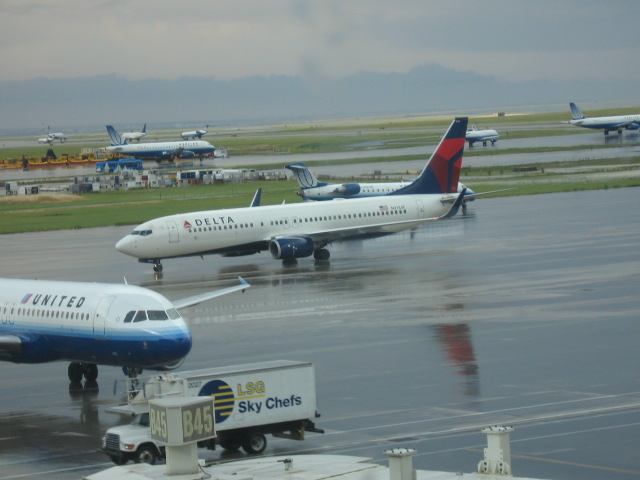
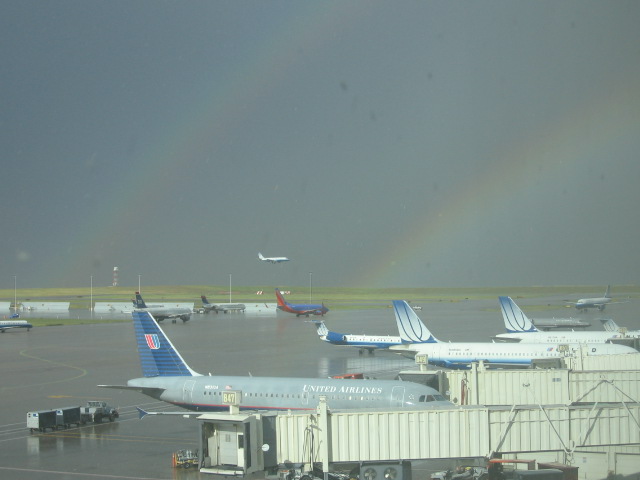
I was sitting in United’s Red Carpet Club watching other planes take off and land, but the one I needed was still at another airport. The only reason to smile was the double rainbow that appeared at one point — you can see it in the photo above.

I had no other options. United has only one flight to Anchorage a day from Denver, though it also flies up there from San Francisco and Chicago. Those flights, however, had already left, so connecting was impossible, even if I could make it to those two cities.

At least I didn’t have to worry about missing another flight, rebooking and potentially losing a previously confirmed upgrade, as this was my last segment for the day.

Things were very different, though, on my way back home. The plane coming to Anchorage from Denver was late — another patch of bad weather had diverted in to Wyoming. It was clear I’d miss my connecting flight, so I called United to get rebooked. The flight I wanted was to Washington National (DCA) — there was no upgrade space available, but they were still selling two revenue seats in first class. An alternative was a flight to Dulles Airport (IAD), which had four revenue seats in first class but nothing to upgrade, either.

A supervisor refused to open upgrade space for me despite the second long delay I was experiencing in three days and was only willing to waitlist me for first class on either flight — there were 22 people waitlisted for an upgrade to DCA, and she didn’t think it was fair to jump me over them.

I got really angry — but not because of her refusal. The plane to DCA was a Boeing 757 and had 24 seats in first class, and the one to IAD was a Boeing 767 with 34 seats in first. Until recently, it was very likely that those flights would have had at least a couple of upgrade seats the night before departure.

But in March, United implemented free domestic upgrades for all elites, which they don’t even need to request. So by the time a top elite member needs a seat because of involuntary rebooking, those seats have been given away to customers with much lower status.

When I got to the Anchorage airport, I saw that I was first on the waitlist, and with two seats still open at 4 a.m. Denver time for an 11 a.m. departure, I thought I was pretty safe. But when I landed in Denver, those two seats were gone. I was still at the top of the waitlist, and three people with reservations on the flight hadn’t checked in.

I did get the upgrade at the gate in the end, but this was the closest I’d come to flying in coach in years.

Continue reading about Preserving upgrades in case of rebooking

nkralev on March 10th, 2010

It’s no secret that times are rough for the airline industry, and the glamor once associated with it is long gone. Many children, however, still dream of a life in the sky. Should they be encouraged?

The answer of Cathay Pacific Airways, Hong Kong’s main airline, is a resounding yes. In 2003, it started a program for high school students called “I Can Fly,” which teaches young aviation enthusiasts the basics of the industry at no cost — from piloting and engineering to marketing and customer service.

About 3,000 students have graduated from the three programs in Hong Kong so far, said Elsa Leung, Cathay’s corporate communication manager. Pilots, flight attendants and other airline and airport staff share their knowledge and experience during lectures, field trips and hands-on exercises…

Continue reading about Aviation meets community service

nkralev on March 9th, 2010

How easy is it for an airline to make its loyal customers happy? Just ask United Airlines. The members of its Mileage Plus program have been happy campers for 10 days, spending their frequent-flier miles like there is no tomorrow.

Many of those travelers waited for that opportunity for months, if not years. They had joined Mileage Plus and mounted sizable accounts with the assumption that they would be able to redeem their miles for flights on the Star Alliance, the global network of 24 carriers of which United is a founding member.

But often in the past few years, when they tried to book “awards” on Singapore Airlines, Germany’s Lufthansa or Asiana of South Korea, among others, finding availability was a Herculean task. Many travelers were angry, but United reservations agents blamed their partners for not providing enough seats…

Continue reading about United yields on ‘award’ blocking

nkralev on March 9th, 2010

At about 9 p.m. last Monday, Delta Air Lines Flight 9 was over eastern Canada on its way back from Cairo. At the same time, Delta Flight 9 took off from New York en route to Los Angeles. That doesn’t make sense to you? Well, it does to the airline industry.

The flight taking off was the “continuation” of the flight that hadn’t yet landed because of a five-hour delay. Delta sells Cairo-Los Angeles as a “direct” flight with a stop in New York, but in reality, that journey consists of two separate flights that have nothing in common except for number 9.

The first one goes from Cairo to New York on a Boeing 767 aircraft, and the second from New York to Los Angeles on a Boeing 737. The arrival of the first leg is evidently not a condition for the departure of the second…

Continue reading about Airlines abuse ‘direct’ flights