Frankfurt
United Airlines, already one of the biggest abusers of fake “direct” flights before its merger with Continental, has increased further the number of those flights in its schedule. Its oddest decision was to introduce fictitious “direct” flights, which consist of two or more segments with nothing in common but their number, between its hubs.
If you are shopping for a ticket from Chicago (ORD) to Denver (DEN), be very careful which flight you book. In addition to 10 daily nonstops with flying time of about 2 hours, United currently has three “direct” flights on that route, but they make a “stop” in Minneapolis (MSP), Des Moines, Iowa, (DSM) and Kansas City, Mo., (MCI), respectively.
Watch out for any indication of that, as obscure as it may be. In most cases, those are not just “stops” — the two “legs” are operated by different aircraft, so they are simply connecting flights. For example, the first “leg” of flight 817 yesterday arrived in Minneapolis at gate E6, but the “continuation” departed from gate E10.
As I’ve written before, most flights labelled “direct” by U.S. carriers are fictitious — they don’t exist in real life. They are meant to make more money for the airlines by tricking customers and perverting a practice that was actually started to help travelers. In fact, they spell nothing but trouble for passengers.
Historically, United and Delta have had more fake “direct” flights in their schedules than any other U.S. carriers, though all airlines engage in that practice.
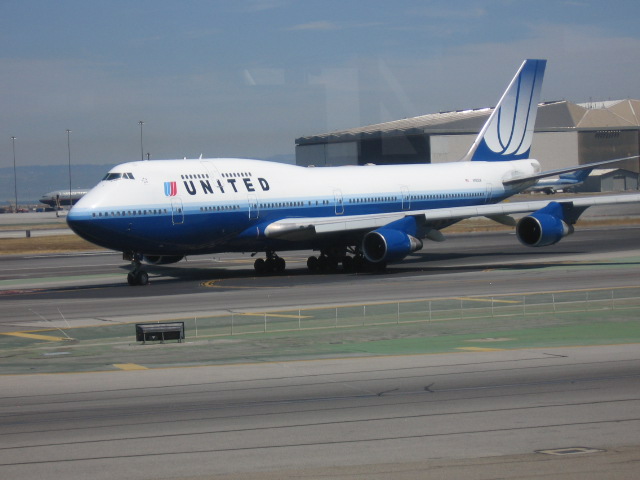
For years, United has focused on adding at least one domestic tag to most of its international flights. For instance, flight 917 from Frankfurt (FRA) to Washington (IAD) “continues” on to Seattle (SEA), though the second flight has nothing in common with the fist. Yesterday, the flight from FRA was operated by a three-cabin Boeing 777, as usual, and arrived at IAD at gate C1. The flight to SEA was operated by a two-cabin Boeing 757 and departed from gate D4.
In the last several months, United has significantly stepped up the questionable practice on purely domestic flights. Currently, there are very few flights with only one segment. Most flights between Washington National (DCA) and Chicago (ORD) used to be one-leg flights. Now, most are part of fake “direct” flights with two or three segments.
It’s clear why the airline is selling “direct” flights from DCA to San Francisco (SFO) — it wants you to think that you can go all the way to the West coast from DCA with no hassle.
But why on earth is it selling fake “direct” flights from IAD to SFO, given that there are nine nonstops on that hub-to-hub route on most days? In its upcoming winter schedule, it has four “direct” flights between those cities. Two of them have two segments — one “stopping” in Dallas (DFW) and one in SEA. The other two have three segments each — one “stopping” in DEN and Las Vegas (LAS), and the other one in ORD and San Diego (SAN).
Is it possible that United has run out of flight numbers because of the merger? That may be the case with three-digit numbers, but what’s wrong with four-digit ones?
Related stories:
DOT should ban fictitious flights
Airlines abuse ‘direct’ flights
United, Continental execs at odds over loyalty program
Continue reading about United steps up fake ‘direct’ flights
The transparency of raw airline data in recent years has been hugely important for our ability to secure the lowest fares and build the best itineraries. ExpertFlyer.com has been a pioneer in that endeavor, and now it has taken an extra step by showing government, military and other fares that have long been a mystery to most travelers.
I first began using ExpertFlyer soon after the website launched in 2005, and was happy to pay the $100 annual fee because it has helped me save thousands of dollars.
Last year, when I left the Washington Times and started teaching seminars, I naturally decided to use the site in my classes — and I received a complimentary subscription. In the interest of full disclosure, ExpertFlyer also donated $1,000 to the book tour I’m currently on. That said, I’m not at all obligated to promote the site in this column.
I’m writing about ExpertFlyer because of its usefulness to my readers. As I explain in my book, “Decoding Air Travel,” unless you are a travel agent or otherwise have access to a Global Distribution System (GDS), you are deprived of viewing raw airline data, such as fare tariffs and flight inventory, as it’s published by the carriers — but before it’s processed by automated booking engines.
This week, ExpertFlyer made available special government and military fares, as well as student and senior fares. The last two were not exactly secret in the past and could be searched on airline websites and online travel agencies, but having access to the raw data is no doubt very useful.
Being able to see government fare data, however, is a big deal. Only federal agencies can book tickets at those fares, but even if you never benefit from them, the information is rather revealing for an air travel geek like me.
The most significant feature of government fares is that they are usually much higher than the lowest regularly published fares, because they are fully refundable and changeable — but they are much lower than the normal full-fare prices available to businesses and consumers. Some companies do negotiate contracts with airlines, but the discount they get is typically between 5 and 15 percent.
Let’s look at the current government fare from Washington to Frankfurt on United — a heavily traveled route by federal employees. Because those flights are less than 14 hours long, only coach tickets are allowed. As of today, the base fare is $718 each way ($1,436 round trip) — the fare basis is YCA, which means it’s a full Y fare, earning 150 percent frequent-flier miles and requiring fewer miles to upgrade than discounted fares, and of course no cash “co-pays.”
Now let’s compare that to the lowest published Y base fare available to any of us — it’s $4,037 round trip. These are only the base fares, but as I learned a couple of months ago when I flew on a YCA fare for the first time, the government also enjoys a big discount on fuel surcharges, which run in the hundreds of dollars.
It’s worth noting that the lowest published United fare from Washington to Frankfurt as of today is $603 round trip, but it’s very restrictive and, of course, nonrefundable. United publishes the same transatlantic fares as Star Alliance partners Lufthansa, Air Canada and British Midland, but any flights on foreign carriers must be booked as United code-share numbers under the so-called Fly America Act. The same rule applies to American and its Oneworld partners, as well as Delta and other SkyTeam carriers.
In addition to the Y government fares, U.S. airlines have begun offering equally nonrestrictive fares with fare bases that book into discounted booking classes, such as L and K. Their downside is that they don’t earn bonus miles and upgrades on them are much pricier.
I’m still learning the government airfare system, but one thing I find hard to understand is why Carlson Wagonlit, the travel company that books travel for several federal agencies, charges almost $90 every time one of its agent touches a reservation — whether to issue a ticket, change it or cancel it. So much for “free” changes and cancellations.
Related stories:
Should airline booking codes be secret?
Openness rattles airline industry
Is ‘award’-seat data held by copyright?
DOT cracks down on airfare advertising
Continue reading about ExpertFlyer boosts airfare transparency
There are so many travel-industry rankings at year’s end, it’s hard to keep track. It’s even harder to figure out which — if any — of them are credible and meaningful. Looking at some of the results, one has to wonder when some of the respondents last flew on the airlines and through the airports they assessed.
Rankings are usually administered by various magazines — one exception are the new Frequent Traveler Awards. In the last several years, I’ve made it a habit to look at the Global Traveler Magazine‘s so-called Tested Awards, most of which make sense. However, as I was reading this year’s results during a flight last week, I couldn’t help but gasp in astonishment at some of the results.
Many of the categories are certainly subjective, and different people’s experiences could easily be different. For example, the in-flight service on the same airline could vary depending on the cabin crew — or even your particular flight attendant.
Still, Lufthansa’s second place for best First Class is surprising. For comparison, Emirates is fifth, Korean Air sixth, and Singapore Airlines eighth. Seriously? Lufthansa is a great airline and it deserves to be in the top 10 — it came out fifth overall in the “Best Airline in the World” category.
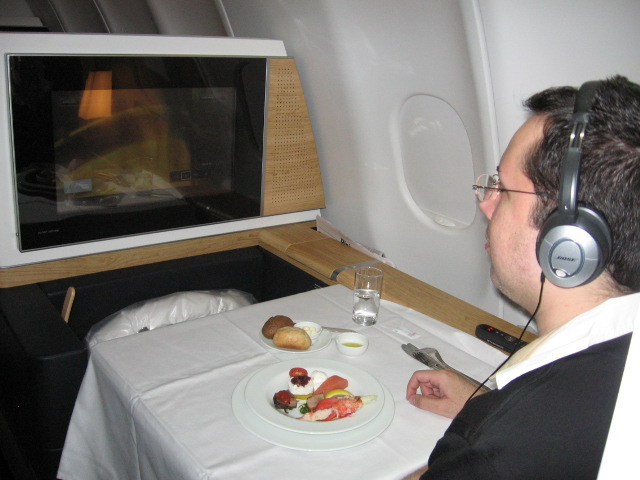
But anyone who has flown in Lufthansa First Class in the last couple of years knows that its hard product lags behind most of its competitors. The most glaring example of that is the tiny TV screen. On the carrier’s Boeing 747 aircraft, First Class is on the upper deck, with 16 seats in a 2-2 configuration, which is the standard for Business Class on most other airlines operating the same aircraft type.
To its credit, Lufthansa has recognized the limits of its product and has undertaken steps to improve it. The above-mentioned 2-2 configuration is about to change to 1-1, which will no doubt disappoint some fliers because it will reduce the number of First Class seats by half, but eight seats is the industry standard and makes a lot of sense.
Lufthansa has finally come out with a new First Class seat on its Airbus 380 planes. Could it be that Global Traveler readers were evaluating those seats? No, because surveys were collected between January and August, and the first Airbus 380 didn’t enter service until late August.
There is one First Class feature on Lufthansa that beats all other airlines to the punch: its First Class Terminal in Frankfurt. But it’s used almost exclusively by Frankfurt-originating passengers, so it’s unlikely its weight in assessing the overall product was predominant for all survey respondents.
Lufthansa was also ranked fifth for best Business Class. Again, if you’ve had a chance to compare its hard product with other Business cabins, you’d probably disagree. One could argue that Lufthansa’s service is better than that of United Airlines, but United’s truly flat seats are among the best in the industry. Lufthansa made the short-sighted decision to install the old Business seats on the Airbus 380, but later announced it would roll out a new hard product next year.
United is the only U.S. carrier in the top 10 of any of the leading overall global categories, taking 10th place for best Business Class and best Business seat design, and fourth place for best First Class design. Its “new” hard product, which was first introduced three years ago, has so far been installed on less than 60 percent of its long-haul fleet.
Deservedly, Lufthansa is missing from the top 10 in any of the best-seat categories. But another perplexing presence in the best Business seat category — ahead of United — is South Korea’s Asiana Airlines. Not only are its current seats not truly flat, but they are less comfortable than comparable products on other carriers, such as Thai Airways. Asiana’s service is, of course, superb, but this is strictly a seat-related category.
In the best global airport category, another surprising result: in third place, Amsterdam has beat out Hong Kong and Munich. In North America, Atlanta came out ahead of San Francisco. Really?
Oh, and did you know that Delta Airlines has the best airport lounges in the world? That’s right, and Lufthansa and Singapore Airlines have been shut out of the top 10 completely. If that’s not madness, I don’t know what is.
Related stories:
Airlines cut back on first-class service
Delayed at the airport? Enjoy!
New Lufthansa business class in a year
Singapore Airlines’ maddening perfection
Continue reading about What’s the real point of airline rankings?
Are you one of those travelers who wait until they get to the airport to find out that their flight has been delayed or canceled? It’s time to become a proactive flier and learn how to predict disruptions, so you can get rebooked before anyone else on your flight, with a minimum impact on your travel plans.
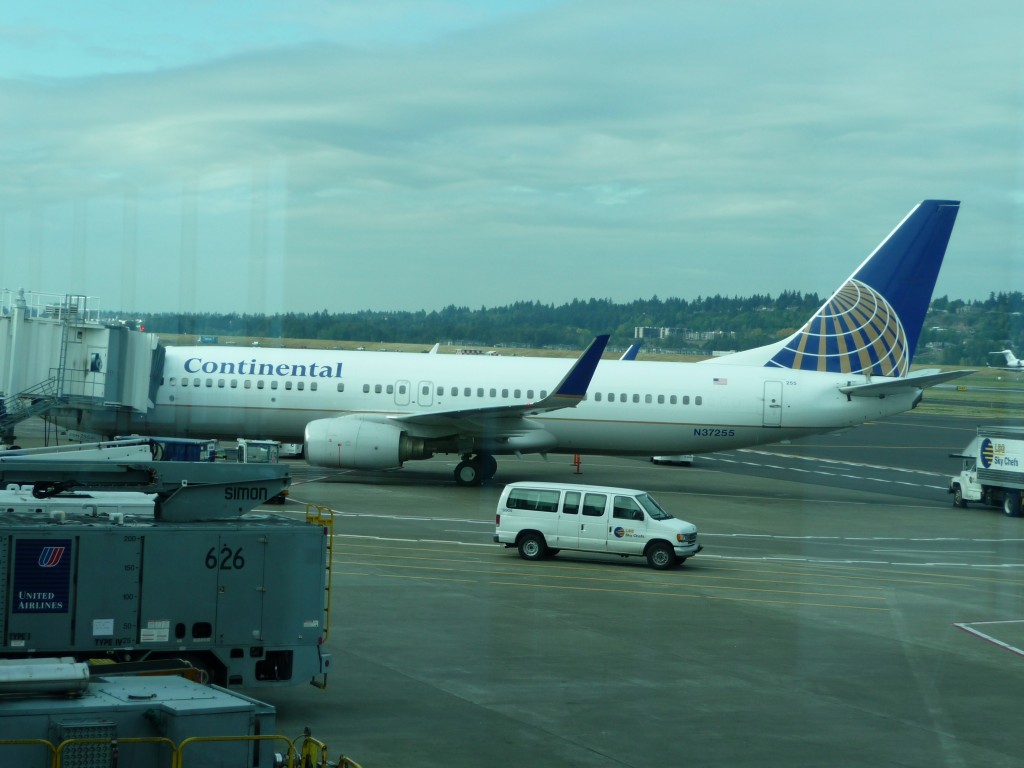
Although there is no guarantee that your prediction success rate will be 100 percent, because airlines often swap aircraft, the method I’ve adopted works most of the time. It’s actually rather simple: I track the planes assigned to my flights by matching arrival and departure gates. Continental Airlines makes it even easier by providing the most advanced data in the industry, but more on that later.
The aircraft for a United Airlines flight I recently took from Washington to San Francisco came from Sao Paulo. Had the flight from Brazil been late, I would have known hours in advance, which would have allowed me to get rebooked on the phone before even leaving home.
You might ask why you need to waste time tracking planes and matching gates, when airlines usually send e-mail and phone alerts in case of delays and cancellations. I find that I’m usually ahead of them, because for some reason their systems often take hours to update.
If I see that United 952 from Washington to Frankfurt is four hours late, I know immediately that the return flight 953 will be delayed, too. But I’ve seen United take hours to reflect that in its system, perhaps hoping that the plane will make time in the air. That can be a valid reason to wait for a final determination, as can be the possibility that another aircraft may be found to replace the delayed one.
So why am I so sure Flight 953 won’t depart on time if Flight 952 is four hours late? There is only one Boeing 767 flying to Frankfurt daily, and it operates both 952 and 953, which leaves no room for aircraft substitution. In addition, the turnaround time for that plane on the ground in Frankfurt is less than two hours, so there is no way the plane will leave Frankfurt on time after arriving from Washington four hours late.
Knowing the type of aircraft assigned to your flight would make the gate-matching exercise much faster, especially at a hub like Washington Dulles or Chicago. To make it even easier, you can use your departing airport’s website, which will display all arriving flights in a certain time frame with their gates on the same page. If you know your flight leaves from Gate 72 in Los Angeles, save yourself time by going to the LAX website, rather than the United site.
Most planes, of course, operate several flights a day, so if I have time, I track my planes since their first voyage in the morning. Yesterday, for example, the Boeing 767 I flew on from LA to Chicago had started the day in LA, flown to Denver and Chicago before returning to LA to pick me up. By the way, the tail number of that plane was N666UA.
What about aircraft replacement? That’s another reason to do your homework. That flight from Washington to San Francisco I mentioned earlier was scheduled to be operated on a Boeing 767 — with a domestic seat configuration, which means two cabins and those utterly unimpressive domestic first-class seats. As soon as I learned my plane was coming from Sao Paulo, I knew there had been a swap to an internationally configured, three-cabin Boeing 777, so I’d sit in a much more comfortable business-class seat. Since the substitution changed seat assignments, I quickly logged in and grabbed my favorite seat in the business cabin.
All major U.S. carriers’ websites show gate information, but Continental beats them all to the punch by displaying much more valuable data — it actually shows the tail number of the specific aircraft assigned to your flight and tells you where it’s coming from, including the inbound flight’s number. For instance, you are flying from Newark to Berlin on Flight 96 today, your Boeing 767′s tail number is N158CO, and it’s coming from Zurich as Flight 79. Right next to that information on the Continental site is a link to the real-time status of that flight.
Continental goes even further, offering descriptions of beverage and meal services for that particular flight, as well as data on in-seat power, entertainment, aircraft features and seat configuration.
This is a great example of a customer-friendly policy, which the merged United should adopt on its website. In fact, all airlines should provide that information — it would certainly make our lives much easier.
Related stories:
Preserving upgrades in case of rebooking
Flight schedule changes overwhelm agents, travelers
Dulles Airport enters the modern age
Continental shows new transparency
Lufthansa agent’s ‘mistake’ stacks up
Continue reading about Predicting flight delays and cancellations
How many busloads of passengers does it take to fill a Boeing 747? Ask the Frankfurt Airport.
With all the innovations and conveniences brought to modern airports, it’s inexplicable to me why airports in some of the most developed countries on the planet remind one of the Third World. Many travelers often complain about London’s Heathrow, but I find Frankfurt no less frustrating.
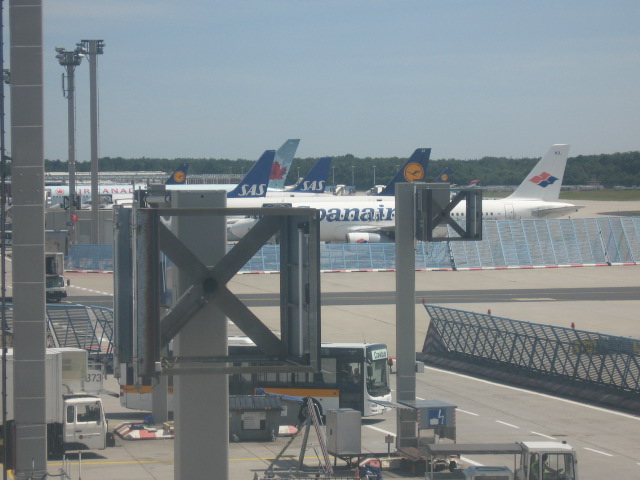
I realize there are not enough gates with jet bridges, and some airlines prefer “remote” gates because their use is cheaper, but I can’t remember flying through Frankfurt and not being taken to or from a plane by bus at least once. As of this week, I’ve had 111 takeoffs and landings at that airport.
As much as I hate the buses, by now I’m used to the prospect of having to put up with them, especially for flights to certain destinations. Most of the time, such flights are flown on narrow-body aircraft, such as Boeing 737 and Airbus 320, which can be filled with just two busloads.
This week, however, I experienced boarding a United Airlines Boeing 747 by bus. I was sure the flight wouldn’t leave on time, and I was right. I can hardly wait for the expansion of Terminal 1 to be completed.
What’s even harder for me to understand is why there aren’t enough gates with jetways at the much newer Munich Airport. I was also disappointed by the transfer experience there this week. With 52 takeoffs and landings, this was the first time I had to change terminals. I arrived at Terminal 1 — courtesy of another bus — and it took me about 45 minutes to reach Terminal 2. The signage was very poor, and the shuttle bus between the terminals runs only once every 20 minutes.
U.S. airports may have their problems, but when was the last time you were taken to the plane by bus?