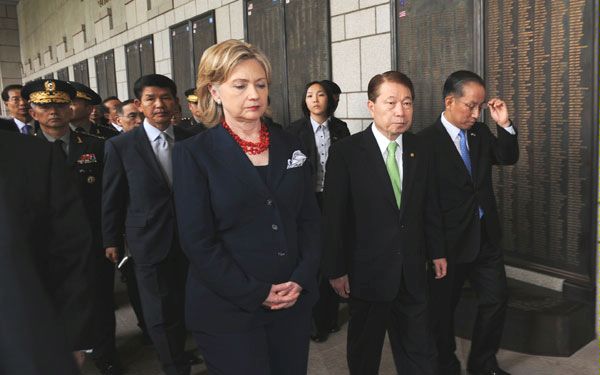
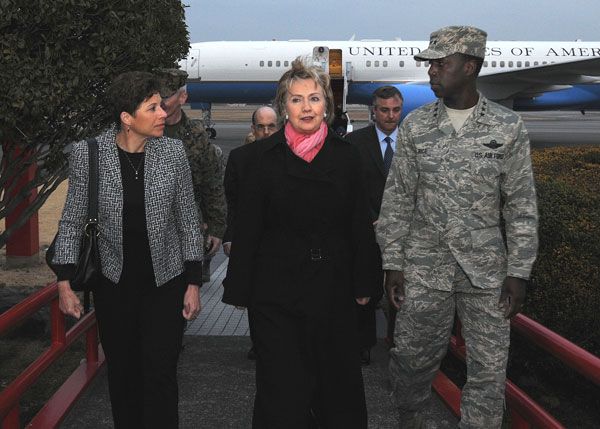
Secretary of State Hillary Clinton this week accomplished a diplomatic feat that her immediate predecessors tried but failed repeatedly to pull off: visiting South Korea, but skipping Japan and China on the same trip. It may sound immaterial, but defying protocol is a tricky thing in diplomacy, especially in Asia.
For years, I’ve been very amused when the State Department would send us in the traveling press corps a note about the secretary plans to visit just South Korea or just China or just Japan. Every time, I’d smirk and bet that he or she would end up going to all three countries — and I was right. That had become a tradition — the Japanese in particular considered it an affront to be ignored by their staunchest ally in favor of Seoul or Beijing.
In early 2008, Condoleezza Rice had to go to South Korean President Lee Myung-bak’s inauguration, and initially had no intention of stopping in Tokyo or Beijing. But after diplomatic pressure from both capitals, she caved in. I skipped Tokyo on that trip.
Clinton herself fell victim to protocol in May. She had to co-chair the so-called U.S.-China Strategic and Economic Dialogue with Treasury Secretary Timothy Geithner in Beijing, and to drop by the 2010 Shanghai Expo in Shanghai. For months, her aides said that no other stops were planned, but in the end, she went to Japan and South Korea, too.
It seems that this time Clinton successfully defied protocol. It helped that she met with her Japanese and Chinese counterparts at the annual meeting of foreign ministers from the Association of Southeast Asian Nations (ASEAN) in Vietnam. But I have little doubt that, in spite of those meetings, the Japanese and Chinese still lobbied for her to drop by their capitals.
By the way, this ASEAN meeting was the first I’ve missed in years. I always thought attending a high-level summit in Southeast Asia in late July was a misery because of the very hot and humid weather, but DC is much worse these days.
Continue reading about Clinton pulls off diplomatic rarity in Asia
Having covered American diplomacy for a decade now, I’ve received many “diplomatic” answers to my questions — but none more so than “Yes, but not really.” I was reminded of it by the recently negotiated Open Skies aviation agreement between the United States and Japan.
The idea of the Open Skies accords, which Washington has with more than 90 countries, was to liberalize air travel between the signatories, allowing flights from any city in the first country to any city in the second without the previously imposed government restrictions.
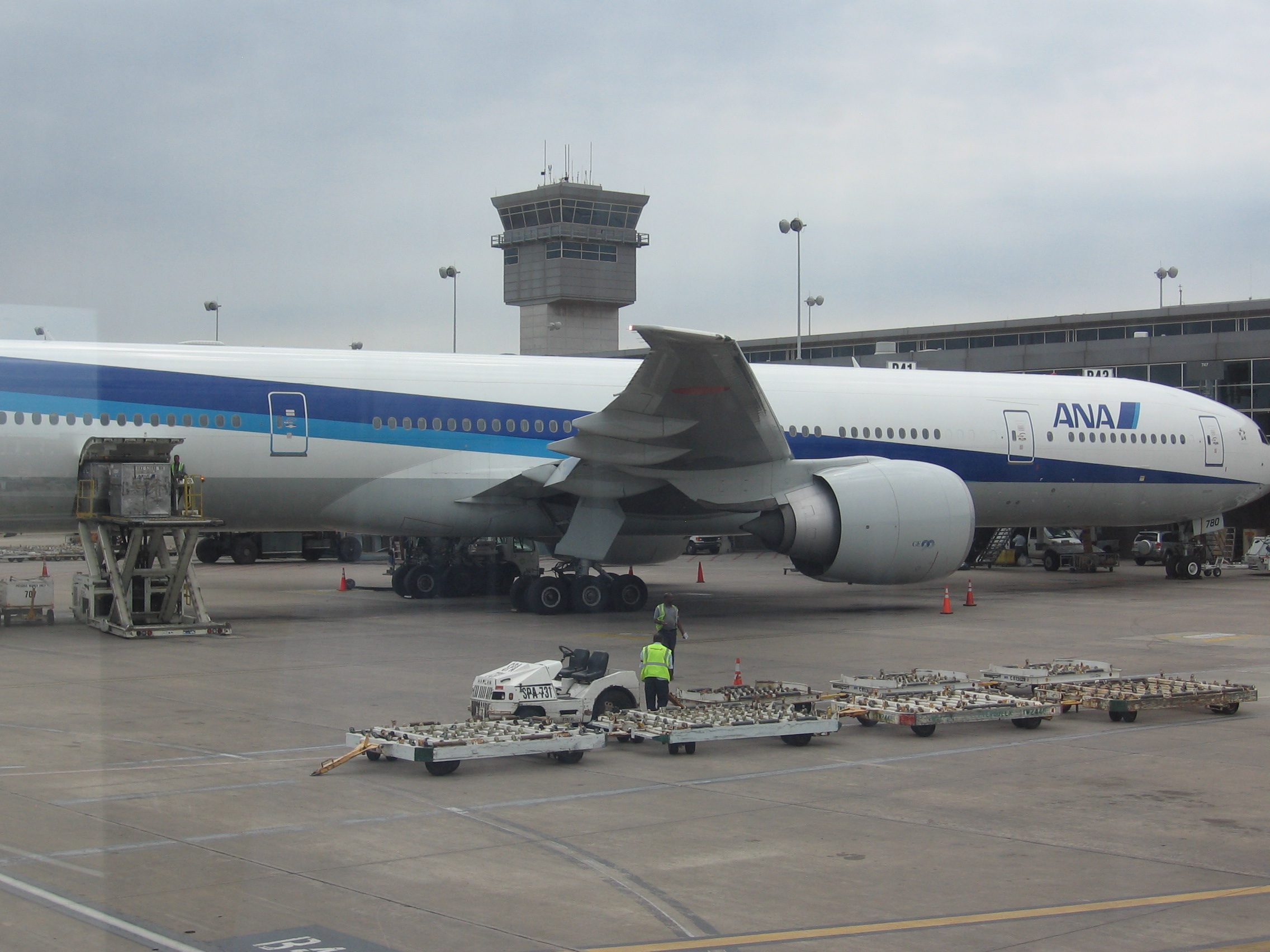
However, the deal reached with Japan in December has one glaring exception — U.S. carriers can have only four pairs of takeoff and landing slots at Tokyo’s Haneda Airport, and only between 10 p.m. and 7 a.m. Even though the document hasn’t been signed yet, there are no plans to change the Haneda limits…
If you ever wanted to sit in first or business class but couldn’t afford it — and upgrading wasn’t an option — your time may have arrived. While airlines await the return of paying “premium” passengers, some of them are letting lower-class fliers occupy plush lie-flat seats.
On Australia’s Qantas Airways and Germany’s Lufthansa, you can now sit in first class even if you hold a ticket for business — no miles or other upgrade instruments are necessary. Qantas also allows coach customers in the business cabin.
The two carriers still offer standard three-cabin service on most of their international networks. However, earlier this year, Qantas decided to stop selling first-class tickets on some routes where demand had slumped. While it pondered the wisdom of removing those seats, it made them part of business class…
Continue reading about Airlines cut back on first-class service
Here is some good news for those of you seeking an alternative to Tokyo’s vast and faraway Narita International Airport: The Japanese government will likely soon allow nonstop flights between the United States and the city’s much smaller and nearby Haneda Airport.
There is, of course, some not-so-good news. Unless U.S. negotiators manage to pull a rabbit out of a hat, those flights will arrive and depart only between 10 p.m. and 7 a.m. — which means that takeoffs and landings at U.S. airports may have to occur in the middle of the night, too.
Access to Haneda is one of the issues being discussed between the United States and Japan as part of ongoing negotiations of an Open Skies Agreement. Washington has similar accords on liberalizing air travel with more than 90 countries, said John R. Byerly, deputy assistant secretary of state for transportation affairs, who oversees those negotiations…
How would you feel if you were detained for more than a week upon arrival in a foreign country for reasons that had nothing to do with you — and you missed your meeting or never even made it to your destination?
Thousands of passengers to Asia, where governments have implemented the most draconian measures to prevent the spread of swine flu, have been facing that prospect every day for two weeks. Unfortunately, in most cases, they were not given all the information they needed in advance so they could plan accordingly.
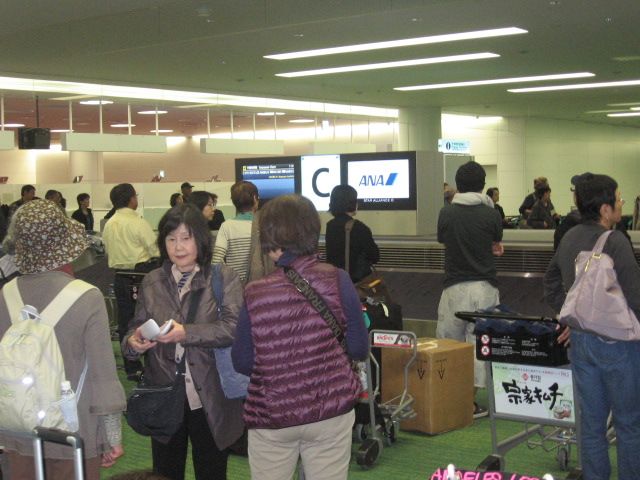
Beginning April 28, dozens of planes arriving daily in Japan from North America have been held after landing until a team of health inspectors — wearing yellow protective gear, masks, goggles and gloves — takes everyone’s temperature with scanners and reviews filled-out questionnaires…


Social media