Las Vegas

nkralev on August 2nd, 2011

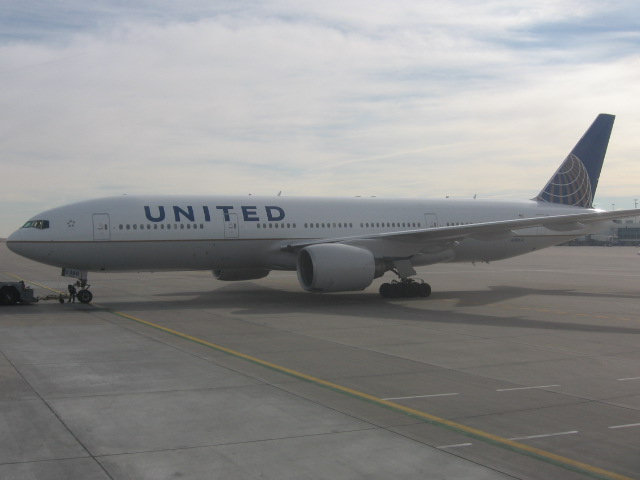
United Airlines, already one of the biggest abusers of fake “direct” flights before its merger with Continental, has increased further the number of those flights in its schedule. Its oddest decision was to introduce fictitious “direct” flights, which consist of two or more segments with nothing in common but their number, between its hubs.

If you are shopping for a ticket from Chicago (ORD) to Denver (DEN), be very careful which flight you book. In addition to 10 daily nonstops with flying time of about 2 hours, United currently has three “direct” flights on that route, but they make a “stop” in Minneapolis (MSP), Des Moines, Iowa, (DSM) and Kansas City, Mo., (MCI), respectively.

Watch out for any indication of that, as obscure as it may be. In most cases, those are not just “stops” — the two “legs” are operated by different aircraft, so they are simply connecting flights. For example, the first “leg” of flight 817 yesterday arrived in Minneapolis at gate E6, but the “continuation” departed from gate E10.

As I’ve written before, most flights labelled “direct” by U.S. carriers are fictitious — they don’t exist in real life. They are meant to make more money for the airlines by tricking customers and perverting a practice that was actually started to help travelers. In fact, they spell nothing but trouble for passengers.

Historically, United and Delta have had more fake “direct” flights in their schedules than any other U.S. carriers, though all airlines engage in that practice.

For years, United has focused on adding at least one domestic tag to most of its international flights. For instance, flight 917 from Frankfurt (FRA) to Washington (IAD) “continues” on to Seattle (SEA), though the second flight has nothing in common with the fist. Yesterday, the flight from FRA was operated by a three-cabin Boeing 777, as usual, and arrived at IAD at gate C1. The flight to SEA was operated by a two-cabin Boeing 757 and departed from gate D4.

In the last several months, United has significantly stepped up the questionable practice on purely domestic flights. Currently, there are very few flights with only one segment. Most flights between Washington National (DCA) and Chicago (ORD) used to be one-leg flights. Now, most are part of fake “direct” flights with two or three segments.

It’s clear why the airline is selling “direct” flights from DCA to San Francisco (SFO) — it wants you to think that you can go all the way to the West coast from DCA with no hassle.

But why on earth is it selling fake “direct” flights from IAD to SFO, given that there are nine nonstops on that hub-to-hub route on most days? In its upcoming winter schedule, it has four “direct” flights between those cities. Two of them have two segments — one “stopping” in Dallas (DFW) and one in SEA. The other two have three segments each — one “stopping” in DEN and Las Vegas (LAS), and the other one in ORD and San Diego (SAN).

Is it possible that United has run out of flight numbers because of the merger? That may be the case with three-digit numbers, but what’s wrong with four-digit ones?

RETURN TO MAIN COLUMN PAGE

Related stories:

DOT should ban fictitious flights

Airlines abuse ‘direct’ flights

United, Continental execs at odds over loyalty program

United StarNet blocking

Continue reading about United steps up fake ‘direct’ flights

nkralev on October 27th, 2010

Do you sometimes prefer making a connection or two instead of taking a nonstop flight, either to save money or rack up more frequent-flier miles? You might have to change your ways. Domestic U.S. transfers are now allowed much less frequently than before, and making connections on flights between an airline’s hubs is almost impossible.

No big deal, you might say. Wouldn’t any reasonable person choose a nonstop any time? Not necessarily. Different travelers have different priorities — some would rather save time, others money. But the best thing about the previous practice was that passengers had options. Now, that’s no longer the case.

Until June, you could make four transfers each way between Washington and Los Angeles on United Airlines — both cities are United hubs. Since then, the lowest fares have said this in the legal routing rules:

TRAVEL MUST BE NONSTOP

It’s not until fares of just under $700 round trip that the routing gets a bit more liberal — but it allows only one connection and only at a hub airport. Here is how this looks in the United tariff:

WAS-CHI/DEN/LAX/SFO-LAX

The slash indicates that you must choose among Chicago, Denver and San Francisco, but you can’t go through two of them — you would have been able to do so had there been a hyphen between them.

How does this affect you? As of this morning, the lowest published United fare between Washington and Los Angeles is $119 each way and books in L class — but it’s only valid on nonstop flights. What if none of the nonstops on the day you need to fly has available L seats? Then you will have to buy up to S booking class — the next lowest currently published — or whatever seat is available. There may be L availability on a connection through Denver, but it wouldn’t qualify for the L fare because it’s not nonstop. The bottom line is, the routing restriction will cost you at least $100 more.

United was actually the last of the major carriers to clamp down on routing rules, and many mileage runners — people who fly just to accumulate miles — had lots of fun for a long time. It still has one of the more liberal rules — except between hubs. American Airlines and US Airways follow the same policy. American requires a nonstop between Dallas and Miami, and US Airways between Philadelphia and Phoenix.

Delta Airlines is one of the strictest. For example, discounted fares between Atlanta, its main hub, and most major cities require a nonstop, even if that city is not a hub, such as San Diego and Las Vegas. A fair comparison would be the United routing between Washington and Las Vegas, which is much more generous:

WAS-SFO/LAX/DEN/CHI/WAS/EWR/HOU/CLE/PHL/CLT/PHX-LAS

This is actually a typical United routing. You can transfer only once at a hub, but it doesn’t necessarily have to be a United hub — Continental and US Airways hubs are also allowed, because United code-shares a huge number of their flights. Of course, current Continental hubs will become United hubs once their merger is complete.

Delta is so strict, in fact, that sometimes it requires a nonstop when neither of the two cities is a hub — for example, between Washington and Los Angeles. The curious part is that Delta doesn’t fly nonstop between those cities, but it code-shares the only daily Alaska Airlines flight from Washington National. So the only way to get a decent fare is to book that one flight at 9:15 a.m. If you can’t, you have to pony up.

To be fair, Delta allows both nonstops and “direct” flights, and when the other carriers say nonstop, they do mean nonstop. “Direct” flights are those fictitious flights I wrote about last month, which have nothing in common except for their number — most of them are operated on different planes and require changing gates and sometimes even terminals.

In addition, Delta is not always as draconian as in the Washington-Los Angeles case. Here is the routing between non-hubs Chicago and Los Angeles:

CHI-SLC/MSP/DTT/CVG/MEM/ATL/LAX/IND/DEN/SFO/LAS/PHX-LAX

The smaller the city, the more liberal the routing — although some bigger places seem to fall through the cracks, probably not for too long. Here is the United routing from Washington to Houston.

WAS-ATL/CLE/DTT/DAY/CMH/IND/RDU-CHI-HOU

WAS-ROC-BUF-CHI-HOU

WAS-ABE/HAR/ROA/SDF/RIC/CAK/CRW/ORF-CHI-HOU

WAS-NYC/EWR-ATL/CLE/DTT/DAY/CMH/IND/RDU-CHI-HOU

WAS-NYC/EWR-ROC-BUF-CHI-HOU

WAS-NYC/EWR-ABE/HAR/ROA/SDF/RIC/CAK/CRW/ORF-CHI-HOU

If you look closely, you will see that up to four transfers are permitted here — this many hyphens are very rare these days. I have the feeling this generosity will disappear once United and Continental start flying as one airline, for which both Washington and Houston will be hubs.

International routings are much more liberal and sometime can fill a page, but that’s a topic for another column.

RETURN TO MAIN COLUMN PAGE

Related stories:

Airlines find new way to overcharge fliers

DOT should ban fictitious flights

Time for travel school — you are invited

Educating the flying public

Continue reading about U.S. carriers tighten routing rules

nkralev on March 10th, 2010

Have you heard that trains are “in” again? They have been “out” for so long, it’s almost hard to believe it, but President-elect Barack Obama’s decision to ride the rail into Washington for his inauguration has excited many train lovers.

Since flying became the main form of long-distance transportation in the United States in the past couple of decades, repeated warnings by railroad executives and industry advocates that insufficient funding and out-of-date equipment would lead to the system’s collapse seemed to fall on deaf ears.

Finally this fall, Congress more than doubled funding for Amtrak, the semi-public company, in a $13 billion railroad improvement bill sponsored by Reps. James L. Oberstar, Minnesota Democrat, and John L. Mica, Florida Republican…

Continue reading about New hopes for rail travel

nkralev on March 9th, 2010

Are you angry at yourself for buying a plane ticket for the holidays too early and the price is now lower? Do you even know whether the fare has dropped? Either way, you may be able to get some of your money back.

For years, travelers were warned against procrastinating when it comes to holiday trips, since conventional wisdom held that air fares usually get higher the longer you wait. But this year, wild swings in the price of oil and a global financial meltdown have shattered stereotypes about air travel.

Although many U.S. carriers have resisted lifting the fuel surcharges they imposed when oil was much more expensive, fares have been cautiously coming down of late. Almost all major airlines now have holiday sales that experts say are more generous than in previous years…

Continue reading about Get refund if airfare drops

nkralev on March 2nd, 2010

Just after 3 pm on an unseasonably hot spring day, an elegant, black sports car pulls up in front of a posh, downtown hotel in San Francisco, and out steps Sharon Stone. Sporting a stylish red scarf, she takes off her sunglasses and walks towards a virile-looking man in a dark suit and cowboy boots. This is Phil Bronstein, her husband of two years and executive editor of the San Francisco Examiner.

Stone and Bronstein then sit down for their first interview together since their wedding on Valentine’s Day, 1998. At the time, gossip columnists were quick to give their marriage no more than a year. They were wrong, but the couple acknowledge the difficulties of a marriage involving two of the most fickle of all professions.

“You work really, really hard at it, because that’s what’s required for a successful relationship,” Stone says, once the waiters in the hotel’s restaurant finally retire, having assured her of the pleasure of her presence…

Continue reading about Stories about Sharon Stone