nkralev on September 14th, 2011

The 10th anniversary of the Sept. 11, 2001, terrorist attacks this week reminded me of how much can go wrong in the airline industry to no fault of its own. Despite everything outside the airlines’ control, there are many reasons to criticize their performance. But how much slack should we cut them?

I’ve written several times about the increased scrutiny of the airlines by both the media and the public, compared to other industries, simply because of the nature of their business. A commercial carrier has more front-line employees than almost any other company, and it’s easier to complain about a person we see in front of us than about an invisible — and sometimes anonymous — representative.

In addition, the airline industry gets more media attention than other types of businesses by default, as many more people are believed to be interested in aviation than in the workings of a cable company or the food industry, for example — even though the latter two affect no fewer consumers than airlines do.

Let’s face it, an aircraft in any position — sitting on ground, soaring in the sky or, God forbid, engulfed in flames — makes for much better photos and video than a food-processing chain.

Bashing the airlines has been common for decades, but it has become even easier in recent years, thanks for social media and the travel blogs that have mushroomed on the Internet.

All that attention has improved customer service, as well as other parts of the airlines’ performance. I’m not talking about the on-board service, which no longer includes free drinks, meals, pillows, blankets, etc. I mean employees’ desire and ability to resolve problems. There are certainly still those who just shrug shoulders and pass you on to someone else, but the helpful ones seem to be more these days.

As my book, “Decoding Air Travel,” and all my columns can testify, I’m by no means an apologist for the airlines. I criticize them and expose their dishonest practices when they deserve it, but I also praise them when they do things right. I’ve also urged other consumer-oriented businesses to learn from the customer-friendly policies of many airlines.

So I’m more than willing to cut the airline industry some slack — not only in situations beyond its control, but also when honest mistakes have been made. For example, late last month, I had a schedule change on a future ticket, which had to be reissued. The agent I spoke with on the phone was supposed to send the reservation to a certain “queue,” but as I learned a few days later, she sent it to the refund queue. As a result, the entire itinerary was canceled, and of course no one notified me. Good thing I called back.

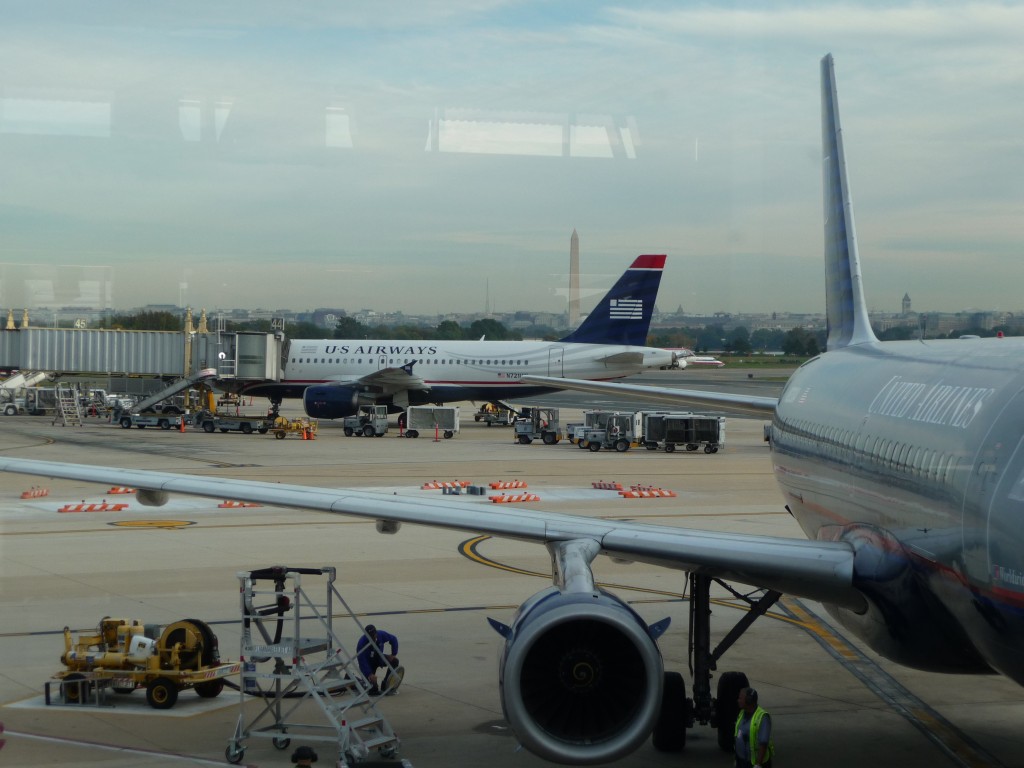
Things happen, so I didn’t get angry in this case. This week, however, I did get mad at US Airways for its failure to invest in a modern website — not a new issue, about which I’ve also written before. That site is probably one of the worst in the industry.

I tried to check in online for a flight from Washington Reagan National Airport (DCA) to New York’s LaGuardia (LGA). Before that, I had attempted to get a seat assignment, but that’s not allowed on shuttle flights until check-in, even in First Class. I did see on the seat map, however, that my preferred 2F was available. So I began the check-in process, but the seat map didn’t open. I tried several times, to no avail. I finally exited, only to find out that the system had automatically assigned me seat 1F.

I didn’t want the bulkhead, but there was no way to change the seat I had. Web support couldn’t help, either, telling me it could only be done at the airport. Of course, by the time I got there the next day, all other seats were gone.

Why is it so difficult for US Airways to offer a working seat map during online check-in? Why is it so hard to allow changes to seat assignments? Why can the websites of United, American and many other airlines provide that service? Is it really rocket science? Almost every airline website has its problems, but US Airways’ beats them all. Its CEO, Doug Parker, needs to realize that it’s 2011.

RETURN TO MAIN COLUMN PAGE

Related stories:

US Airways’ website fails at basics

US Airways hears feedback, fixes website

Does badmouthing airlines help anyone?

Travel companies teach customer-service lessons

Continue reading about How much slack do the airlines deserve?

nkralev on June 8th, 2011

The U.S. Department of Transportation (DOT) seems semi-serious about false airfare advertising. It fined several airlines this week for violating its rules of disclosing taxes and fees, but it still tolerates the disgraceful “one way based on a required round-trip purchase” manipulation practiced by some carriers.

Continental Airlines was fined $120,000 for failing to include fuel surcharges in fares listed on its website. US Airways and TACA, the Central American company, must pay $45,000 and $55,000, respectively, for the same wrongdoing — indicating that fares didn’t include taxes and surcharges, but not disclosing actual amounts.

“Consumers have a right to know the full price they will be paying for airfares,” said Transportation Secretary Ray LaHood. “We established airline price advertising rules to protect the consumer, and will take enforcement action when these rules are violated.”

Starting on Oct. 24, DOT will require airlines to include all taxes, surcharges and government fees in advertised fares — not just using asterisks and fine-print explanations.

However, advertising only half of a ticket price will continue. As I’ve written before, I have nothing against listing one-way fares — when they can be truly bought as such. To this day, American Airlines, Delta, British Airways, Lufthansa and others promote only half of mandatory round-trip purchases on their websites.

In fact, Lufthansa doesn’t even bother to spell out the words, using instead “OW based on RT purchase.” The German carrier doesn’t do those gimmicks on its European sites because of strict European Union rules.

In March, I wrote that United Airlines became the first major U.S. carrier to begin advertising predominantly round-trip fares on its site. Continental has since followed suit. US Airways still uses a mixed method.

One would hope this item will be next on DOT’s agenda.

RETURN TO MAIN COLUMN PAGE

Related stories:

Proper airfare advertising comes to U.S.

Fare sales often lost in translation

When an airfare sale is not quite a sale

Airlines find new way to overcharge fliers

Continue reading about DOT cracks down on airfare advertising

nkralev on April 27th, 2011

One by one, airlines are waking up to the sobering reality of the modern Global Distribution System (GDS) model, which they created decades ago. Two carriers have now taken legal action, and this is only the beginning. If more airlines want to see changes and lower costs, they should join forces instead of watching from the sidelines.

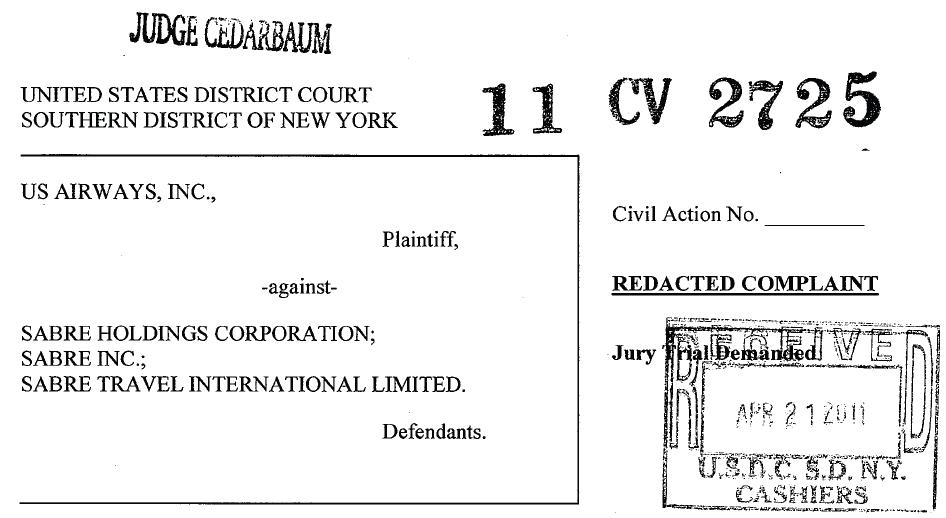
Judge Miriam Goldman Cedarbaum of the United States District Court for the Southern District of New York is about to become an expert on airline data distribution — in the 82nd year of her life. You can see her name stamped on a complaint (pictured above) filed last week by US Airways against Sabre, the largest GDS in the United States.

Sabre should take this lawsuit very seriously. Cedarbaum is not just any judge, and she is certainly not to be trifled with. One of the many high-profile cases she has overseen was against would-be Times Square bomber Faisal Shahzad, who was sentenced to life in prison without parole in October.

The most important reason for Sabre to prepare for a serious fight is the actual merit of the US Airways complaint, which the GDS predictably dismissed in a press release after the court filing. The airline accuses Sabre of monopoly, unfair practices and stifling competition by “locking travel agents” into using the GDS, so they “effectively become unable and unwilling to provide their customers with alternative, more efficient” booking channels.

“Rather than compete on the merits, Sabre has used its massive power over airlines such as US Airways to entrench its antiquated and inefficient technological systems, to preserve its supra-competitive booking fees, and to harm competition,” the carrier wrote in its complaint.

“Sabre’s technology has hardly changed from your grandfather’s distribution system, and was long ago left in the dust by new, innovative solutions that are web-based and take advantage of the networked economy,” it added. “These new offerings, however, have been stifled by the GDSs’ grasp over travel agencies and the exercise of their market power over airlines.”

The airline is referring to the technology I’ve written about before, known as a “Direct Connect” model, which allows carriers to host their data and make bookings independently of a GDS. Airlines prefer that model because it lets them control their data and offer non-airfare products, and it also saves them lots of money.

As I explained in February, about 60 percent of the roughly 1 billion tickets issued worldwide each year are sold through a GDS, according to Farelogix, a technology company mentioned in the US Airways filing. The average GDS fee paid by the airlines is about $12 per ticket, or more than $7 billion a year in distribution costs, Farelogix CEO Jim Davidson told me. In contrast, Farelogix’s “Direct Connect” allows carriers to spend only between $2 and $3 per ticket, saving about 80 percent of the current costs.

In its court filing, US Airways said that 35 percent of its revenue, “amounting to
over $3.5 billion annually, is booked through Sabre.” That’s exactly why no airline wants to be taken off a GDS — whether Sabre, Travelport or Amadeus. That’s also the reason why US Airways is only the second carrier — after American Airlines — to stand up to a GDS.

Having just written about a hybrid model that would make it possible for GDS portals to provide access to a carrier’s “Direct Connect” channel, I was surprised when US Airways signed a new agreement with Sabre several weeks ago. Instead of joining in America’s efforts to change the GDS model, US Airways is simply caving in, I thought.

Earlier this month, American reached an agreement with Expedia to implement a hybrid model, and then sued Travelport and Orbitz, claiming violation of antitrust laws. Online travel agencies like Expedia and Orbitz rely almost exclusively on GDS use, and some of them are owned by GDS companies.

Now US Airways has reconsidered and decided in favor of a fight. In its complaint, it says that Sabre forced it into their latest contract with “numerous oppressive and
anti-competitive terms.” The carrier “had no choice but to sign the agreement, which it did under protest, or face a complete shut off from Sabre’s network,” it said.

One of the most draconian clauses is that US Airways is banned from offering fares on its website unless it also makes them available to Sabre. In addition, Sabre penalizes travel agents who book tickets through any other channel.

As my record in this column shows, I’m a frequent critic of the airlines. But their complaints against the GDS companies are legitimate and need to be addressed. What the GDS management teams are doing is nothing short of business bullying. Worse yet, they pretend to be victims, trying to trick consumers into supporting them by falsely claiming that their model is the only way to ensure comparison-shopping.

Instead, they should be less greedy and let go of their unrealistic dreams of enormous and easy profits. Resisting inevitable change as a result of advanced technology is a recipe for extinction, not prosperity and longevity. The sooner the GDS companies realize that, the better for all parties in the air travel system, including consumers.

For their part, airlines should unite in their opposition to the current GDS model if they want to see results they like. They shouldn’t leave it to American and US Airways to fight their battle alone and then benefit from the outcome — and I’m sure the outcome will ultimately be more favorable for the airlines than the present state of data distribution.

RETURN TO MAIN COLUMN PAGE

Related stories:

American wins first battle in data war

GDS travel-booking model faces change

New seminar on travel-booking war

Airlines find new way to overcharge fliers

The risks of third-party airline bookings

Continue reading about Airlines, want better GDS model? Unite!

nkralev on February 14th, 2011

US Airways has denied recent suspicion that it has begun to block award seats made available by its Star Alliance partners for mileage redemption by members of its Dividend Miles program — a practice pioneered by United Airlines, which I first exposed in 2008.

The airline has been silent on the issue since reports about apparent blocking surfaced last fall. Many travelers said they found award inventory on various Star carriers, using one or more of the publicly available sources — the websites of All Nippon Airways, Continental Airlines and Air Canada — but US Airways agents were unable to see those available seats.

To some of us, that looked very much like StarNet blocking — manipulating the alliance’s award “middleware,” which provides access to any Star partner’s inventory on a first-come-first-served basis, to avoid paying other carriers for seats booked on their flights. The patterns resembled those on United, with the most filtering applied to Business and First Class cabins, though some fliers stumbled on coach seats as well. The most affected availability appeared to be on Lufthansa, but also on Swiss, United and others.

In addition, it made financial sense for US Airways to be limiting access to premium partner awards. In the last couple of years, it has in effect been printing miles with lightening speed, as a result of extraordinary promotions it has had, including selling miles at 100-percent bonus. Many Dividend Miles members bought miles and redeemed them for Business and First Class on partner flights, which likely weighed heavily on US Airways’ budget.

Several travel bloggers wrote about the issue, including Gary Leff on “View from the Wing” and Ben Schlappig on “One Mile at a Times.” Leff was more inclined to give the airline the benefit of the doubt, suggesting the problem might have been caused by technical glitches, as well as US Airways agents’ ignorance that some of their partners have First Class in addition to Business.

I’m not a big Dividend Miles fan, though I did help my sister buy miles for a trip to Europe with her family last summer, so it took me some time to look into the issue. I finally got around to it and alerted a US Airways contact at its Phoenix headquarters who has been very helpful in the past — Valerie Wunder, associate manager of media relations. She asked the powers that be and gave me the following response:

“We don’t block award inventory on other airlines, nor do we do the inverse — other Star partners block us from seeing their inventory to maximize their revenues.”

Probably the most frequent difficulty Dividend Miles members have been experiencing has to do with intercontinental First Class awards on Lufthansa, Swiss and others, so I asked Wunder if US Airways may be trying to restrict access to those specific seats.

“We have no restrictions on redemptions, regardless of class,” she said.

However, she offered no explanation for the problem. The mystery continues.

RETURN TO MAIN COLUMN PAGE

Related stories:

Clarifying United’s StarNet blocking

US Airways hears feedback, fixes website

New Lufthansa business class in a year

Continental shows new transparency

Continue reading about US Airways denies StarNet blocking

nkralev on October 27th, 2010

Do you sometimes prefer making a connection or two instead of taking a nonstop flight, either to save money or rack up more frequent-flier miles? You might have to change your ways. Domestic U.S. transfers are now allowed much less frequently than before, and making connections on flights between an airline’s hubs is almost impossible.

No big deal, you might say. Wouldn’t any reasonable person choose a nonstop any time? Not necessarily. Different travelers have different priorities — some would rather save time, others money. But the best thing about the previous practice was that passengers had options. Now, that’s no longer the case.

Until June, you could make four transfers each way between Washington and Los Angeles on United Airlines — both cities are United hubs. Since then, the lowest fares have said this in the legal routing rules:

TRAVEL MUST BE NONSTOP

It’s not until fares of just under $700 round trip that the routing gets a bit more liberal — but it allows only one connection and only at a hub airport. Here is how this looks in the United tariff:

WAS-CHI/DEN/LAX/SFO-LAX

The slash indicates that you must choose among Chicago, Denver and San Francisco, but you can’t go through two of them — you would have been able to do so had there been a hyphen between them.

How does this affect you? As of this morning, the lowest published United fare between Washington and Los Angeles is $119 each way and books in L class — but it’s only valid on nonstop flights. What if none of the nonstops on the day you need to fly has available L seats? Then you will have to buy up to S booking class — the next lowest currently published — or whatever seat is available. There may be L availability on a connection through Denver, but it wouldn’t qualify for the L fare because it’s not nonstop. The bottom line is, the routing restriction will cost you at least $100 more.

United was actually the last of the major carriers to clamp down on routing rules, and many mileage runners — people who fly just to accumulate miles — had lots of fun for a long time. It still has one of the more liberal rules — except between hubs. American Airlines and US Airways follow the same policy. American requires a nonstop between Dallas and Miami, and US Airways between Philadelphia and Phoenix.

Delta Airlines is one of the strictest. For example, discounted fares between Atlanta, its main hub, and most major cities require a nonstop, even if that city is not a hub, such as San Diego and Las Vegas. A fair comparison would be the United routing between Washington and Las Vegas, which is much more generous:

WAS-SFO/LAX/DEN/CHI/WAS/EWR/HOU/CLE/PHL/CLT/PHX-LAS

This is actually a typical United routing. You can transfer only once at a hub, but it doesn’t necessarily have to be a United hub — Continental and US Airways hubs are also allowed, because United code-shares a huge number of their flights. Of course, current Continental hubs will become United hubs once their merger is complete.

Delta is so strict, in fact, that sometimes it requires a nonstop when neither of the two cities is a hub — for example, between Washington and Los Angeles. The curious part is that Delta doesn’t fly nonstop between those cities, but it code-shares the only daily Alaska Airlines flight from Washington National. So the only way to get a decent fare is to book that one flight at 9:15 a.m. If you can’t, you have to pony up.

To be fair, Delta allows both nonstops and “direct” flights, and when the other carriers say nonstop, they do mean nonstop. “Direct” flights are those fictitious flights I wrote about last month, which have nothing in common except for their number — most of them are operated on different planes and require changing gates and sometimes even terminals.

In addition, Delta is not always as draconian as in the Washington-Los Angeles case. Here is the routing between non-hubs Chicago and Los Angeles:

CHI-SLC/MSP/DTT/CVG/MEM/ATL/LAX/IND/DEN/SFO/LAS/PHX-LAX

The smaller the city, the more liberal the routing — although some bigger places seem to fall through the cracks, probably not for too long. Here is the United routing from Washington to Houston.

WAS-ATL/CLE/DTT/DAY/CMH/IND/RDU-CHI-HOU

WAS-ROC-BUF-CHI-HOU

WAS-ABE/HAR/ROA/SDF/RIC/CAK/CRW/ORF-CHI-HOU

WAS-NYC/EWR-ATL/CLE/DTT/DAY/CMH/IND/RDU-CHI-HOU

WAS-NYC/EWR-ROC-BUF-CHI-HOU

WAS-NYC/EWR-ABE/HAR/ROA/SDF/RIC/CAK/CRW/ORF-CHI-HOU

If you look closely, you will see that up to four transfers are permitted here — this many hyphens are very rare these days. I have the feeling this generosity will disappear once United and Continental start flying as one airline, for which both Washington and Houston will be hubs.

International routings are much more liberal and sometime can fill a page, but that’s a topic for another column.

RETURN TO MAIN COLUMN PAGE

Related stories:

Airlines find new way to overcharge fliers

DOT should ban fictitious flights

Time for travel school — you are invited

Educating the flying public

Continue reading about U.S. carriers tighten routing rules