Aircraft

nkralev on October 14th, 2010

Should the new United Airlines have international first class, like the old United, or not, like the old Continental Airlines? Most frequent fliers expect a decision in favor of one of the two models, but why not go with a mixed model? Why not keep first class on routes where it makes business sense, and fly two-cabin planes where it doesn’t?

Since the two carriers’ merger was announced in May, there have been many opinions in online travel forums advocating just coach and business class, but it’s hard to see the world’s largest airline without long-haul first class at all. Continental may call its premium cabin BusinessFirst, but it’s business class.

In addition, United has already installed new first- and business class seats on more than half of its wide-body fleet, and it makes little sense to now remove first class and expand business class.

Regardless of the mechanics, there are routes that can sustain first class and actually make money, especially now that business travel has recovered from the slump during the global recession. Wouldn’t it be a luxury for United to pick and choose the routes on which it operates three-cabin planes and even change them seasonally?

Many foreign airlines have flown both two- and three-cabin aircraft on long-haul international routes for years, including United partners in the global Star Alliance, such as Lufthansa, Thai Airways and Asiana Airlines. In fact, Asiana currently flies one two-cabin and one three-cabin plane daily between Seoul and Los Angeles. In the Oneworld alliance, British Airways, Cathay Pacific and Qantas use a mixed model.

If you look at the loads in both first and business class on all those carriers, you will discover that they are selling extremely well — many flights in the next few weeks are actually sold out. As I reported last year, the recession forced some airlines to cut back on first-class service temporarily, but things now are very different.

So let’s not count United’s first class out quite yet.

RETURN TO MAIN COLUMN PAGE

Related stories:

Why new United should have domestic business — not first — class

New Lufthansa business class in a year

United, Continental execs at odds over loyalty program

Flying new United route — rare occurrence

What to do with empty premium seats?

Airlines cut back on first-class service

Continue reading about Keeping United international first class
nkralev on October 7th, 2010

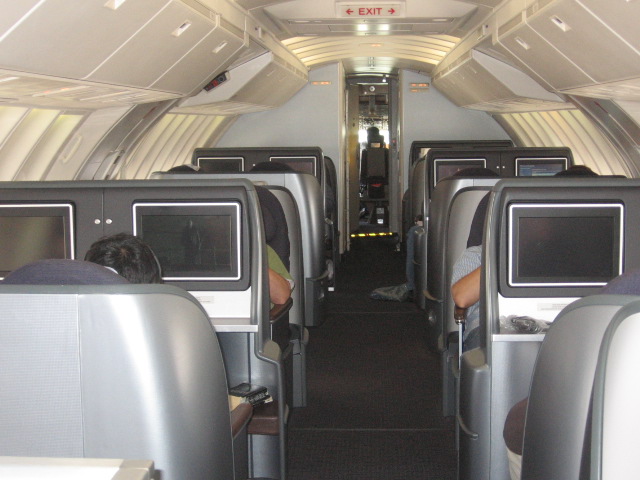
Lufthansa appears to have listened to the recent criticism of its decision to install its old angled business-class seats on the newly arrived Airbus 380 aircraft — finally, truly flat seats are planned when its first Boeing 747-800 enters service in late 2011.

Many Lufthansa customers were puzzled and disappointed when the German carrier didn’t bother to introduce fully flat beds on the A380. It was the perfect opportunity — the current seats have been inferior to those of many competitors for years and don’t quite fit the image of a leading airline, which Lufthansa certainly is. In addition, it rolled out brand-new first-class seats on the A380.

“The next major overhaul will be with delivery of the 747-8I in late 2011,” Lufthansa spokesman Martin Riecken said in an e-mail message. “We already have a test seat on one route, but the final design decisions are still not taken. We improved the current business class slightly with the introduction of the A380 in May this year — mainly ergonomic improvements.”

The company has attributed its decision to stick with the old seats to the delayed A380 delivery, saying they were appropriate when the aircraft orders were first made. It’s unclear, however, if Airbus would have allowed Lufthansa to changed its mind, given that interior work didn’t start until just months before the first delivery in May.

It’s unlikely Lufthansa tried to amend its order, judging by its leadership’s previous comments that the old seats, which are lie-flat but not horizontal to the floor and were first installed in 2003, were sufficient for the time being.

“Our existing seat is not at the very top of the market compared with certain [business class] seats offered by some carriers,” Marianne Sammann, general manager for Lufthansa and Austrian Airlines in Britain and Ireland, was quoted as saying in a Wednesday article in Britain’s Business Traveller magazine. “Perhaps with hindsight we would have considered an alternative, but at the time of ordering the A380 our existing seat was the right product.”

Among Lufthansa’s partners in the global Star Alliance, Air New Zealand, Singapore Airlines, Air Canada, United Airlines and Swiss International Airlines offer truly flat beds in business class.

Interestingly, Singapore reacted to the A380 delay differently from Lufthansa — instead of waiting, it installed the new seats on an order of new Boeing 777-300ER aircraft, which began arriving in 2006.

United Airlines rolled out its new seats in 2008, though it has retrofitted only about half of its fleet so far. Still, those seats are much better than Lufthansa’s, and while United’s soft product may not be as good as Lufthansa’s, United is my choice on an overnight flight to Europe.

Last year, Swiss International Airlines put fully flat beds on its new Airbus 330-300 planes, but it currently has only eight of them. Both Swiss and Austrian are owned by Lufthansa, though Austrian’s hard product is inferior to the other two.

Outside the Star Alliance, Air France, Australia’s Qantas Airways and Emirates all introduced new truly flat beds on their A380 aircraft. Air France, however, also disappointed its customers recently by announcing plans not to install the new seats on other aircraft types.

Lufthansa has 15 A380 planes on order, with the option to buy another five. No details about the new business-class seats are available yet, but it’s clear it will take a few years for its entire fleet to be reconfigured.

RETURN TO MAIN COLUMN PAGE

Related stories:

What to do with empty premium seats?

Airlines cut back on first-class service

Lufthansa agent’s ‘mistake’ stacks up

Continue reading about New Lufthansa business class in a year

nkralev on October 5th, 2010

Are you one of those travelers who wait until they get to the airport to find out that their flight has been delayed or canceled? It’s time to become a proactive flier and learn how to predict disruptions, so you can get rebooked before anyone else on your flight, with a minimum impact on your travel plans.

Although there is no guarantee that your prediction success rate will be 100 percent, because airlines often swap aircraft, the method I’ve adopted works most of the time. It’s actually rather simple: I track the planes assigned to my flights by matching arrival and departure gates. Continental Airlines makes it even easier by providing the most advanced data in the industry, but more on that later.

The aircraft for a United Airlines flight I recently took from Washington to San Francisco came from Sao Paulo. Had the flight from Brazil been late, I would have known hours in advance, which would have allowed me to get rebooked on the phone before even leaving home.

You might ask why you need to waste time tracking planes and matching gates, when airlines usually send e-mail and phone alerts in case of delays and cancellations. I find that I’m usually ahead of them, because for some reason their systems often take hours to update.

If I see that United 952 from Washington to Frankfurt is four hours late, I know immediately that the return flight 953 will be delayed, too. But I’ve seen United take hours to reflect that in its system, perhaps hoping that the plane will make time in the air. That can be a valid reason to wait for a final determination, as can be the possibility that another aircraft may be found to replace the delayed one.

So why am I so sure Flight 953 won’t depart on time if Flight 952 is four hours late? There is only one Boeing 767 flying to Frankfurt daily, and it operates both 952 and 953, which leaves no room for aircraft substitution. In addition, the turnaround time for that plane on the ground in Frankfurt is less than two hours, so there is no way the plane will leave Frankfurt on time after arriving from Washington four hours late.

Knowing the type of aircraft assigned to your flight would make the gate-matching exercise much faster, especially at a hub like Washington Dulles or Chicago. To make it even easier, you can use your departing airport’s website, which will display all arriving flights in a certain time frame with their gates on the same page. If you know your flight leaves from Gate 72 in Los Angeles, save yourself time by going to the LAX website, rather than the United site.

Most planes, of course, operate several flights a day, so if I have time, I track my planes since their first voyage in the morning. Yesterday, for example, the Boeing 767 I flew on from LA to Chicago had started the day in LA, flown to Denver and Chicago before returning to LA to pick me up. By the way, the tail number of that plane was N666UA.

What about aircraft replacement? That’s another reason to do your homework. That flight from Washington to San Francisco I mentioned earlier was scheduled to be operated on a Boeing 767 — with a domestic seat configuration, which means two cabins and those utterly unimpressive domestic first-class seats. As soon as I learned my plane was coming from Sao Paulo, I knew there had been a swap to an internationally configured, three-cabin Boeing 777, so I’d sit in a much more comfortable business-class seat. Since the substitution changed seat assignments, I quickly logged in and grabbed my favorite seat in the business cabin.

All major U.S. carriers’ websites show gate information, but Continental beats them all to the punch by displaying much more valuable data — it actually shows the tail number of the specific aircraft assigned to your flight and tells you where it’s coming from, including the inbound flight’s number. For instance, you are flying from Newark to Berlin on Flight 96 today, your Boeing 767′s tail number is N158CO, and it’s coming from Zurich as Flight 79. Right next to that information on the Continental site is a link to the real-time status of that flight.

Continental goes even further, offering descriptions of beverage and meal services for that particular flight, as well as data on in-seat power, entertainment, aircraft features and seat configuration.

This is a great example of a customer-friendly policy, which the merged United should adopt on its website. In fact, all airlines should provide that information — it would certainly make our lives much easier.

RETURN TO MAIN COLUMN PAGE

Related stories:

Preserving upgrades in case of rebooking

Flight schedule changes overwhelm agents, travelers

Dulles Airport enters the modern age

Continental shows new transparency

Lufthansa agent’s ‘mistake’ stacks up

Continue reading about Predicting flight delays and cancellations

nkralev on April 6th, 2010

Have you been accused by airline agents of trying to “game the system” by asking if they could open up for mileage redemption seats they obviously won’t sell for cash? Now a top airline executive is encouraging fliers to alert agents when the system fails in its predictability, so it can be “tweaked.”

Before you do that, however, make sure you know what you are talking about — learn all booking codes used by the respective carrier, if you haven’t already, and be able to access and understand its inventory data. Just because there are dozens of open business-class seats months before a flight doesn’t mean you are entitled to an upgrade or an “award” ticket.

Still, many frequent fliers have enough knowledge and experience to sense when the yield-management system — the computer software airlines use to predict how a flight will sell — is not working properly. The problem is that most agents are unreceptive when a customer points that out, saying they don’t tell inventory management what to do, because it knows best.

Continue reading about ‘Tweaking’ airlines’ yield management

nkralev on March 18th, 2010

How would you like to fly to Australia in Qantas Airways’ luxurious first class on its new Airbus A380 aircraft for $1,200? You could actually buy such a ticket last week, but as regular readers of this column might have guessed, that was yet another case of a mistake fare.

Just like 2009, the new year began with a major airline making an error when filing a fare, and then deciding not to honor the issued tickets. As I wrote last January, Swiss International Air Lines published a $300 business-class fare from Toronto to several European and Indian cities. In November, British Airways filed a $560 round-trip coach fare from the United States to India.

On Wednesday, it was American Airlines’ turn. A frequent flier noticed that the $1,200 fare from Los Angeles to Sydney, which is typically an economy price, now booked into first class — not even business. Similar fares were available from other U.S. cities…

Continue reading about Airlines refuse to honor mistake fares