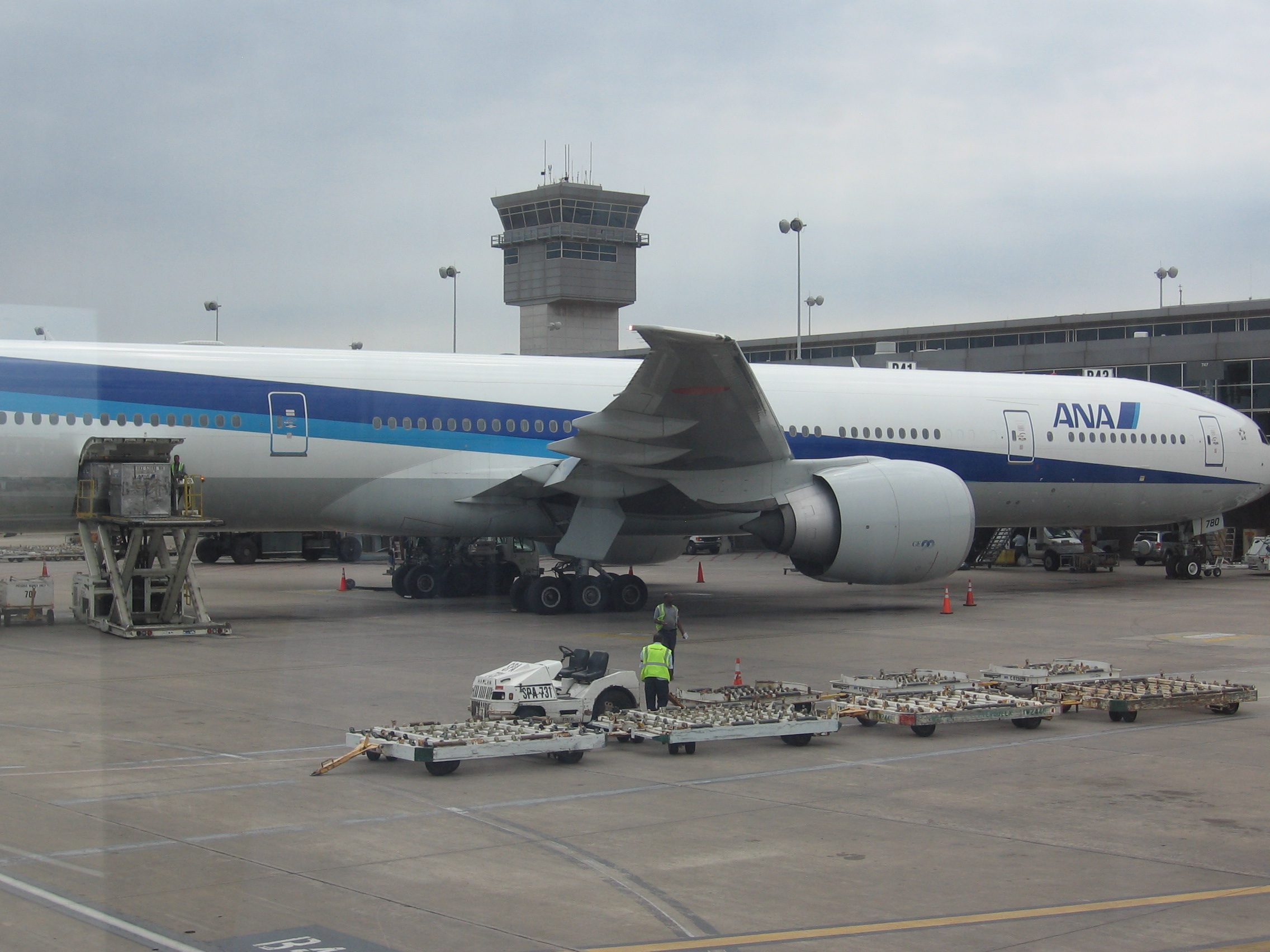
Are you one of those travelers who wait until they get to the airport to find out that their flight has been delayed or canceled? It’s time to become a proactive flier and learn how to predict disruptions, so you can get rebooked before anyone else on your flight, with a minimum impact on your travel plans.
Although there is no guarantee that your prediction success rate will be 100 percent, because airlines often swap aircraft, the method I’ve adopted works most of the time. It’s actually rather simple: I track the planes assigned to my flights by matching arrival and departure gates. Continental Airlines makes it even easier by providing the most advanced data in the industry, but more on that later.
The aircraft for a United Airlines flight I recently took from Washington to San Francisco came from Sao Paulo. Had the flight from Brazil been late, I would have known hours in advance, which would have allowed me to get rebooked on the phone before even leaving home.
You might ask why you need to waste time tracking planes and matching gates, when airlines usually send e-mail and phone alerts in case of delays and cancellations. I find that I’m usually ahead of them, because for some reason their systems often take hours to update.
If I see that United 952 from Washington to Frankfurt is four hours late, I know immediately that the return flight 953 will be delayed, too. But I’ve seen United take hours to reflect that in its system, perhaps hoping that the plane will make time in the air. That can be a valid reason to wait for a final determination, as can be the possibility that another aircraft may be found to replace the delayed one.
So why am I so sure Flight 953 won’t depart on time if Flight 952 is four hours late? There is only one Boeing 767 flying to Frankfurt daily, and it operates both 952 and 953, which leaves no room for aircraft substitution. In addition, the turnaround time for that plane on the ground in Frankfurt is less than two hours, so there is no way the plane will leave Frankfurt on time after arriving from Washington four hours late.
Knowing the type of aircraft assigned to your flight would make the gate-matching exercise much faster, especially at a hub like Washington Dulles or Chicago. To make it even easier, you can use your departing airport’s website, which will display all arriving flights in a certain time frame with their gates on the same page. If you know your flight leaves from Gate 72 in Los Angeles, save yourself time by going to the LAX website, rather than the United site.
Most planes, of course, operate several flights a day, so if I have time, I track my planes since their first voyage in the morning. Yesterday, for example, the Boeing 767 I flew on from LA to Chicago had started the day in LA, flown to Denver and Chicago before returning to LA to pick me up. By the way, the tail number of that plane was N666UA.
What about aircraft replacement? That’s another reason to do your homework. That flight from Washington to San Francisco I mentioned earlier was scheduled to be operated on a Boeing 767 — with a domestic seat configuration, which means two cabins and those utterly unimpressive domestic first-class seats. As soon as I learned my plane was coming from Sao Paulo, I knew there had been a swap to an internationally configured, three-cabin Boeing 777, so I’d sit in a much more comfortable business-class seat. Since the substitution changed seat assignments, I quickly logged in and grabbed my favorite seat in the business cabin.
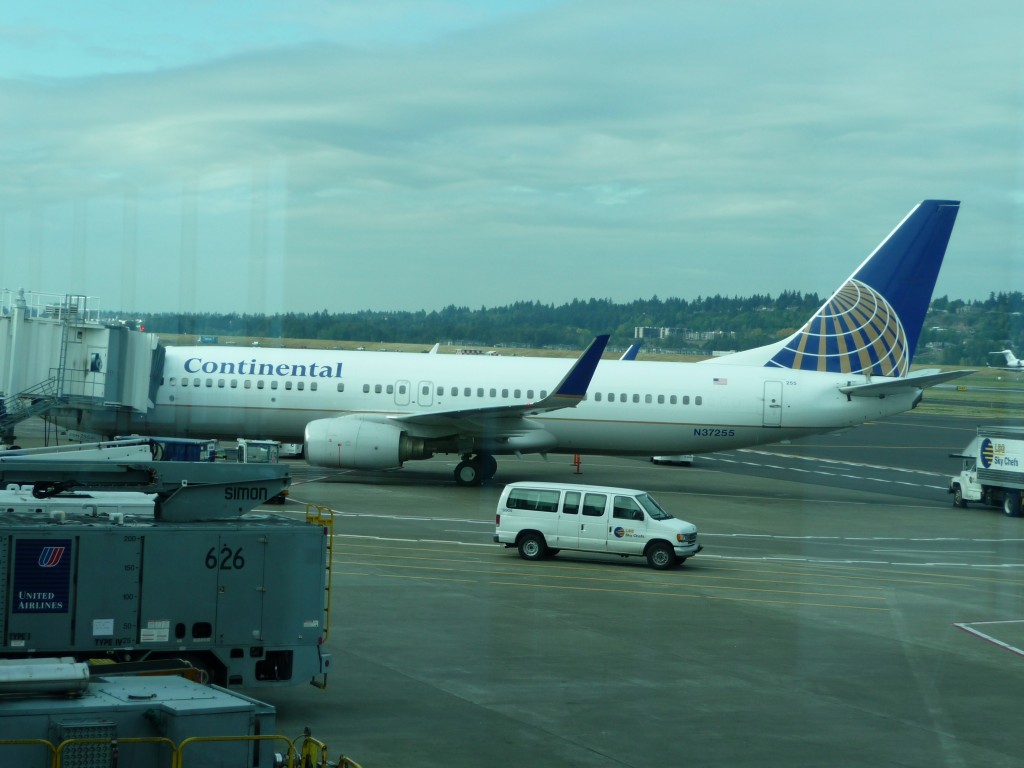
All major U.S. carriers’ websites show gate information, but Continental beats them all to the punch by displaying much more valuable data — it actually shows the tail number of the specific aircraft assigned to your flight and tells you where it’s coming from, including the inbound flight’s number. For instance, you are flying from Newark to Berlin on Flight 96 today, your Boeing 767′s tail number is N158CO, and it’s coming from Zurich as Flight 79. Right next to that information on the Continental site is a link to the real-time status of that flight.
Continental goes even further, offering descriptions of beverage and meal services for that particular flight, as well as data on in-seat power, entertainment, aircraft features and seat configuration.
This is a great example of a customer-friendly policy, which the merged United should adopt on its website. In fact, all airlines should provide that information — it would certainly make our lives much easier.
Related stories:
Preserving upgrades in case of rebooking
Flight schedule changes overwhelm agents, travelers
Dulles Airport enters the modern age
Continental shows new transparency
Lufthansa agent’s ‘mistake’ stacks up
Continue reading about Predicting flight delays and cancellations
US Airways has set a good example of listening to customer feedback and fixing a problem. In my case, there was added criticism in a newspaper column, but instead of complaining, the airline rolled up sleeves and started working.
In March, I wrote in my Washington Times column about its website’s inability to display many itineraries, even when booked directly with US Airways. At the time, spokeswoman Valerie Wunder at the company’s headquarters in Phoenix arranged a conference call with two in-house experts, who told me that the reason for the glitch was the site’s failure to recognize some foreign airport codes.
I’m happy to report that now I can view reservations containing some of the same airport codes I wasn’t able to see before. I hope the problem has been fixed across the system. That said, there are other issues with the US Airways site, but most other airlines have them, too.
Another company that has taken my criticism constructively is RCN, the cable operator. In a May column, I wrote about a massive April 26 outage that reportedly affected not only D.C. but several states. Because most customers have “bundled” services, they lost all of them for about five hours beginning in early afternoon on a Monday — those included businesses and many people working from home, who could do little with no phone and Internet in the middle of a weekday.
I concluded that RCN hadn’t improved its customer-service policies since a previous incident, which I reported a year earlier. In that case, my entire building lost phone, TV and Internet service around 7 p.m. on a Saturday. Service was not restored for more than 18 hours. Customer-service agents in the Philippines gave me and my neighbors conflicting information about the problem and how long it would take to fix it.
After my latest column, I received a call from Richard Beville, vice president and general manager for the D.C. area, who invited me to lunch to discuss how RCN can improve its customer service.
I try to hold companies in different sectors to the same standards everyone expects from airlines, which probably get more criticism than any other industry. While some of that criticism is deserved, the high visibility of thousands of front-line employees with customers around the world every day magnifies even a mundane incident, especially if splashed on Facebook or Twitter.
Continue reading about US Airways hears feedback, fixes website
A new survey by the Consumer Travel Alliance released this week found that luggage and other additional airline fees increase the average ticket price by up to 50 percent. The truth is, there is a relatively easy way to have most of those fees waived — if only travelers were better educated and more open-minded.
My impression during almost constant global travel for most of the last decade is that people think they know how to travel — but then they complain about being “scammed” by the airlines. My approach has been to learn as much as possible about rules, restrictions and fees, and then to look for ways to waive them and generally make the system work for me.
One of the reasons I started the “On the Fly” Seminars was to educate people how to be better travelers — and to change negative attitudes toward travel. In fact, my FLY 201 class covers exactly how to get those extra fees waived: by achieving elite airline status.
Many people think they don’t travel enough to get elite status or it’s cheaper to fly a different airline every time. I find both of these arguments valid in very few cases.
First, you don’t need to fly 100,000 miles a year. The first elite level in most frequent-flier programs will get your baggage fees waived. Moreover, because of elite benefits offered and recognized across global airline alliances, a silver membership with one carrier will secure those waivers on every member-airline. You can fly on any Star member and credit your miles to any of the Star loyalty programs.
However, mileage requirements to achieve status vary greatly. For example, you need 25,000 miles for Premier on United Airlines, which will give you Star Alliance silver status — but you only need 4,000 miles on the alliance’s newest member, Greece’s Aegean Airlines. Not all fares on United earn 100 percent mileage in Aegean’s program, but right now it gives you 1,000 miles just for signing up. I’m sure if most of you looked at your flight history in the past year, you’d see that you could have qualified had you kept your miles in the same place.
Second, relying on Travelocity or Priceline to tell you which airline has the cheapest ticket and go to a different carrier every time is not the best way to fly in the current environment. Even if you had to pay a bit extra to stay within the same alliance — but if you managed to secure elite status — at the end of the year you most likely spent less money because you didn’t pay luggage fees.
There is no question that airlines should make all those extra fees more transparent earlier in the booking process. There is also little doubt that their frequent-flier programs were created to make money. But they do reward their loyal customers, so if you are going to give them your money, why not learn how to benefit from your loyalty as much as you can?
Continue reading about Avoiding luggage and other airline fees
Dealing with flight delays and cancellations is challenging enough for travelers, but for some of us it has an additional complication: How to preserve our upgrades in case of rebooking. My trip to Alaska this week provided a textbook example.
As experienced and creative as I might be in handling flight disruptions, the weather is always my worst enemy. I’ve rarely felt more helpless than I did in Denver on my way to Anchorage. My plane had diverted to Colorado Springs because of a thunderstorm, and my departure time kept being pushed back more times than I cared to count.
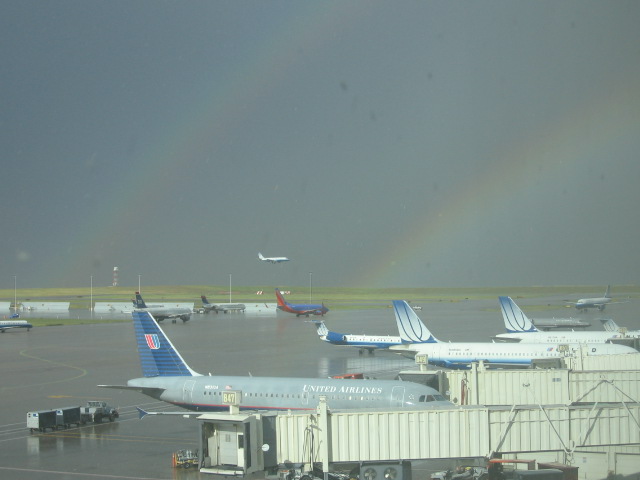
I was sitting in United’s Red Carpet Club watching other planes take off and land, but the one I needed was still at another airport. The only reason to smile was the double rainbow that appeared at one point — you can see it in the photo above.
I had no other options. United has only one flight to Anchorage a day from Denver, though it also flies up there from San Francisco and Chicago. Those flights, however, had already left, so connecting was impossible, even if I could make it to those two cities.
At least I didn’t have to worry about missing another flight, rebooking and potentially losing a previously confirmed upgrade, as this was my last segment for the day.
Things were very different, though, on my way back home. The plane coming to Anchorage from Denver was late — another patch of bad weather had diverted in to Wyoming. It was clear I’d miss my connecting flight, so I called United to get rebooked. The flight I wanted was to Washington National (DCA) — there was no upgrade space available, but they were still selling two revenue seats in first class. An alternative was a flight to Dulles Airport (IAD), which had four revenue seats in first class but nothing to upgrade, either.
A supervisor refused to open upgrade space for me despite the second long delay I was experiencing in three days and was only willing to waitlist me for first class on either flight — there were 22 people waitlisted for an upgrade to DCA, and she didn’t think it was fair to jump me over them.
I got really angry — but not because of her refusal. The plane to DCA was a Boeing 757 and had 24 seats in first class, and the one to IAD was a Boeing 767 with 34 seats in first. Until recently, it was very likely that those flights would have had at least a couple of upgrade seats the night before departure.
But in March, United implemented free domestic upgrades for all elites, which they don’t even need to request. So by the time a top elite member needs a seat because of involuntary rebooking, those seats have been given away to customers with much lower status.
When I got to the Anchorage airport, I saw that I was first on the waitlist, and with two seats still open at 4 a.m. Denver time for an 11 a.m. departure, I thought I was pretty safe. But when I landed in Denver, those two seats were gone. I was still at the top of the waitlist, and three people with reservations on the flight hadn’t checked in.
I did get the upgrade at the gate in the end, but this was the closest I’d come to flying in coach in years.
Continue reading about Preserving upgrades in case of rebooking
Doing something no one has ever done before is both exciting and scary at the same time. In other words, I can use all the help I can get to spread the word.
The “On the Fly” Seminars I mentioned in my column last week are now officially open for registration. The first classes will take place on June 25 and 26 in Washington. If you come, you will learn now to travel cheaply but luxuriously.
For a long time, one of my missions has been to encourage more people to travel — both domestically and internationally. I realize travel has become difficult in recent years, and most of the pleasure that used to come with it has been sucked out by the airline industry’s desperate attempts to lower costs.
There was a time — more than a decade ago — when sitting in the coach cabin didn’t bother me too much. Planes and air travel always excited me, and the promise of what awaited at the other end of my journey left me little time for self-pity. Plus, I’d take only a couple of trips a year.
But then I began traveling around the world for work, as the Washington Times’ diplomatic correspondent, and flying between three continents in a week in coach and enduring today’s airport routine started to seem really ugly. So I decided to look for ways to travel in business class — paying for it wasn’t an option, given my budget limitations, and the only alternative was to achieve the highest elite status by flying 100,000 miles a year.
At the beginning, that wasn’t too easy — it required me to fly on the same airline or its alliance partners. The global alliances — Star, Oneworld and SkyTeam — were not as big as they are today, and none of their member-carriers served some of the countries I went to. Even when they did, that option might not have been the cheapest.
With some creativity and strategic planning, however, I managed pretty well — and the benefits of top elite status changed my life. At the airport, priority lines, business lounges and red-carpet boarding have made the experience much less of a hassle. On board, I’ve enjoyed flat beds, great meals and on-demand entertainment, thanks to complimentary upgrades I’ve been able to confirm long before a flight.
The real challenge was how to maintain that combination of paying low fares and flying in luxury year after year. Since knowledge means power, I decided to take the power in my own hands and stop relying on travel agents or online booking engines to find me the best deals — by learning all I could about airfares and airline inventory, and by accessing raw, real-time airline data right from the source where it’s published.
Now I’ve decided to share my knowledge and experience with others. Come see for yourself.