Diplomats

nkralev on July 30th, 2010

The middle of the summer is a good time to review the balance of political appointees vs. career diplomats in ambassadorial posts around the world. Not surprisingly, the familiar 30-percent quota for political appointments of the last several decades remains largely intact.

Actually, for some people, continuing the tradition of awarding presidential campaign contributors with embassies may be surprising, given President Obama’s promise to change the way Washington works during the 2008 election.

However, as I wrote a year ago, reality set in soon after Obama took office. According to a list maintained by the American Foreign Service Association (AFSA), the diplomats’ union, of all ambassadors Obama has nominated so far, about 40 percent are political appointees.

That number, though, is a bit misleading, because almost all political appointees change when a new president moves into the White House — unlike career diplomats, who typically remain in their posts for another year or two. It’s more appropriate to look at all embassies around the world — not just Obama’s nominees — and the AFSA list shows 29.7 percent political appointees out of 185 positions globally. That number is slightly lower than it was during the last years of George W. Bush’s presidency.

Another interesting number is that of the nominated but not-yet-confirmed career diplomats under Obama — there are 40 in each category. In contrast, of 55 political appointees, 52 have been confirmed by the Senate.

This issue is understandably controversial for Foreign Service members, and there was a time last year when the White House was on its way to nominating more than 30 percent political appointees. As I reported then, Secretary of State Hillary Clinton had to interfere.

“Why is ours the only profession where it’s considered acceptable to appoint someone without any experience?” Steven B. Kashkett, AFSA’s acting president, said at the time. “Would you appoint someone to head a hospital without medical experience?”

Continue reading about Political ambassadorships hold at 30%

nkralev on July 2nd, 2010

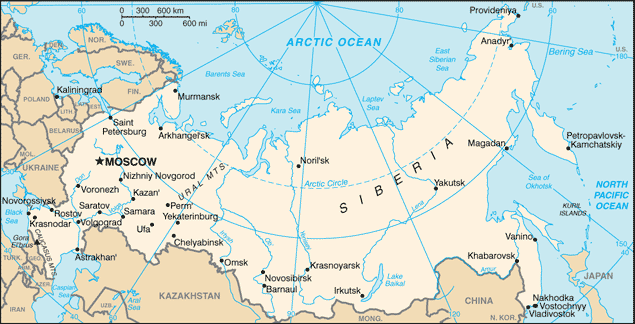
Many people, including famous ex-KGB spies, were shocked this week that Russia is still spying on the United States. Really? Did we forget that even Washington’s allies have been known to engage in such activities?

As I said in three radio and TV interviews, the real surprise in the latest case is that those people were willing to risk so much to gain so little. It appears that they sent no classified information or any other intelligence secrets to Moscow in the decade they operated.

In fact, most of the information they were tasked with collecting can be obtained in perfectly legal ways. What will President Obama’s agenda be during his trip to Russia? What will the U.S. negotiating position be on the new START treaty? Those were among the questions I was trying to answer at the time, along with my colleagues on the diplomatic beat and analysts at various think-tanks. Of course, we all wanted to know the answers before they were made public — no matter whether we intended to publish them or not.

I still don’t fully understand why the Russians had to resort to such complicated and sophisticated methods from the golden age of spying. The best explanation I could come up with is that they didn’t comprehend the rules of the U.S. policy community, or perhaps they were too paranoid to have diplomats at the embassy in Washington try to get the information they needed.

Why do you think foreign diplomats invite U.S. journalists to lunch? Sure, they have their own propaganda to spread, but they also try to learn things, since many Washington reporters are better plugged-in to U.S. policy-making and personalities than the average diplomat.

The main difference in the purpose of the Russians’ activities in this case compared to the Cold War is that, back then, they were trying to harm U.S. interests. Now their goal was to use the collected information to protect and advance Russian interests. A legitimate goal but certainly an illegitimate method to achieve it.

Continue reading about Who thought spying on U.S. was dead?

nkralev on June 20th, 2010

Historically, the State Department hasn’t been a big champion of education and training — it has relied mostly on diplomats learning their craft on the job, and taking time for a course at the Foreign Service Institute (FSI) in Arlington, Va., was long deemed almost futile.

The introductory A-100 class every new diplomats is required to take, has been shortened several times over the past two decades, and is now only five weeks long. Given that many Americans join the Foreign Service with no significant knowledge, background or experience in foreign affairs, it’s hard to understand how they can be prepared to represent the United States abroad in five weeks, before they arrive at their first posts.

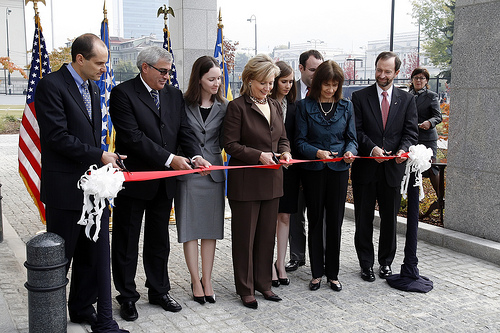
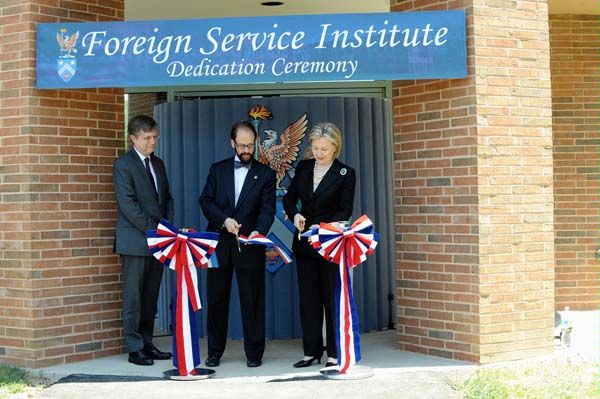
However, that attitude has been changing in the last several years, and FSI’s new expansion, which was christened by Secretary of State Hillary Clinton on June 18, is the latest proof. Nearly 100 new classrooms have been built, adding to the institute’s facilities that can now train as many as 60,000 students a year, according to Clinton.

“FSI once trained 3,000 students a year with a focus on orientation and language skills,” she said. “the curriculum has been widened in order to provide more of the education and training that is called for, including classes in public diplomacy and outreach, crisis response and stabilization, economic governance and democracy building, and preparation for high-stress assignments to the most difficult posts in places like Iraq, Afghanistan and Pakistan.”

There are no indications that A-100 will be extended beyond five weeks.

“By adding nearly 100 classrooms, we will help ensure that FSI continues to provide the full training curriculum and the training experience. I mean, it’s not just what you learn in the classroom. It’s the interactions. It’s the space to be able to spend time and learn from each other, the mentoring that goes on,” Clinton added.

FSI, whose official name is George P. Shultz National Foreign Affairs Training Center, was founded in 1947. It replaced the Foreign Service School, which was established in 1924.

Continue reading about Foreign Service school adds 100 classrooms

nkralev on April 29th, 2010

A dispute over the State Department budget has pitted the chairman of the Senate Budget Committee, Sen. Kent Conrad of North Dakota, against a fellow Democrat and head of the Foreign Relations Committee, Sen. John F. Kerry of Massachusetts, and the Obama administration.

Mr. Conrad led an effort to slash President Obama’s $58 billion international affairs request for 2011 by $4 billion, a cut his committee approved last week. Despite protests from Secretary of State Hillary Rodham Clinton and all her living predecessors, the senator stood his ground on Wednesday.

“The fact is that international funding has grown significantly in recent years,” he said. “Budgets are about setting priorities. Our budget provides a responsible and balanced approach”…

Continue reading about Cuts to State Dept. budget ignite interparty row

nkralev on April 9th, 2010

The State Department plans to create seven new senior positions to ensure that a public-diplomacy perspective is always “incorporated” in policy-making around the world, as well as to respond quickly to negative coverage of the United States in foreign media.

In an ambitious strategy that goes beyond any previous efforts to reach out to other countries, the Obama administration “seeks to become woven into the fabric of the daily lives of people” there, its top public-diplomacy official said Wednesday.

“We must do a better job of listening, learn how people in other countries and cultures listen to us, understand their desires and aspirations, and provide them with information and services of value to them,” said Judith A. McHale, undersecretary of state for public diplomacy and public affairs…

Continue reading about State plans new public diplomacy posts