nkralev on July 30th, 2010

The middle of the summer is a good time to review the balance of political appointees vs. career diplomats in ambassadorial posts around the world. Not surprisingly, the familiar 30-percent quota for political appointments of the last several decades remains largely intact.

Actually, for some people, continuing the tradition of awarding presidential campaign contributors with embassies may be surprising, given President Obama’s promise to change the way Washington works during the 2008 election.

However, as I wrote a year ago, reality set in soon after Obama took office. According to a list maintained by the American Foreign Service Association (AFSA), the diplomats’ union, of all ambassadors Obama has nominated so far, about 40 percent are political appointees.

That number, though, is a bit misleading, because almost all political appointees change when a new president moves into the White House — unlike career diplomats, who typically remain in their posts for another year or two. It’s more appropriate to look at all embassies around the world — not just Obama’s nominees — and the AFSA list shows 29.7 percent political appointees out of 185 positions globally. That number is slightly lower than it was during the last years of George W. Bush’s presidency.

Another interesting number is that of the nominated but not-yet-confirmed career diplomats under Obama — there are 40 in each category. In contrast, of 55 political appointees, 52 have been confirmed by the Senate.

This issue is understandably controversial for Foreign Service members, and there was a time last year when the White House was on its way to nominating more than 30 percent political appointees. As I reported then, Secretary of State Hillary Clinton had to interfere.

“Why is ours the only profession where it’s considered acceptable to appoint someone without any experience?” Steven B. Kashkett, AFSA’s acting president, said at the time. “Would you appoint someone to head a hospital without medical experience?”

Continue reading about Political ambassadorships hold at 30%

nkralev on July 23rd, 2010

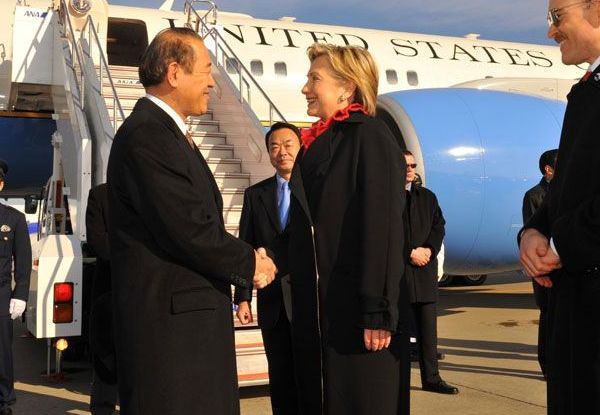
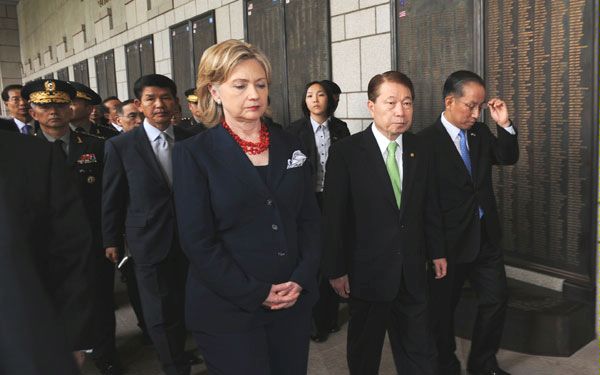
Secretary of State Hillary Clinton this week accomplished a diplomatic feat that her immediate predecessors tried but failed repeatedly to pull off: visiting South Korea, but skipping Japan and China on the same trip. It may sound immaterial, but defying protocol is a tricky thing in diplomacy, especially in Asia.

For years, I’ve been very amused when the State Department would send us in the traveling press corps a note about the secretary plans to visit just South Korea or just China or just Japan. Every time, I’d smirk and bet that he or she would end up going to all three countries — and I was right. That had become a tradition — the Japanese in particular considered it an affront to be ignored by their staunchest ally in favor of Seoul or Beijing.

In early 2008, Condoleezza Rice had to go to South Korean President Lee Myung-bak’s inauguration, and initially had no intention of stopping in Tokyo or Beijing. But after diplomatic pressure from both capitals, she caved in. I skipped Tokyo on that trip.

Clinton herself fell victim to protocol in May. She had to co-chair the so-called U.S.-China Strategic and Economic Dialogue with Treasury Secretary Timothy Geithner in Beijing, and to drop by the 2010 Shanghai Expo in Shanghai. For months, her aides said that no other stops were planned, but in the end, she went to Japan and South Korea, too.

It seems that this time Clinton successfully defied protocol. It helped that she met with her Japanese and Chinese counterparts at the annual meeting of foreign ministers from the Association of Southeast Asian Nations (ASEAN) in Vietnam. But I have little doubt that, in spite of those meetings, the Japanese and Chinese still lobbied for her to drop by their capitals.

By the way, this ASEAN meeting was the first I’ve missed in years. I always thought attending a high-level summit in Southeast Asia in late July was a misery because of the very hot and humid weather, but DC is much worse these days.

Continue reading about Clinton pulls off diplomatic rarity in Asia

nkralev on July 22nd, 2010

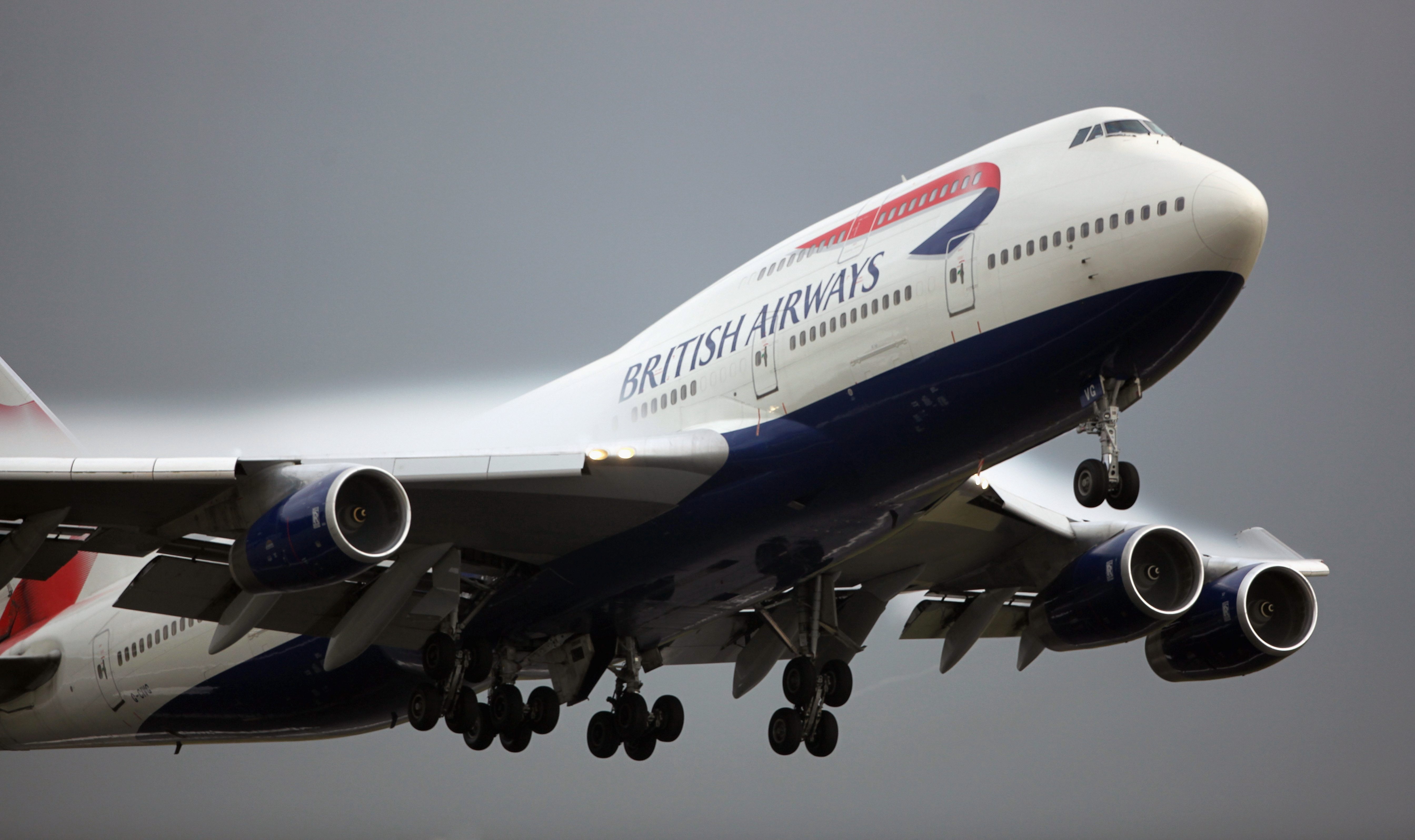
British Prime Minister David Cameron surprised many this week by traveling to Washington for his first official White House visit since taking office on a commercial British Airways flight, instead of taking a dedicated plane, to save money. Now some Americans are wondering if U.S. officials could follow suit.

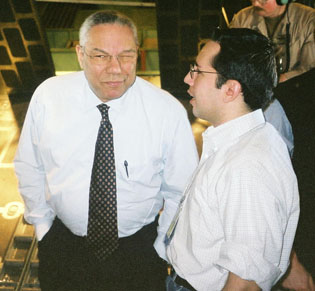
Having traveled around the world with four U.S. secretaries of state — Hillary Clinton, Condoleezza Rice, Colin Powell and Madeleine Albright — over the last decade, I can see how commercial flying would save the State Department millions of dollars a year. However, it would also guarantee a logistical nightmare.

Most people don’t know that Clinton has been taking commercial flights since she became secretary of state, but that happens only when she goes home to New York from DC. Work-related flights to New York are flown on small Air Force planes.

On foreign trips, the security detail and the staff accompanying the secretary make for a large entourage that would be hard to accommodate on one commercial aircraft in business or first class. Knowing the security requirements, I’m guessing regular passengers would be required to board two hours before takeoff.

More importantly, the secretary often visits more than one country in one day, so trying to accomplish that commercially is practically impossible. Not to mention that nonstop flights don’t exist to many destinations most of the time.

Last year, I wrote two columns detailing Clinton’s first trip as America’s chief diplomat.

Rice used to take a smaller plane than the C-32 — the Air Force version of the Boeing 757 — on quite a few trips. That required most of the staff and press corps to fly commercially, which was fine with me, since I flew much more comfortably and got tons of frequent-flier miles.

Apparently, Cameron didn’t have the limitations mentioned above, and there are plenty of nonstop stop between London and DC. It’s impressive, though, that he flew in business class — not first — and his meetings in DC were arranged around the British Airways schedule, according to the British press. His two immediate predecessors, Gordon Brown and Tony Blair, also flew on a BA plane, but it was chartered and dedicated to them.

Speaking of the State Department and saving money on travel, I’ve witnessed excessive spending of taxpayers dollars for years, but that’s a topic for another column.

Continue reading about British leader flies to DC commercially

nkralev on June 20th, 2010

Historically, the State Department hasn’t been a big champion of education and training — it has relied mostly on diplomats learning their craft on the job, and taking time for a course at the Foreign Service Institute (FSI) in Arlington, Va., was long deemed almost futile.

The introductory A-100 class every new diplomats is required to take, has been shortened several times over the past two decades, and is now only five weeks long. Given that many Americans join the Foreign Service with no significant knowledge, background or experience in foreign affairs, it’s hard to understand how they can be prepared to represent the United States abroad in five weeks, before they arrive at their first posts.

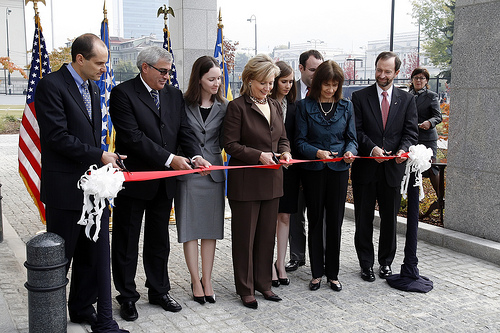
However, that attitude has been changing in the last several years, and FSI’s new expansion, which was christened by Secretary of State Hillary Clinton on June 18, is the latest proof. Nearly 100 new classrooms have been built, adding to the institute’s facilities that can now train as many as 60,000 students a year, according to Clinton.

“FSI once trained 3,000 students a year with a focus on orientation and language skills,” she said. “the curriculum has been widened in order to provide more of the education and training that is called for, including classes in public diplomacy and outreach, crisis response and stabilization, economic governance and democracy building, and preparation for high-stress assignments to the most difficult posts in places like Iraq, Afghanistan and Pakistan.”

There are no indications that A-100 will be extended beyond five weeks.

“By adding nearly 100 classrooms, we will help ensure that FSI continues to provide the full training curriculum and the training experience. I mean, it’s not just what you learn in the classroom. It’s the interactions. It’s the space to be able to spend time and learn from each other, the mentoring that goes on,” Clinton added.

FSI, whose official name is George P. Shultz National Foreign Affairs Training Center, was founded in 1947. It replaced the Foreign Service School, which was established in 1924.

Continue reading about Foreign Service school adds 100 classrooms

nkralev on June 1st, 2010

Secretary of State Hillary Clinton mentioned my departure from the Washington Times during a press conference today. Here is part of the official transcript:

MR. CROWLEY: On his last day of covering the State Department, Nick Kralev of The Washington Times.

SECRETARY CLINTON: Oh, Nick.

QUESTION: Hello.

SECRETARY CLINTON: We should sing Auld Lang Syne or something. (Laughter.)

QUESTION: Well, thank you very much even without doing it.

Madam Secretary, I’d like to ask you a couple things about the Israeli situation which, as you know, is getting more and more serious by the day. I know there are many unknowns at this point, but do you accept Israel’s argument of self-defense? And do you think that the investigation should be done by Israel or by a third independent party, as other Security Council members have said?

And more broadly, we all know there are so many moving pieces to this. There’s Turkey, there’s Israel and in the Palestinians, there’s Iran, there’s Syria. What are the implications in your mind of this situation to the peace process and in the larger issues in the Middle East? Thanks.

SECRETARY CLINTON: Well, Nick, on your last day, you’ve asked a very complicated set of interrelated questions. And let me put it into context as I respond…

Later, State Department spokesman P.J. Crowley added his own best wishes:

MR. CROWLEY: But before we start, I want to pay tribute to Nick Kralev. It is our last — his last day at the — covering the beat here at the State Department. Nick, best wishes with your upcoming book project.

QUESTION: Thank you, P.J., and thanks for your work and all your help in the last year and a half.

It was time to move on, but I’m sad I’m leaving during Clinton’s tenure. She has been a great secretary to cover and travel with — and she has surprised everyone with her performance in a position she never expected to hold.

Continue reading about Clinton mentions my last day at State