Seoul

nkralev on November 16th, 2010

One of the questions I’ve been asked most frequently in the last decade is whether I’ve earned any frequent-flier miles from my nearly 200 flights with four U.S. secretaries of state. Sadly, the answer is no — and what makes it even sadder is that my press colleagues accompanying the president do get miles and even elite status.

I’ve known many journalists over the years who were top elites purely as a result of White House travel. Some of them didn’t really use their elite benefits because of their very limited commercial flying. There were also a few who didn’t even know they had the coveted status.

So why the differentiation? The above photo will help explain things. I snapped it while waiting for Secretary of State Hillary Clinton in Beijing a year ago — we flew to Afghanistan that day.

Clinton’s plane is the one of the right — as I wrote last year, it’s the Air Force version of the Boeing 757, also known as C-32. Air Force One — the Boeing 747 on the left — was waiting for President Obama and later took him to Seoul.

The State Department traveling press corps — about a dozen on average — flies on the secretary’s aircraft. Air Force One, however, has enough seats only for a pool of 12, and usually more than 100 reporters go on a foreign presidential trip. There is a rotation for the pool seats on every flight, but most of the time reporters fly on a so-called press plane chartered by the White House, usually from United Airlines.

What you don’t see on the above photo is that, across from the two Air Force planes, to the left of the traffic lane, there was a parked United aircraft, which was of course the press charter.

Everyone on that plane earned United miles, and many of those traveling with the president regularly have 1K status — United’s highest published elite level, requiring 100,000 flown miles per calendar year. Moreover, fliers get first-class mileage credit, which means 150 percent elite-qualifying miles.

Before every trip, different airlines bid for the charter contract, and the White House travel office and the White House Correspondents Association choose the offer they deem best. Although most of the time they select United, for Obama’s trip to Asia last week the winner was Delta Airlines.

The trip took travelers around the world — they flew over the Atlantic en route to India, then went to Indonesia, South Korea and Japan, before returning to Washington via the Pacific. According to the Great Circle Mapper, that’s about 22,000 miles. Delta spokesman Anthony Black declined to say whether the fliers will earn mileage, citing “customer privacy.”

I admit I’ve been a little jealous about all the “missed” miles over the years — almost half a million — but I never wanted to cover the White House because of the domestic politics involved in that beat.

I found another way to earn miles from official trips. After flying almost 100,000 miles with Colin Powell in 2003, I’d had it with non-mileage-earning flights. I still needed to re-qualify for 1K. The following year, I decided that I’d go on the secretary’s plane but would drop off at the last stop and come home commercially. Now I’ve been 1K for a decade.

Some of you might think I was crazy to give up a seat on the secretary’s plane and a hassle-free journey, not having to worry about passport control, customs and sometimes even security screening.

But I thought about it in a different way. I was paying half the price the State Department would charge me — yet, I was getting much better seats as a result of business-class upgrades, mileage credit and better food — yes, even on United.

RETURN TO MAIN COLUMN PAGE

Related stories:

My trips with Clinton back in the news

In air with Clinton on first trip abroad

Clinton weathers job’s long flights

Press ready for Obama, Clinton travel

Continue reading about Flying with Obama and earning miles

nkralev on October 14th, 2010

Should the new United Airlines have international first class, like the old United, or not, like the old Continental Airlines? Most frequent fliers expect a decision in favor of one of the two models, but why not go with a mixed model? Why not keep first class on routes where it makes business sense, and fly two-cabin planes where it doesn’t?

Since the two carriers’ merger was announced in May, there have been many opinions in online travel forums advocating just coach and business class, but it’s hard to see the world’s largest airline without long-haul first class at all. Continental may call its premium cabin BusinessFirst, but it’s business class.

In addition, United has already installed new first- and business class seats on more than half of its wide-body fleet, and it makes little sense to now remove first class and expand business class.

Regardless of the mechanics, there are routes that can sustain first class and actually make money, especially now that business travel has recovered from the slump during the global recession. Wouldn’t it be a luxury for United to pick and choose the routes on which it operates three-cabin planes and even change them seasonally?

Many foreign airlines have flown both two- and three-cabin aircraft on long-haul international routes for years, including United partners in the global Star Alliance, such as Lufthansa, Thai Airways and Asiana Airlines. In fact, Asiana currently flies one two-cabin and one three-cabin plane daily between Seoul and Los Angeles. In the Oneworld alliance, British Airways, Cathay Pacific and Qantas use a mixed model.

If you look at the loads in both first and business class on all those carriers, you will discover that they are selling extremely well — many flights in the next few weeks are actually sold out. As I reported last year, the recession forced some airlines to cut back on first-class service temporarily, but things now are very different.

So let’s not count United’s first class out quite yet.

RETURN TO MAIN COLUMN PAGE

Related stories:

Why new United should have domestic business — not first — class

New Lufthansa business class in a year

United, Continental execs at odds over loyalty program

Flying new United route — rare occurrence

What to do with empty premium seats?

Airlines cut back on first-class service

Continue reading about Keeping United international first class

nkralev on July 23rd, 2010

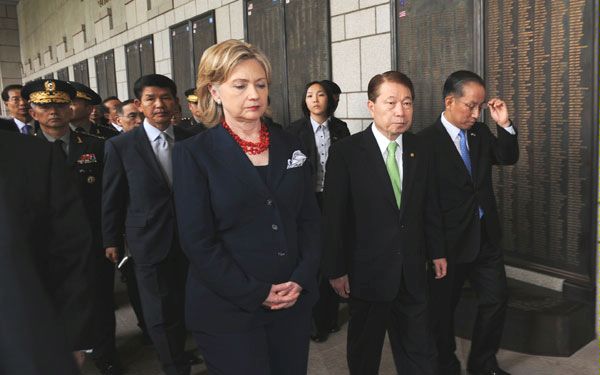
Secretary of State Hillary Clinton this week accomplished a diplomatic feat that her immediate predecessors tried but failed repeatedly to pull off: visiting South Korea, but skipping Japan and China on the same trip. It may sound immaterial, but defying protocol is a tricky thing in diplomacy, especially in Asia.

For years, I’ve been very amused when the State Department would send us in the traveling press corps a note about the secretary plans to visit just South Korea or just China or just Japan. Every time, I’d smirk and bet that he or she would end up going to all three countries — and I was right. That had become a tradition — the Japanese in particular considered it an affront to be ignored by their staunchest ally in favor of Seoul or Beijing.

In early 2008, Condoleezza Rice had to go to South Korean President Lee Myung-bak’s inauguration, and initially had no intention of stopping in Tokyo or Beijing. But after diplomatic pressure from both capitals, she caved in. I skipped Tokyo on that trip.

Clinton herself fell victim to protocol in May. She had to co-chair the so-called U.S.-China Strategic and Economic Dialogue with Treasury Secretary Timothy Geithner in Beijing, and to drop by the 2010 Shanghai Expo in Shanghai. For months, her aides said that no other stops were planned, but in the end, she went to Japan and South Korea, too.

It seems that this time Clinton successfully defied protocol. It helped that she met with her Japanese and Chinese counterparts at the annual meeting of foreign ministers from the Association of Southeast Asian Nations (ASEAN) in Vietnam. But I have little doubt that, in spite of those meetings, the Japanese and Chinese still lobbied for her to drop by their capitals.

By the way, this ASEAN meeting was the first I’ve missed in years. I always thought attending a high-level summit in Southeast Asia in late July was a misery because of the very hot and humid weather, but DC is much worse these days.

Continue reading about Clinton pulls off diplomatic rarity in Asia

nkralev on May 17th, 2010

One of the biggest misconceptions about the travel industry is that it offers the worst customer service around. In fact, in the last couple of years, airline and hotel companies have achieved significant improvements, and it would be wise for other businesses to watch and learn.

Regular readers of this column can testify that I’m no apologist for the travel sector — I try to point out both good and bad practices, though the criticism may sometimes outweigh the praise. But I get angry when I read or hear in the media that airlines are synonymous with bad customer service.

As I wrote a year ago, the constant face-to-face interaction of thousands of front-line airline and hotel employees with customers around the world every day magnifies even a mundane incident, especially if splashed on Facebook or Twitter. The high visibility has taught carriers and hospitality companies valuable lessons, and many of them have learned from their mistakes…

Continue reading about Travel companies teach customer-service lessons

nkralev on March 18th, 2010

It’s puzzling why in the United States, one of the most lucrative travel markets in the world, the concept of airport transit hotels is so foreign. There are signs that may be changing, but current plans seem more like baby steps than bold decision-making.

A recent trip to Asia reminded me of the lack of entrepreneurial thinking exhibited by many U.S. airport operators. Readers of this column may remember my praise for terminals in Hong Kong and Singapore earlier this year.

Beyond design, comfort and cleanliness, having such a time- and hassle-saving convenience as a hotel under the same roof as your departure gate makes a lot of sense at a large international airport. It’s not hard to imagine that it could be a moneymaking venture…

Continue reading about Hotels steps away from airport gates