Sheraton
When it comes to elite status downgrades, the landing can be either hard or soft, and each company in the travel industry has its own rules. Hilton’s harsh and inflexible policy has just made it easier for me to defect — a move I’ve been contemplating for more than a year.
I have previously written columns critical of Hilton HHonors, the hotel chain’s loyalty program. I haven’t enjoyed it, because I like the person in charge of the program — Jeff Diskin, senior vice president for global customer marketing at Hilton Worldwide. However, Hilton HHonors has lost much of its competitiveness in recent years.
I’ve been a Diamond member of the program consistently since 2003, and the Hilton chain was my first choice when booking hotel rooms for years. If it had no properties in the place I was going to — or they were too expensive — my second choice was Starwood, the program that includes Sheraton, Westin and St. Regis, among other brands.
I have two main criteria when I assess hotel loyalty schemes. The first is the meaningfulness of the benefits that come with elite status. The second is the number of points accrued on paid hotel stays and the points needed for an award stay. On both fronts, Hilton HHonors has fallen behind its competitors. Top elite benefits are not as good as those at Starwoord or Hyatt, for example, and award rates have been significantly inflated — more so when compared to other programs’ points devaluation.
My travel slowed down in 2010 — I flew just over 100,000 miles instead of the 200,000 the previous year — and I knew I wouldn’t accrue the 28 stays required to maintain my Diamond status. Many companies, including Starwood and the airline British Midland (BMI), offer elite members who haven’t met the requirements for re-qualification a soft landing — they downgrade you to the next lower elite tier, not the bottom one, regardless of how many points or miles you’ve accumulated in the last year.
I had only two stays with Starwood in 2010, and I needed 10 to qualify for Gold status. However, as a Platinum member last year who lost the status for 2011, I was given Gold status anyway. The same thing happened with my BMI membership — I went from Gold to Silver, even though I didn’t credit a single mile to my BMI account in 2010.
Ironically, I almost had the number of stays needed for Gold Hilton status but was still downgraded from Diamond to Silver last week. I could have had Silver after only four stays, instead of the 14 I made. I knew about Hilton’s hard-landing policy but thought that getting closer to the required 16 stays might help. On a trip to Las Vegas in December, my non-Hilton hotel was included in a prepaid package. Still, I decided to book a room at the Hilton and pay extra — that was my 14th stay.
However, Hilton HHonors showed no appreciation whatsoever. So I got Starwood Gold after two stays, but 14 stays weren’t enough for Hilton. I realize there are official policies, but that’s not the point. There are many ways to reward customer loyalty, especially after seven years of qualifying for Diamond status — not with credit card spending, but with actual hotel stays.
Hilton Worldwide has some great properties. The Conrad hotels are among my favorites, particularly those in Asia. I’ve been delaying the inevitable, but Hilton HHonors just made it easier to say goodbye. The program no doubt still works for many travelers, but it doesn’t work for me — and that’s what matters.
Related stories:
Hilton embraces ‘games-players’
Hilton or Starwood? Not even a close call
Hilton, InterContinental cross swords
Hilton devalues its loyalty program
Continue reading about Hilton tries hard to lose my business
I’m no expert in hotel management, but it seems reasonable to expect that, when a Wyndham property becomes a Sheraton, there would be a transition period — even just one day — during which the hotel would be closed to make various changes. That didn’t happen in Miami, and hundreds of guests are still being disserviced as a result every day.
I stayed at the Sheraton Miami Airport last week and was stunned how easily a hotel can get away with charging high rates but failing to provide basic necessities, such as heat. I’m all for letting the market determine prices, except that guests book rooms at the Sheraton not knowing they will be cold and their TV won’t work.
I realize it’s warm in Miami this time of year, and the temperature reached the low 70s the day I checked in at the Sheraton — but at night it fell to about 50F. For me, that’s cold. Moreover, most U.S. hotels are obsessed with air-conditioning, and my rooms are often frigidly cold when I arrive. I expected to be warm in Miami — if I wanted cold, I would have stayed in DC.
The heating capability of my air-conditioner in Miami was disabled, and the only thing I could do was to at least turn off the cold, but not much had changed three hours later. The temperature outside dropped, and cold air from the hallway was coming in through the unusually wide gaps under my door and on the side.
I had work to do but wasn’t being very productive, so I thought I’d watch a little TV to take my mind off the cold. Another surprise: Most channels on the fancy flat TV didn’t work. I approached the desk to call guest services and realized there was no phone on it. There was one on the nightstand.
By the way, I was in one of the hotel’s best rooms, according to the clerk who checked me in. I’d used my Starwood points to reserve an upgraded room, even though I should have received a free upgrade as a Platinum Starwood member.
I went down to the front desk and alerted the same clerk about the phoneless desk, thinking it was probably an oversight. I couldn’t remember the last time I’d stayed at a hotel of that category that didn’t have a phone on the desk. I’d been at the Hampton Inn at the Miami airport the night before, and that much cheaper property had two phones in the room. Obviously, it’s not a big deal, but there are certain standards hotels are required to respect to maintain their category.
The clerk said he’d never heard of any hotel room having two phones. Minutes later, an engineer who came to my room told me a different story. The hotel had been a Wyndham property until Dec. 15, 2010, when it became a Sheraton overnight. The new management decided it would keep it open and save money by fixing things over the following few months with guests in the building.
There had been desk phones, in addition to those on nightstands, but the new masters got rid of them — it wasn’t clear if they will be replaced. The TV problems were due to some work being done as part of the transition.
As for the temperature, the engineer said the heating equipment in most rooms had been dilapidated for years, but the previous management decided not to fix it. Moreover, they also ordered all portable heaters disposed of. Only 14 of the hotel’s 405 rooms still had a heating capability, and I was eventually moved to one of them. I lost the upgrade I’d paid for, but that was no longer important.
Perhaps the Sheraton’s new management could have been less greedy and closed the hotel for a few days until all problems got taken care of. It would have lost some revenue, but it would have been the proper thing to do.
Related stories:
Hilton or Starwood? Not even a close call
Hotels find smoking fines hard to charge
Great hotel and non-smoking conference in Moscow
How do you decide which hotel to choose in the city you are visiting if you want to redeem your points for a free night? I had to make that decision this month, and unlike in many similar situations, it wasn’t even a close call.
I usually start with the chains where I have top elite status — Hilton HHonors and Starwood. Hilton’s Diamond benefits are inferior to Starwood’s Platinum perks — Hilton doesn’t give you suite upgrades and free Internet. The only advantage with Hilton is that award stays count toward elite status, which is rather significant in my book.
However, in January, Hilton devalued its points by raising both the categories of many hotels and the number of points needed for a free night in some categories. Even though the affected properties weren’t as many as the unaffected ones, the average traveler wouldn’t know that, because those that remained unchanged are in places few people visit. I have the full list, but have yet to come across a hotel that stayed the same while making reservations.
Even before the devaluation, I thought all Hilton properties in Anchorage, AK, were a bit overrated, but I had stayed at three of them on points nevertheless. When I looked at the new categories last month, I was horrified — not only was the Hilton now Category 6 (previously the highest until a seventh tier was created this year), but the Hampton Inn, the lowest-end brand in the chain, was Category 5, requiring 35,000 points for one night.
By contrast, the only Starwood property in Anchorage, the Sheraton, is Category 3, which means only 7,000 points per night. Unfortunately, it doesn’t offer the popular cash-and-points option.
So let’s compare the two full-service hotels — the Hilton and the Sheraton. At the first — Category 6 out of seven — I need 40,000 points out of a maximum of 50,000 for the highest category. At the second — Category 3 out of seven — I need 7,000 points out of maximum 35,000. Naturally, I chose the Sheraton.
There was another factor in my decision. I needed a conference room for my “On the Fly” Seminar, so I called and left messages for the sales managers at the Sheraton and four of the Hilton properties — the Embassy Suites, the Hilton Garden Inn, the Homewood Suites and the Hampton Inn. Of the last four, only the Embassy Suites — one of the newest and nicest hotels in town — bothered to call me back, but their price was too high. The Sheraton offered me a much better rate.
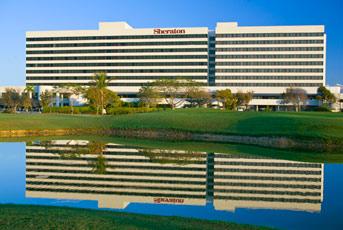
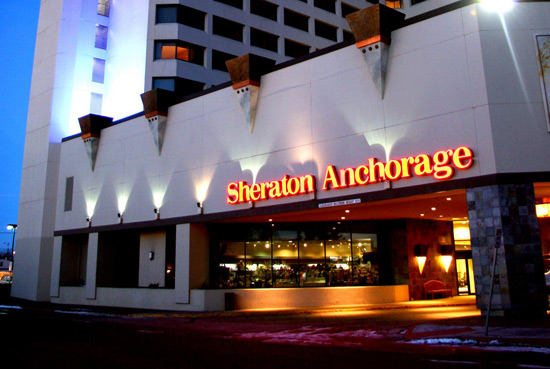
So I was happy with the Sheraton. Although it’s not a very attractive building from outside, it underwent a major renovation recently and is quite decent inside. I got a suite, lounge access, free Internet and free breakfast. My only cash expense was on the conference room.
What would you have done?
Continue reading about Hilton or Starwood? Not even a close call
Have you tried to watch fireworks in the bright late-night Alaska sky on July 4th? I had the sun in my eyes a couple of years ago, but if the weather forecast is correct, this coming Sunday will be gloomy and rainy. Too bad for me.
I decided to make my third visit to Anchorage a couple of months ago, and since I was going anyway, I thought I’d teach an “On the Fly” Seminar there on July 6. It will take place at 6:30 p.m. in the second-floor boardroom of the Sheraton hotel. Only ladies have signed up so far. Where are all the male travel enthusiasts? Here is an easy link to the registration page.
One of our students in DC just told me she has already saved $500 on her very first domestic plane ticket since she attended a seminar last week. I’ll do a separate post about that, but the point is, the proud Alaska travelers should act quickly, before the limited seats vanish.
About four years ago, I decided that I’d try to get to Alaska every summer, and to Hawaii every winter — but only if airfares drop to about $400. Not only is it appropriate to go to Alaska during the very hot and humid DC summer, and to Hawaii during the cold winter, but both those places are the furthest one can get to on a domestic plane ticket — and get tons of frequent-flier miles. I did miss Alaska last summer, and Hawaii this past winter.
I try to be creative with my routing when I can, so this time I’m flying from DC to San Francisco, then to Denver and on to Anchorage. I was surprised to find such an option in the legal-routing section of the fare, but I took advantage of it. The trip will yield about 23,000 miles, including my double bonus as a top elite, which of course is only 2,000 miles short of a free domestic round-trip ticket.
So Alaskans, look forward to seeing you in a few days.
It’s no secret in the hotel loyalty business that Hilton HHonors has been probably the least creative and attractive among the major programs in recent years. Fortunately, its management has recognized that weakness and begun to address it, albeit cautiously.
While competitors such as Starwood, which includes the Sheraton, Westin and other brands, and to a lesser extent the InterContinental Hotel Groups Priority Club, came up with various promotions quarter after quarter, Hilton’s strategy seemed heavily reliant on name-recognition and reputation.
Jeff Diskin, senior vice president for global customer marketing at Hilton Worldwide, said in an interview last week that the company considers the quality of its hotels and the distribution of its network to be its main strengths…