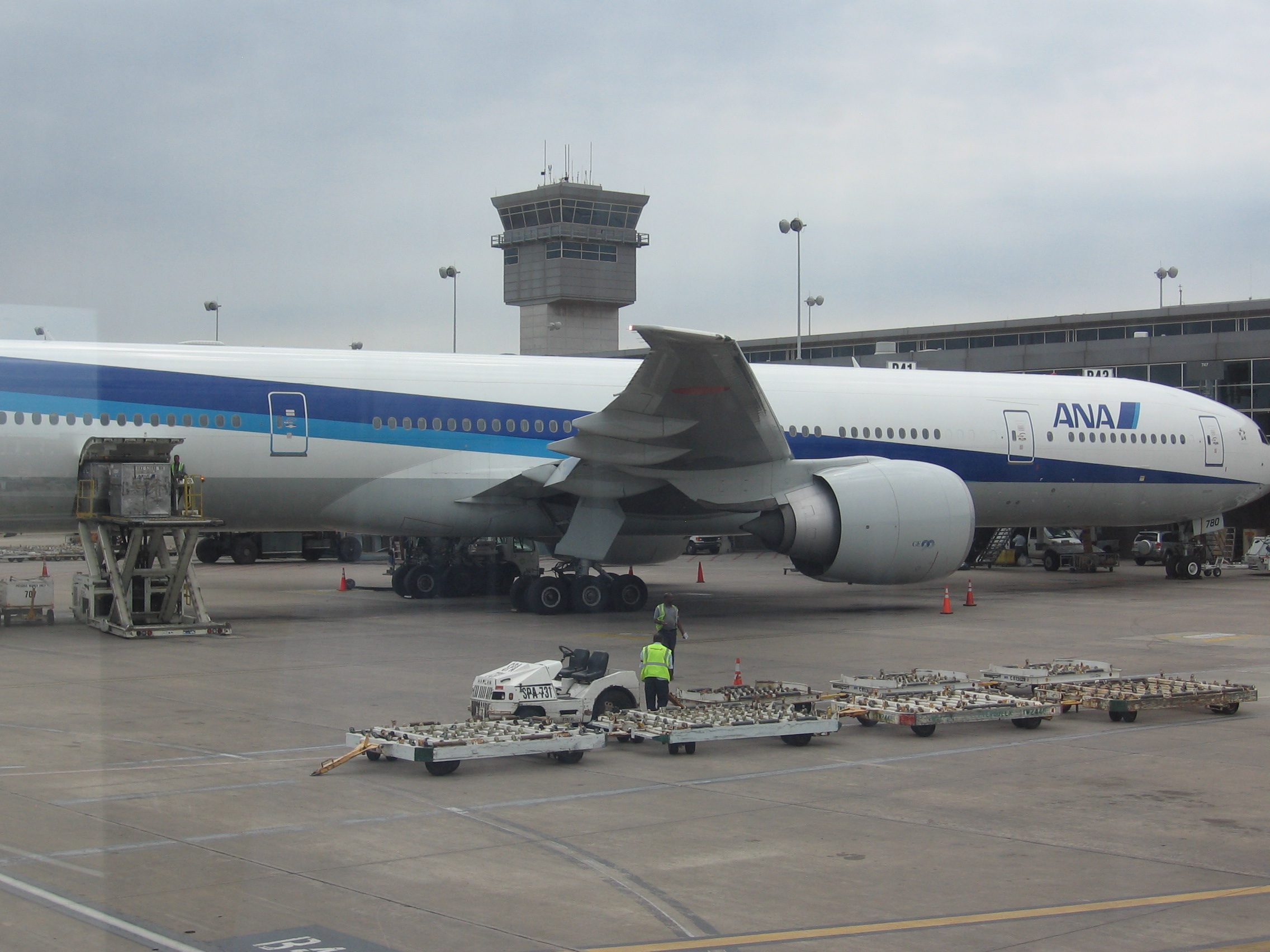
When I landed at Tokyo’s Haneda Airport today, I had one of my easiest, fastest and smoothest international arrival experiences. But I wondered where all those airlines that last year fought and won a fierce battle over the right to fly to Haneda actually were.
It appears the industry overestimated Haneda’s appeal to travelers, and it also might have miscalculated how many passengers remain in Tokyo, as opposed to those who connect to other destinations.
It’s true that the March earthquake and tsunami had a negative impact on travel to Japan in general, but traffic to and from the much bigger Narita Airport has largely recovered.
Haneda’s smaller size and proximity to central Tokyo provide a significant advantage. However, as I first wrote two years ago, most medium- and long-haul flights arrive and depart between 10 p.m. and 7 a.m. — not exactly the most preferred time by the majority of travelers. In addition, onward flight connections from Haneda are extremely limited.
That didn’t seem to bother most airlines last year, when the rights to fly from various foreign cities to Haneda were being awarded by the Japanese and other governments. U.S. carriers in particular made rather bold proposals. In the end, the Department of Transportation gave American Airlines the right to fly from New York, Delta from Detroit and Los Angeles, and Hawaiian Airlines from Honolulu.
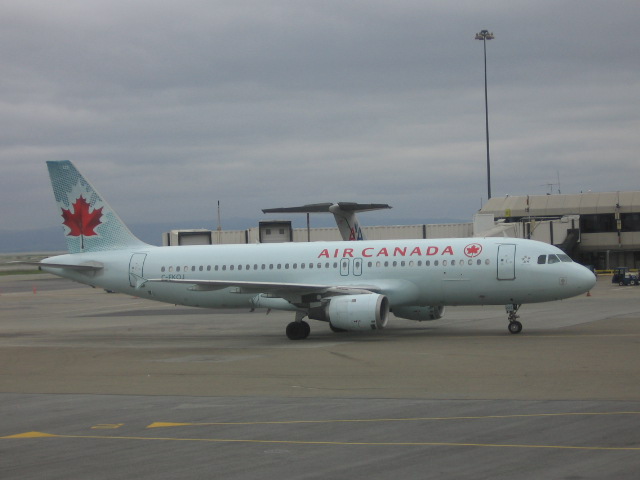
American’s flights are nowhere to be found in its winder schedule, though they are planned for next summer. The same goes for Delta’s Detroit flights. It does operate the LA flight throughout the year, as does Hawaiian on the Honolulu route. Air Canada has postponed indefinitely its plan for flights from Vancouver, even though it started selling tickets late last year.
The Japanese carriers have trimmed their plans, too. All Nippon Airways has kept only LA in North America, while Japan Airlines serves San Francisco. European and other long-haul routes are also very few.
British Airways is the only foreign carrier outside Asia and the United States that currently flies to Haneda — and not every day. The Asian carriers include Air China, Asiana, Cathay Pacific, China Airlines, AirAsia, China Eastern, Eva Airways, Korean Air, Malaysia Airlines, Shanghai Airlines, Singapore Airlines and Thai Airways.
Flights loads to and from Haneda are not what those carriers expected — my Singapore Airlines flight was less than half-full in Economy and about two-thirds full in Business Class, where I had two lie-flat seats to myself, though even one would have been just fine.
Related stories:
When ‘open skies’ aren’t really open
U.S. flights likely to Tokyo Haneda
Continue reading about Carriers lose appetite for Tokyo Haneda
I’ve always brushed off suggestions that airline websites are deliberately programmed to increase the fare if you don’t take their initial offer immediately. But I’ve become suspicious since Air Canada’s site recently jacked up a ticket price on me by hundreds of dollars in seconds, even as its lowest published fare and the flight inventory remained unchanged.
Airlines have gone to great lengths in recent years to encourage customers to book tickets on their websites, and that can certainly save travelers time and hassle in the event of any changes to a ticketed reservation. However, to their utter shame, many carriers haven’t built reliable and user-friendly sites.
In fact, some airlines, such as South Korea’s Asiana, have outsourced their entire online booking process — at least in the U.S. market — to a third-party travel agency, which charges its own booking fees. And some of us thought a carrier’s own website was the one place we could go to avoid fees.
Other airlines have made their sites so difficult to navigate that one needs a day off to figure out basic booking features and frequent-flier program rules. Not to mention that many, such as Qatar Airways, never display the most important element of a reservation: ticket numbers.
And then there are those carriers whose sites look all modern and dandy, only to go nuts on you once you begin using them. A case in point is Air Canada’s site, which went out of control last month when I tried to price out a trip from Washington to Tokyo via Toronto, as part of the research for my forthcoming book.
At first, I got a total of $1,014.82, booked in L class on all four segments. The site cancels the pricing page automatically after 10 minutes if you don’t make a purchase — I didn’t — and sends you back to the home page. I thought I’d simply rebuild the same itinerary.
To my astonishment, this time the site broke the fare into W and S classes, producing a total of $1,611.82. I checked the tariff and the inventory on ExpertFlyer.com, which I use to access raw real-time airline data, to make sure nothing had changed in the past 15 minutes, and it hadn’t. I also called Air Canada to verify that. There was no reason for the site’s odd behavior.
I started a new search with the same elements, and a new surprise followed just seconds later. Now the booking classes were M on the outbound and L on the return, for a total of $3,794.82. I tried again, and this time I got a through M fare on the outbound and broken S/W on the way back, for a total of $4,088.82.
I’ve been skeptical about suggestions that airline deliberately increase prices on unsuspecting customers because I know how airfares work. For a particular fare to change, one of two things has to happen: a change in the tariff or the inventory. If they both stay the same, there is no reason for the price to jump by hundreds or thousands of dollars within seconds. That was the case here.
So what was the Air Canada website doing? Did it remember my data and play tricks on me? I tried closing my browser and reopening it, but that didn’t help. I checked back a couple of days later, and the same shenanigans repeated. In another couple of days, I rebooted my computer, and I finally got the initial and proper fare — at $1,015.29, it was 47 cents higher because of currency fluctuations.
I decided to do the same experiment again and performed three additional searches, just a couple of minutes apart. Sure enough, the fare came back higher every time: $1,612.29, $3,795.29 and $4,089.29.
I called Air Canada and spoke with a very polite reservations supervisor named Monalisa. At first, she thought I was doing something wrong and confirmed the $1,015.29 fare on her system, and also verified the tariff and the inventory, which still showed nine seats in L class. Then she went to the website and did exactly what I’d done — she was as surprised as I was to see those outlandish prices. She promised to report the problem to the appropriate department.
It could be just a software glitch — after all, the fare difference should be more subtle than $600 if deliberate — but it certainly looks suspicious. If Air Canada doesn’t want to drive customers away and into the arms of third-party sites, such as Expedia and Travelocity — or worse, other airlines — it should offer a much stellar booking experience on its own site.
But that wasn’t Air Canada’s only problem. I noticed that the penalties for changes and cancellations displayed under the priced itineraries were unusual for heavily discounted international tickets. Moreover, they never changed even as the fare kept going up.
They said the tickets were refundable for C$200 — there is currently near-parity between the U.S. and Canadian dollars — and “cancellations can be made up to 45 minutes prior to departure.” Changes could be made “prior to day of departure” for $100 each way, “plus applicable taxes and any additional fare difference.” On the departure day, changes were permitted at the airport for C$100 “plus applicable taxes (no charge for fare difference) for same-day flights only.”
I didn’t trust what I saw, so I checked the actual fare rules on ExpertFlyer, which are published by none other than Air Canda. As I suspected, the L fare was nonrefundable, and the change fee was $250. I went back to the carrier’s website and discovered a hardly noticeable link at the bottom of the page to the proper fare rules, which matched the information on ExpertFlyer.
These were big discrepancies, and I suspected they were causing serious problems, so I mentioned them to Monalisa. Unlike the fare-rising problem, she was aware of this one. “I’ve made several complaints in the last several months [to the website people], but they apparently this isn’t a priority for them,” she told me.
She also explained that the rules shown on the Air Canada site are typical for domestic Canadian tickets, and they use the same template for the much more diverse international rules, instead of creating new content. If a customer who has booked a nonrefundable ticket on the website wants to cancel it, Monalisa said they will honor the incorrect rules displayed on the site.
So until they bother to fix the problem — perhaps that would be more expensive than refunding tickets — travelers will keep taking advantage of the mistake. If you are one of them, make sure to print out those made-up rules.
Similar examples can be found on many other websites. Delta Airlines, for instance, has put the following text on a page titled “Ticket Changes”: “For travel outside the United States, the change fee is typically $250, but can vary based on location and type of fare. Changes are usually permitted only to the return portion of an international itinerary.”
No issue with the first sentence, assuming travel originates in the United States. As for the second, I can’t even imagine who and why came up with such a misguided blanket statement. All you need to do is read the actual rules of any international Delta fare to realize that, if any changes can be made, they are in fact allowed on both the outbound and return portions.
Related stories:
Airlines find new way to overcharge fliers
US Airways hears feedback, fixes website
Openness rattles airline industry
Is India going too far in curbing airfares?
Continue reading about When airfares jump on you for no reason
Airlines are consistently among the most criticized companies by both the public and the media. While much of the criticism is deserved, does some of it amount to nothing more than badmouthing that helps no one? Isn’t it time for fliers to learn the air travel system’s ins and outs, and not blame the airlines for all their ills on the road?
In this column, I’ve denounced certain airline practices, such as the fictitious “direct” flights that are simply two flights with the same number but nothing else in common. There is no question the industry has made the system very complex, mostly for financial reasons, and it’s profiting from customers’ lack of knowledge.
However, the system is what it is, and there isn’t much we can do to change it to our liking. What we can do is invest some time and effort in learning its intricacies, rules and restrictions, so we don’t feel like we got screwed next time we fly and make sure we don’t miss a wedding or a funeral, or let an airline ruin our vacation.
I talked about this on Peter Greenberg’s syndicated radio show last weekend, though I probably did too much complaining before I got to the point. Greenberg used to be the travel editor for NBC’s “Today” show but moved to CBS last year.
There are certainly times when criticism — or constructive customer feedback — does make a difference. Take just one issue with United Airlines. Last year, it announced it would do away with advance domestic upgrade certificates for top elites, but after an outcry it reversed its decision. Earlier this month, the carrier said it would reduce the number of certificates elite fliers get annually — another outcry followed, and the implementation of the new policy was delayed by a year.
Contrast that to the experience of Michelle Renee, about which I wrote last year. She decided to skip a flight on her ticketed itinerary from Los Angeles to Australia on United, but she didn’t tell the airline and was shocked to find out at the Sydney airport that the change would incur a fee. She wrote a blistering blog post against United on the Huffington Post. Had she known that if you miss a ticketed flight voluntarily, the rest of your itinerary is automatically voided, she would have thanked the agent who salvaged her ticket.
Is it the airlines’ job to educate passengers about the rules they impose or are travelers responsible for learning those rules on their own? Do most of us buy plane tickets blindly, without reading and understanding the conditions and restrictions that come with them?
In a more recent Huffington Post blog, another United critic, Tamar Abrams, wrote about being mistreated by an employee after her flight from Singapore to Tokyo was canceled. The agent’s behavior aside, I suggested to Abrams that she didn’t have to put herself in that agent’s hands. In fact, she could have known about the cancellation about 12 hours earlier, before she had gone to bed, because her plane didn’t make it to Singapore from Tokyo the previous night. She could have called United then and got rebooked, even before getting to the airport.
Was it Abrams’ responsibility to track her plane and predict the cancellation? No, but it would have helped her a lot and saved her hassle and an unpleasant experience. United usually contacts passengers regarding flight disruptions, though Abrams said she didn’t get notified in advance.
The ease with which anyone can book a plane ticket online gives the wrong impression that modern air travel is a piece of cake. Yet, most fliers don’t know the meaning of a code-share flight or the difference between a nonstop and a direct flight.
Next time, before you spend $1,000 on a ticket, it might be a good idea to learn exactly what you are buying and what it entitles you to. After all, travel should be an exciting experience, not a nuisance we dread.
Related stories:
Time for travel school — you are invited
Predicting flight delays and cancellations
Travel companies teach customer-service lessons
Continue reading about Does badmouthing airlines help anyone?
Did you know that hundreds of fictitious flights inhabit airline schedules every day? They don’t exist in real life — just on paper. They are meant to make more money for the airlines by tricking customers and perverting a practice that was actually started to help travelers. In fact, they spell nothing but trouble for passengers.
Those fictitious flights are labeled “direct” by the airlines, which years ago decided to rewrite the dictionary and use that term for flights that weren’t nonstop but made at least one stop on the way to their destination. First, those flights were operated by the same aircraft, but later a “plane change” was introduced. The Department of Transportation has allowed the airlines to abuse the practice any way they like.
On my way back home from Boston last weekend, I was on United Airlines Flight 897, which the purser announced repeatedly was “a nonstop service to Washington Dulles, with continuing service to Beijing.”
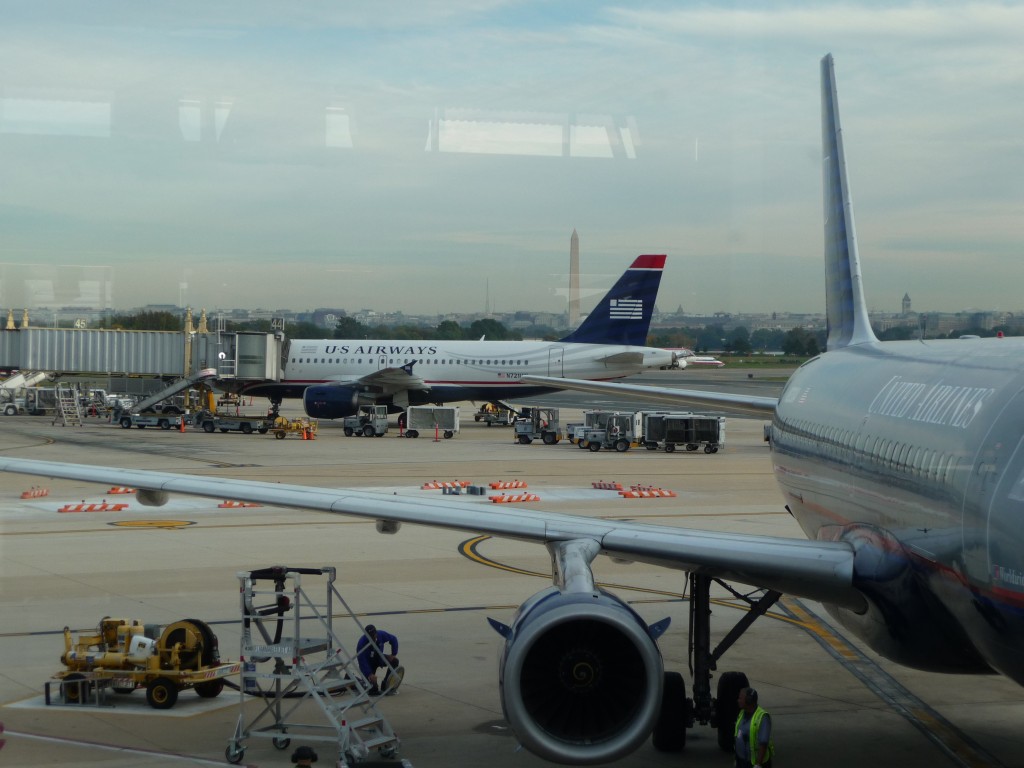
I immediately cringed, because there is nothing “continuing” about the two flights, except for their number. The plane I was on was a two-cabin Boeing 757 and arrived at gate C19 at Dulles. The plane destined for Beijing was a three-cabin Boeing 777 and departed from gate C3. So the passengers connecting to Beijing did exactly what others did connecting to Flight 803 to Tokyo at gate C1 — or any other flight for that matter. They left the first plane and walked to their new gate.
Did the Beijing-bound travelers benefit in any way from the fact that their tickets had one flight from Boston to Beijing? Absolutely not. In fact, many of them were probably surprised to discover they were on two separate flights.
Then why does United even have that fictitious “direct” flight? Because it wants customers to think that they can fly from Boston to Beijing without the hassle of a connection — a competitive advantage no other carrier offers.
Have you tried to upgrade a “direct” flight? That can be a nightmare — not just for passengers but also for those who work in inventory management. They have to create inventory for a flight that doesn’t exist and to balance the load of two separate flights on different aircraft types with a different number of cabins and hugely different number of seats. As a result, the lowest booking classes and upgrades are often unavailable on “direct” flights. Some travelers are willing to pay more to avoid the hassle of transfers, not realizing there is a hidden connection.
Almost every international United flight has a domestic tag attached to it, but United is by no means the only U.S. airline abusing the system. All major carriers do it. Delta pretends to fly “directly” from Minneapolis to Moscow, Continental from Amsterdam to Denver, US Airways from Los Angeles to Zurich and American from Tokyo to Boston.
As I wrote two years ago, United and Delta are the biggest abusers, while American seems to be the most prudent in that most of its “direct” flights are operated by the same aircraft. American is also the only one whose website displays a “direct” flight as two separate segments at the very beginning of the booking process.
In the rare cases when foreign carriers, such as Lufthansa and Singapore Airlines, operate “direct” flights, they are flown on the same plane, so there is no danger you will miss your “continuation,” which happens regularly on U.S. airlines. If my flight from Boston to Washington had been late, United wouldn’t have held the plane for Beijing just because the two flights share the same number.
Related stories:
Airlines abuse ‘direct’ flights
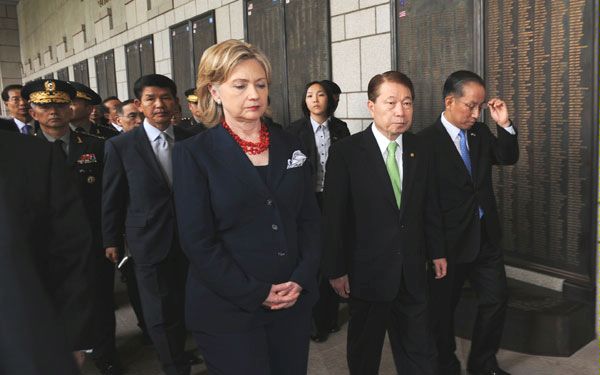
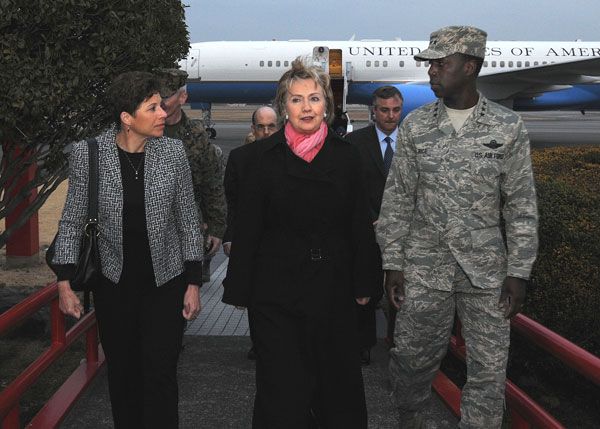
Secretary of State Hillary Clinton this week accomplished a diplomatic feat that her immediate predecessors tried but failed repeatedly to pull off: visiting South Korea, but skipping Japan and China on the same trip. It may sound immaterial, but defying protocol is a tricky thing in diplomacy, especially in Asia.
For years, I’ve been very amused when the State Department would send us in the traveling press corps a note about the secretary plans to visit just South Korea or just China or just Japan. Every time, I’d smirk and bet that he or she would end up going to all three countries — and I was right. That had become a tradition — the Japanese in particular considered it an affront to be ignored by their staunchest ally in favor of Seoul or Beijing.
In early 2008, Condoleezza Rice had to go to South Korean President Lee Myung-bak’s inauguration, and initially had no intention of stopping in Tokyo or Beijing. But after diplomatic pressure from both capitals, she caved in. I skipped Tokyo on that trip.
Clinton herself fell victim to protocol in May. She had to co-chair the so-called U.S.-China Strategic and Economic Dialogue with Treasury Secretary Timothy Geithner in Beijing, and to drop by the 2010 Shanghai Expo in Shanghai. For months, her aides said that no other stops were planned, but in the end, she went to Japan and South Korea, too.
It seems that this time Clinton successfully defied protocol. It helped that she met with her Japanese and Chinese counterparts at the annual meeting of foreign ministers from the Association of Southeast Asian Nations (ASEAN) in Vietnam. But I have little doubt that, in spite of those meetings, the Japanese and Chinese still lobbied for her to drop by their capitals.
By the way, this ASEAN meeting was the first I’ve missed in years. I always thought attending a high-level summit in Southeast Asia in late July was a misery because of the very hot and humid weather, but DC is much worse these days.
Continue reading about Clinton pulls off diplomatic rarity in Asia